garama:

Inspired by common water flea.

Here’s not all the sketched versions or variations I’ve made of him, but they’re recent ones. I want him to be an amphibian and have legs (to walk around in his space ship), but having a character with no legs would be a nice change. But it has it’s own limits.

I tried to give him a tail that separates into two legs, but I wasn’t able to make that work, sadly. It would have been a perfect solution, haha.

I like him!

What does he eat? Algae salads?

art-of-swords:

Sword Facts & Myths

  • All Medieval swords weighed at least 12 pounds – FALSE

Most Medieval swords weighed around 2.5 lbs – even long hand-and-a-half and two-handed swords weighed less than 4 lbs.

  • Medieval swords were not sharp – FALSE

Some surviving samples of Medieval swords are still sharp – many are razor-sharp.

  • All swords should balance within 2” of the guard – FALSE

A sword’s balance should be determined by its function, not an arbitrary standard. Swords intended for cutting often balance 5 or 6 inches from the guard.

  • Swords were made to cut through armour – FALSE

Period armour was often work- and case-hardened and curved such that it is difficult to hit at a right angle. Late Medieval thrusting swords, even the ones with a reinforced point, were used to thrust into the gaps in armour, not through the plate.

  • Viking swords were heavier than Medieval swords – FALSE

The Viking sword was a very highly developed sword form. Often the blades were quite thin in cross section, and as a result, were often the same or lighter in overall weight than other similarsized swords.

  • There is no such thing as the “perfect” sword – TRUE

There are only “perfect” swords for their intended purpose and the tastes of the owner.

  • A “good” sword should be able to bend past 90 degrees without taking a set – FALSE

Flexibility is only one of the aspects of the steel properties that is important in a sword. Too flexible, and it is inefficient in the thrust and the cut. Too stiff and it is prone to breakage. Most makers are content if a sword will bend to 45 degrees without taking a set.

  • Real swordfights were just like they are in the movies – FALSE

Swordfights in movies are choreographed for entertainment not authenticity. Edge to edge parries and fancy techniques are designed to heighten drama in a scene. An actual swordfight would be short, brutal and much quieter.

  • Japanese swords are the sharpest and best swords ever made – FALSE

Japanese swords have many admirable qualities and were well-suited to their intended use, but they are not necessarily sharper or better than a properly designed and sharpened Medieval sword. 

  • Medieval swordmakers were uneducated barbarians – FALSE

It is apparent from even a cursory study of surviving Medieval swords that blademakers and cutlers were highly skilled artisans with a profound understanding of mathematics and proportion.

  • Not all swords should be as sharp as a razor – TRUE

The sword’s intended purpose is always the guide to use — thrusting swords are not intended for cutting, so some may not even have an edge at all, just a well-defined and reinforced point.

  • Swords were tempered in urine or blood – FALSE

The steels smelted in Medieval Europe required either clean water or oil for quenching. Urine or blood would not allow a blade to temper properly.

  • The “blood groove” is on a sword to release pressure in the wound and allow the sword to come back out – FALSE

“Blood groove” as a term is a recent invention — “fuller” is the proper name for the groove or grooves on a sword blade. The purpose of the fuller has nothing to do with “blood” — fullers reduce weight, assist in the proper distribution of mass in a blade, and help make the blade more stiff.

  • A good sword can cut through a concrete pillar – FALSE

Swords were intended to cut through flesh, clothing, and (in earlier swords) leather or mail armour. They are not intended to cut wood, concrete or metal pillars, even though that is often seen in films.

  • A sword will fall apart if you don’t clean the tang of the sword – FALSE

The tang of a sword, if properly made and the rest of the sword properly maintained, will not require any maintenance for generations of use. 

  • Japanese folded steel is superior to European sword steel – FALSE

Folding steel was a technique used by Japanese smiths to try to get the best steel they could from very poor ore sources. Folded steel blades are more likely than modern monosteels to have large, unseen inclusions of impurities that may in fact critically weaken a blade. By folding the steel billet many, many times, they achieved a more even distribution of carbon and worked most of the impurities out of the steel. The result is stunningly beautiful, but we have to believe that if a 16th C Japanese smith had access to modern monosteels, he would have switched in a heartbeat.

  • Pattern-welded steel is superior to mono-steel – FALSE

Like folding steel, pattern-welding was a technique used to try to get the best steel from very poor ore sources.  Pattern-welding is the art of hammering together, and then twisting and re-hammering layers of iron (often of varying carbon content). The Celts as far back as the 5th century BC may have made swords by pattern-welding, and this technique was used extensively until at least the end of the 10th century.  After this, better, more consistent iron ore was obtainable, and furnace technology improved, making this laborious technique unnecessary. Also like folded steel blades, pattern welded blades are more likely than modern monosteels to have large, unseen inclusions of impurities that may in fact critically weaken a blade.

  • Swords are just big knives – FALSE

The design of a sword is far more complex than a knife. Flexibility  balance and vibration are far more critical in a sword-length blade than in a knife-length blade.

Info source: © 2005 Albion Armorers, Inc.

Photo source: © Royal Armouries

the-evil-twin:

i-wanna-be-a-klaine-ship-ranger:

prufrocking:

thegestianpoet:

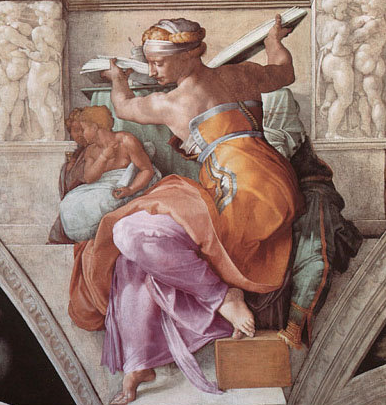
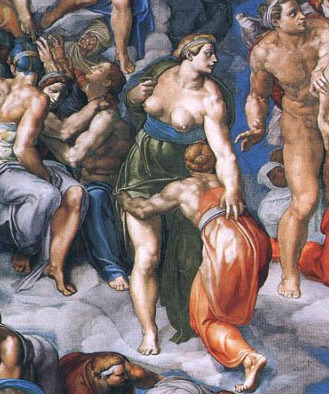
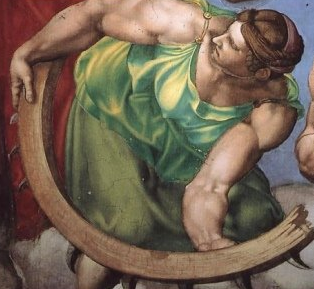
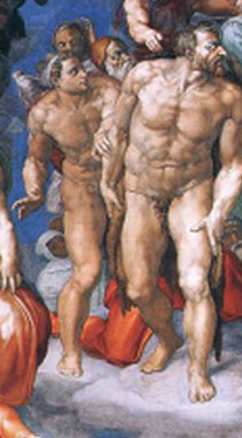
and let’s take a moment to appreciate the fact that michelangelo had probably never seen a girl naked and when he want to sculpt or paint them his mentality seems to be “wow, everyone likes women….they must be like…..buff dudes. i love buff dudes. women are buff dudes but with little chest lumps and no wiener”

image

“nailed it.”

image

image

image

And my personal favorite, Adam and Eve

image

he literally painted adam and steve

I am in the absolute SHITTIEST mood right now, but this actually made me laugh out loud. 

captainlordauditor:

fandom-and-random:

jewishdragon:

vexahliaderolo:

hot tip if you wanna play a warlock or another high charisma character but have an irl charisma of like 10:

there’s more than one kind of charisma. the default always seems to be “suave ladykiller/casanova who can and will knowingly manipulate people and do it with a sly smile”, but that’s not the only kind.

i play a 20 charisma warlock who is… none of those things. she’s kind of shy and easily flustered but she IS extremely good-hearted and kind, and she radiates a certain kind of aura that just makes people want to like her and trust her because they can tell she’s a good person.

don’t feel boxed in by traditional portrayals of charisma and let it scare you away from playing classes you’re interested in.

be ENDEARING AS FUCK, make yourself stupidly likable and trustworthy

but there is no defined way to do this, the options are limitless!

I’m playing a bard and people expect bards to be smooth and flirty, but mine is more just really friendly! She likes people and people like her, but she is in no way suave or manipulative.

You don’t have to live up to traditional views of charisma if you don’t want.

My sister is like this! She’s outgoing and friendly, but people just tell her things for no reason. She just radiates this aura of Nice Southern Belle You Can Tell Anything.

If all else fails, play some sort of adorable tiny catfolk with large eyes and lots of fuzz. 

Alright, so I’m watching The Zoo, a documentary about the behind-the-scenes stuff at the Bronx Zoo, and they just showed a shot of a locker room where the keepers stash their stuff. Pretty much all the lockers have various zoo bird feathers (peacock, ostrich, pheasant, parrot, etc) hung on them, I’m guessing from finding them in enclosures. 

Good to know that magpie impulse doesn’t wear off when you spend long enough around the birds.

Hey, I heard it was illegal to write porn depicting underage sex in the US. How is it that AO3 is able to host this stuff and not get censured? Thanks!

ao3tagoftheday:

Hey anon! In light of some recent Discourse™ I have been seeing the last few days, I’m going to take a short break from silly tags to talk about censorship!

Ok. It is illegal in the United States (and in most other countries I think) to produce, distribute, or possess pornographic images of minors. A thing that is not illegal: writing.

Why is that, you may ask? Why would we want it to be legal to write about adults having sex with children or children having sex with each other? Well, a variety of reasons. First of all, if we treated writing about children having sex the way we treat images/video of that, a large percentage of YA literature would suddenly be illegal. So would writing about adolescent sexuality in other ways, including potentially educational literature or even studies about adolescent sexual health. That would be really bad.

But what about writing about full-on sexual abuse, statutory rape, pedophilia? Shouldn’t that be illegal? No. Banning such writing would risk censoring research and education about sexual abuse. It would also prevent survivors from writing about their own experiences. And it would ban works of real literary merit, like, say, Lolita, which deconstruct and address the psychology of sexual abuse in a literary setting.

Fundamentally, the reason that society bans images of child pornography is that, in order to make them, you have to put children in a sexual context and take pictures/video of them. In other words, to make child pornography, you have to harm children. That’s why it’s illegal. Writing, on the other hand, harms no one in its creation. The only harm it can do is to those who read it, which literally no one has to do. Freedom of speech means we have the freedom to say what we want, so does everyone else, and we don’t have to listen to them if we don’t want to.

So no, AO3 isn’t breaking any laws. And if they were, it would be because the law was wrong.

If you have comments, complaints, or want to scream at me, you can find me at my personal @boytranscending. I won’t be addressing this subject any further on this blog.

glumshoe:

glumshoe:

Lunate zale moth. I find the raised, crown-like layer on the thorax most interesting in this otherwise unremarkable species.

YES thank you! That is exactly why I love it. I couldn’t find any mention of that structure in any nature guides online so I will content myself with calling it a Mini Me Hat.