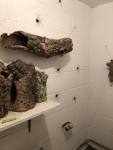
From (The Spider Shop) an entire small bathroom as a whipspider habitat is such an amazing aesthetic concept and I’m sure they love it when the lights are out and there’s no humans bothering them, HOWEVER I’d be so worried about them getting hurt or lost when the door is opened and it looks like the toilet is still used by people?!
I don’t know how they’re clinging to those tile walls either, my one can’t climb anything smoother than bare rough brick.
Oh yeah you might notice how they’re arranged really evenly on that wall, too – that’s actually how they live in the wild!
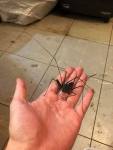
They inhabit caves, hollow trees or sheer rock walls in the tropics, and will spend most of their time just sitting in one spot, slowly slowly waving their ultra-long “whips” (legs modified into feelers) all around themselves in a circle to search for any passing prey.
If they feel the whip of a fellow spider they will move just out of their way, so they all end up exactly at “arm’s length” from one another in a sort of loose grid or checkerboard of little hunting spots.
It’s almost like a perfect video game setup. If you’re an insect lost in a whipspider cave, you’ve got to navigate this minefield of nearly blind predators whose huge long skinny arms are just constantly, silently circling in search of YOU!
Not a lot of things they eat are really smart enough to last very long that way.
Actually even if they were smart this is still the setup they’re dealing with:
WAIT ANOTHER THING I FORGOT
So they live in total darkness, and most of their prey, like cockroaches, rely entirely on touch to navigate that environment.
So, the prey feels something brushing it in the dark, something little and light, just the tip of something, no big deal….and has an instinct to just move AWAY from that thing, right? Problem solved?! But since the arms reach around so far, it often means a situation like this:
….And if the prey doesn’t just blindly march straight into its mouth from there, the whipspider will do this:
It doesn’t need to pounce or chase. The prey doesn’t have a direction to go where it won’t bump into one of the arms, turn around, and try to go a different way, like a roomba, as the arms slowly close in and shrink that corral more and more towards the predator’s jaws!
Whip spiders sense the world in weird and wonderful
ways.
By Mary Bates
Whip spiders, also known as tailless whip
scorpions, are actually neither spiders nor scorpions. These strange
creatures belong to a separate arachnid order called Amblypygi, meaning
“blunt rump,” a reference to their lack of tails.
Researchers have discovered that some of the more than 150 species
engage in curious behaviors, including homing, territorial defense,
cannibalism, and tender social interactions—all mediated by a pair of
unusual sensory organs.
Like all arachnids, whip spiders have eight legs. However, they walk on
only six. The front two legs are elongated, antennae-like sensory
structures called antenniform legs. These legs, three to four times
longer than the walking legs, are covered with different types of
sensory hairs. They constantly sweep the environment in a whiplike
motion, earning whip spiders their common name. Whip spiders use their
antenniform legs the way a blind person uses a cane—except that in
addition to feeling their environment, whip spiders can smell, taste,
and hear with their antenniform legs.
All aspects of a whip spider’s life center on the use of these legs,
including hunting—whip spiders are dangerous predators, if you’re a
small invertebrate that shares the arachnids’ tropical and subtropical
ecosystems…



 BettSplendens Tumblr Evac