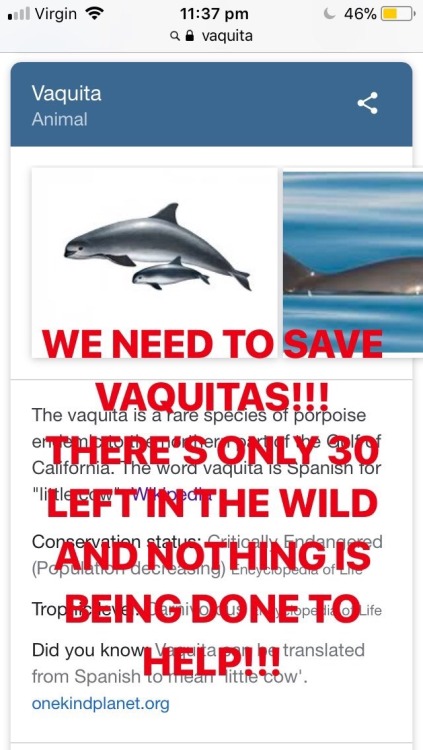
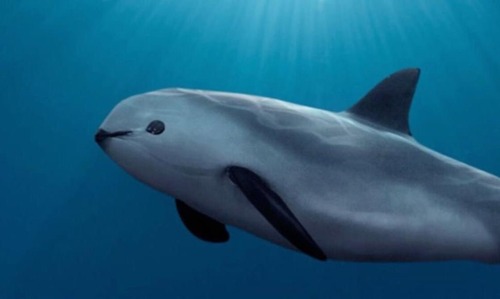
These beautiful animals are the vaquitas, the world’s smallest and most endangered porpoise. There are an estimated 12-30 remaining in the wild and their numbers have been rapidly declining due to being caught in illegal fishing nets.
APROXIMATELY 36 ARE KILLED EACH YEAR. THERE ARE ONLY 30 LEFT. THIS COULD BE THEIR LAST YEAR IF WE DON’T DO SOMETHING ABOUT IT!!!
Donate to conservation foundations like the WWF who work to protect vaquitas! We need to keep this beautiful animal on our planet!!!
Please share this post so we can spread awarness because hardly anyone knows about them!!!
Unfortunately, these are something of a zombie species. There’s nowhere safe to move them to, and the poaching in their native habitat isn’t about to stop any time soon. Even if it did, there might not be enough of them left alive for the population to rebound.
I wish we could save them, but we have very limited conservation resources, and we need to focus on keystone species. Cute as they are, vaquitas are pretty much doomed. Donating is great, but it’s probably best to donate to foundations that work to save animals that have a chance to be saved.
I can honestly say I’m not surprised at all – given the captive mortality rate,and the immense stress the population is already under, adding the stress of capture and captivity on top of that? Would have probably killed them all faster.
I’m not saying anything new when I say that, in my opinion, vaquita are functionally extinct.
They are a zombie species. They are dead and gone, we’re just waiting for the population numbers to catch up to that fact. The population is too small to succesfully breed back to strength without suffering inbreeding collapse, and their environment is not going to improve fast enough for them to persist anyway.
Too little, too late, and all for naught. This is a great example, unfortunately, of an empty token gesture, of people trying to look like they’re doing something when what they should have done was listened years ago and stopped it from ever getting this bad. Maui’s dolphin is another prime example of this – down to approximately forty individuals – only 10 of which are females, and even fewer are females of reproductive age – are abhorrently under-protected, their habitat is exploited by mining and drilling, as well as commercial fishing. Despite biologists lobbying the New Zealand government for better protection measures, nothing is really being done.
We are not learning from our mistakes, it would seem.
 BettSplendens Tumblr Evac