topaztaxidermy:

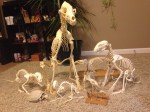
I’ve got my army ready

Nice! What all are they? 

I see: 
Dog or coyote in the center

Larger skeleton to the right looks like a raccoon? 

Small, pedestal-mounted animal in front of that one is maybe a weasel? Can’t see the front of its mouth. Small, slender thing. 

The one to the right of the canid, is that a possum? The head is a bit odd, very narrow.

Directly behind that one, I’d say squirrel by the pose and face. 

Behind that, on the pedestal, nutria? It has a rodent-looking skull and is definitely kinda big. 

The one between the canid’s forelimbs, that’s a rabbit, right? Tiny tail and rodent-like face. 

Clearly that’s a turtle to the left. 

Far left, is that a badger? 

Did you know a lot of large weevils have such tough shells that people who want to pin them for collections have to use a tiny drill to get through the elytra? You physically cannot push a pin through the elytra with your bare hands, nor with any thimble-related efforts. I tried to pin one, and I kid you not, I bent pins on that thing. I finally just held it in place with two pins across its body because I didn’t have a tiny enough drill bit.

zoologicallyobsessed:

Yep! Hence why I do not have any weevils in my taxidermy insect collection yet.  have a hard enough time pinning beetles and getting them soft enough to pin through the elytra let alone with weevils and I’d be worried I’d ruin it if I tried to drill through it.

It works pretty well to just place them firmly against the foam underneath and pin them with two pins crossing over the junction between thorax and abdomen. They aren’t all nicely pinned through, but it holds them in place. 

You could probably also relax one, spread the elytra and wings, and pin it unusually low on the body, through the abdomen, avoiding the elytra entirely. Beetle wing spreading takes some practice, but it can make nice displays. Start with cockroaches as easy-to-get practice bugs. Lift the elytra up and out, spread the wing underneath (you’ll need tweezers) until it’s fully spread and in a mostly natural position, trap it that way, and wait. 

Semi-related question: is it really taxidermy, since it’s just a dead thing without anything else? I feel like it’s not taxidermy just like a mummified mouse or a clean animal skull isn’t taxidermy. Taxidermy is stuffing an animal hide to make it look lifelike. I always see dried insects referred to as taxidermy, but I feel like that’s not the right word for it. I’m just not sure what other word to use, aside from “pinned”. 

any idea where i can source specimens to practice skinning and tanning on? i live in a pretty urban place so i don’t really have access to local farmers or hunters stuff if that makes sense

vultureculturecoyote:

Some pet shops sell frozen mice and rats for snake food. Or you can order them online as snake food. Small mammals like rats are perfect for that.

 You might also be able to source things like whole rabbits from butchers. But I’m not sure if they would sell them whole. I couldn’t get any whole animals from my butchers because apparently dead animals are a “bio-hazard” unless unless they are in 12 separate pieces…

It’s the guts and brains that are an issue. Lots of nasty, nasty diseases that can be carried in there. Same thing that makes it hard for people to raw feed their dogs and cats properly, that unavailability of organs. Particularly the digestive tract.

Depending on laws in your area, roadkill may work. Some places you can’t legally pick up roadkill, some you can. If it’s fresh, freeze it for awhile to kill the worst of the pathogens, then it’ll work fine as a practice specimen. Just don’t eat any part of it. 

Sorry if I sound dumb but how can you cut off the skin without opening the body or seeing organs? Do you only remove the top layer of skin?

vultureculturecoyote:

Uhhhh i’m really bad at explaining things lmao. What I mean is you don’t open the abdominal cavity or whatever. 

Its not just skin and then organs directly underneath. There is a thick layer of muscle directly under the skin that just looks like raw meat. When skinning something you don’t go through that muscle layer. Or at least you try not to, it can sometimes happen if you are inexperienced. 

Here I tried to illustrate what I mean. 

image

If you also wanted to butcher the animal for meat you would have to cut through the muscle layer and remove the organs. That’s a normal part of the butchering process. But if you just want the skin for taxidermy you don’t have to. I don’t hunt and most of my animals come from natural death or whatever so I don’t eat the meat, wouldn’t be safe. I just put things I don’t use back out in the woods for the scavengers and get the bones later. 

When you skin an animal, you end up with an intact animal skin on one side and the naked animal body on the other. It looks just like the animal before, except that it’s all muscle, like an anatomy class model. The organs are contained inside a bag in the guts, which has muscle around it. It’s stinky and messy if you cut into the gut bag, so you try not to do that. 

Also, skin isn’t very strongly attached, it’s held on by membranes and can be pretty easily peeled away from most small animals. There’s minimal cutting on, say, a m.ouse, you just have to cut through the skin down the belly and then peel the skin off. For bigger animals like a d.eer, you have to keep cutting membranes as you peel the skin off. 

twodogsagirlandavetdegree:

snakesandkittens:

I am currently preparing a very rare and interesting pathological specimen: the amputated leg of a d.og with implant site osteosarcoma. He had a torn ACL repaired several years ago with a metal plate, but then developed the extremely rare side effect of bone cancer at the site. The leg was amputated at the clinic where I work, and I am preparing it to articulate and display as a teaching specimen. This is the tibia.

Incredibly cool. Without teaching specimens learning would be so much harder. Thank you for taking the time to prepare this one!