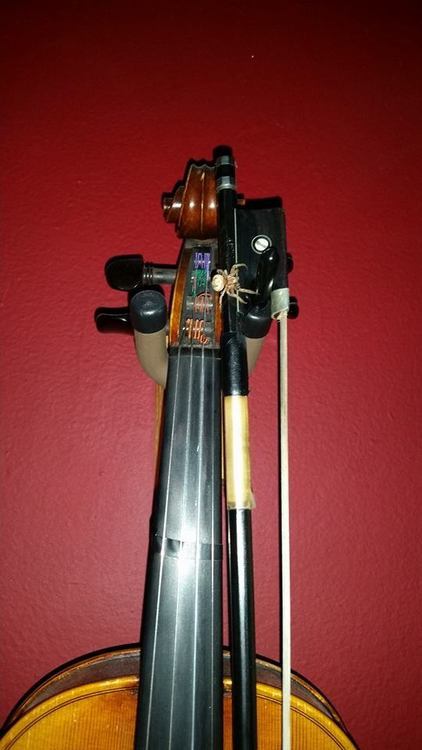
I’m not someone who believes in ghosts, but I was sitting in my room, alone and in the dark, and I heard the strings of my violin being softly plucked.
My violin is hanging on the wall several feet away.
So I gathered my courage, grabbed my phone, and used the camera light to investigate.
And found this.
A goddamn spider was playing my violin. Not even joking. The little shit.
I think I’d have preferred a ghost….
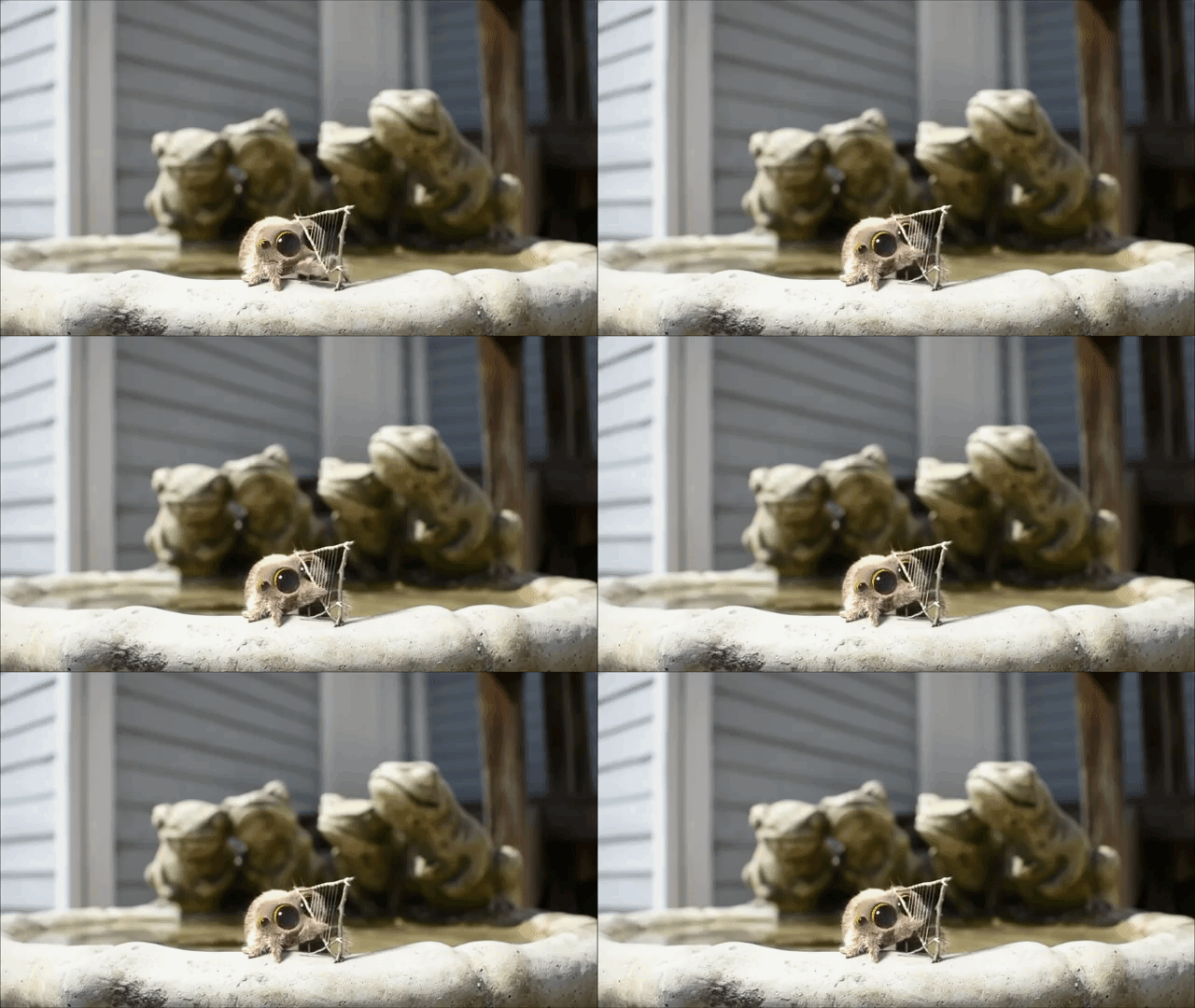
So anyway…. *tiny incoherent cough exhumes from spider* Here’s Wonderwall.
bwa ha ha ha
I hesitated before posting, but I bet I know what’s going on here. The plucking was pretty rhythmic, right?
Male spiders pluck the webs of female spiders in a pattern to determine if the female is interested.
That spider was trying to mate with your violin…
Ahh so it’s a boy(I just assume every insect I see is a girl) that’s such a cute mating ritual!
He just wants love!
The behavior would indicate that it is a male. Only females weave webs. Male spiders have to be careful not to be mistaken for prey and eaten, so they pluck the web. Poor thing didn’t exactly get any this time!
Poor spider thinking “Damn this web was made by a strong spider, a real awesome spider, can I possibly get with this boss ass spider??”
poor little hyperion, dreaming of the moon
“hello, I am not food, are you looking for romance or should I leave in order to continue not being food?”
A female orbweaver spider (Argiope sp.), Sinton TX. July 2013.
One of the largest I’ve seen, but everything is bigger in Texas.
These orbweavers spend most of their mornings rebuilding their webs along fieldsides, grasslands, and in gardens. Many produce a zig-zag pattern in the center of their web called a stabilimentum, which was, at one point, thought to help hold the web together. Nowadays, it is thought as a means to reflect light in the web that attracts unsuspecting insects, and future meals.
She’s all fat with eggs, looks like.
Orb weavers are cool because they’re really chill. They just sit in their web, and that’s it. They don’t skitter around all fast or jump on things. Plus, they make huge, pretty orb webs.
Yep, that’s right – Zookeeper Problems just hit 1,000 posts! Not to get too sappy but… wow. Who would’ve known that my little hobby gif blog would grow to have a following of around 14,000 of you across Tumblr and Facebook. I am still thankful for every note, follow, like, share, and message. Y’all are the best.
You should watch this to see how they build the web pattern, it’s not how you think.
Spiders do this because they need to have pathways of non-sticky silk to walk on. First, they put down the basic ‘spokes’ of the web, the parts the spider is walking on here. Once that’s all in and sturdy in non-sticky silk, they put down the sticky spiral-pattern silk that’s used to capture things.
And it’s all instinct. They’re programmed to do this, they don’t even know what they’re doing.
These tiny planthoppers are included in a complex of arthropods who, by virtue of their wing markings and postures, are believed to be mimicking jumping spiders (Salticidae) (see image below)
It’s a trapdoor spider! They have a network of webbing along the ground around their tunnel, and they keep their feets on it so they can feel if something is nearby. If a bug is unlucky enough to come within grabbing range, they pop out and snag it, then duck back into their door.


 BettSplendens Tumblr Evac