Once you get over the startle factor, realizing you’re seeing the Perfect Shed drops this into the category of those Immensely Satisfying Stim Videos.
[image description: a time lapse video loop in black and white of a snake shedding its skin, seen head-on, as the snake crawls forward through the skin toward the camera. Description ends]
ok. i had to look this up, because this seems just too ridiculous. and wiki does not disappoint: “…
the hognose snake will often roll onto its back and play dead with its mouth open and tongue lolling, going as far as to emit a foul musk from the cloaca.
Emission of cloacal musk is considerably less likely than in many other
species. If the snake is rolled upright while in this state, it will
often roll over again as if to insist that it is really dead.”
ahh i actually havent ! at first i thought you were actually talking about a CATERPILLAR that looks like a snake, and said cocoon on accident (specifically the caterpillar of the hemeroplanes triptolemus, or snake-mimic hawk moth)
but it TURNS OUT theres a species of butterfly that takes it way further, to the point where all the other caterpillars are like “is this really fuckin necessary”
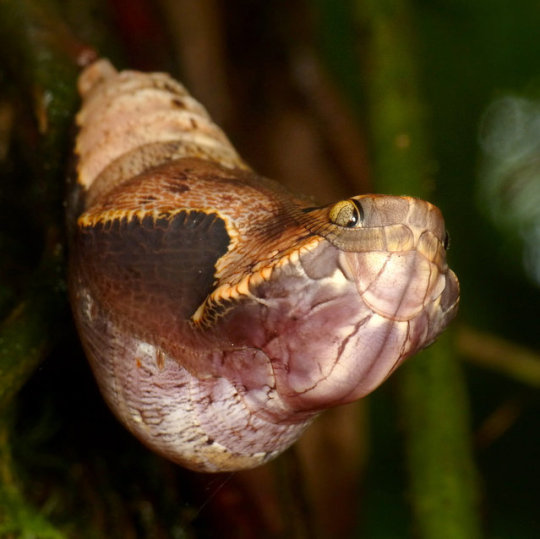
its the chrysalis of the daring-owl butterfly ! a species thats found in trinidad and spends a good portion of its young adult life trying to convince other things that its not actually completely helpless
LOOK at the detail thats gone into this though- i cant even imagine the journey this look mustve taken, with lightly less-snakelike chrysalises being eaten over time again and again until youve got something with definable eyes and scales
apparently if disturbed theyll also rock violently back and forth, furthering the idea that this is a very dangerous pitviper with the tiniest body imaginable
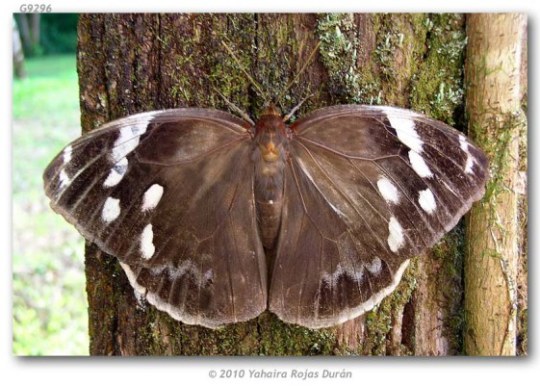
the adult butterflies are much less exciting but honestly they dont need to be with a history like that a+ bug
The fiddle-string snake (Imantodes cenchoa), also known as the blunthead tree snake,is a species of rear-fangedcolubrid snake endemic to Mexico, Central America, and South America. They are known for their slender bodies and large heads, of which the eyes make up 26%. Their excellent vision helps them hunt for frogs, lizards, and reptile eggs.









 BettSplendens Tumblr Evac