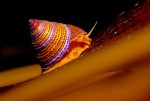
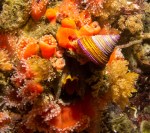
The purple-ring topsnail is a medium-sized sea snail with gills and an operculum.This is a sublittoral marine gastropod mollusk in the family Calliostomatidae. This snail lives off of the Pacific coast of North America.his species is fairly omnivorous, feeding seasonally on kelp, sessile fauna like bryozoans, and detritus.
It SNOWED in MISSISSIPPI!!! It ended up being the heaviest snow since the 1880s! Anyway I saw a lot of people making videos of their dogs experiencing snow for the first time so this happened
I love that snails can cringe so hard their entire face disappears
These are diamond-tipped indenter heads. They are used to inflict ludicrous pressure upon various shit in order to measure the hardness of said shit. Recently, one of these was used to measure the hardness of a certain animal’s shell, and, instead of crushing the ever-loving fuck out of it, it found serious resistance.
The aforementioned animal is a snail.
Let me spell this out for ya. There is a snail that can resist the onslaught from an industrial-grade diamond applied with the pressure of several metric fucktonnes. A. Snail. That. Can. Resist. A. Diamond. Indenter.
Just imagine stepping on one of these guys. Instead of breaking their shells like those of usual snails, you’d break your own fucking ankle.
Jesus trilobitic Christ.
Today’s Episode: the Scaly-Foot Gastropod
Just look at this little piece of shit. Look at it and say to my face it doesn’t look like a tank.
What we’ve got here is the rather lamely-named scaly-foot gastropod, also known by the considerably more badass-sounding names of iron snail and
Chrysomallon squamiferum. The SFG hails from the deep-sea thermal vents known as black smokers, deep-sea vents from which water gushes constantly. That water, by the way, originates from below the mantle.
The proximities of black smokers are perfectly lightless, unforgiving badlands, with water rich enough in poisonous sulphuric chemicals to perform the chemical equivalent of curbstomping on any “superior” lifeform that dares stick it’s overspecialized, prissy ass down there, heat up to 450 degrees Celsius (one thirteenth of the temperature of the Sun’s surface) and pressures that could turn any land-dwelling scum into a Flatlander within seconds. If creatures want to survive here, they must either be hyper-effective murder-machines, or damn nigh unkillable.
The SFG’s predators, such as venomous, killer cone snails with bionic harpoon guns evolved from their own “teeth”, and car-wrecking carnivorous crabs that kill snails by pressing down on their shells for days with jagged ultra-hard pincers specifically designed to do this belong in the first category.
The SFG itself belongs in the second.
Hoooly shit does it ever.
The unkillability itself is obtained by using the chemosynthetic bacteria lurking in its glands to absorb and mineralize the poisonous iron-sulphides the water is overabundant with, making them non-poisonous for the snail. It then coats its shell with the minerals, constructing an unique three-layer structure no other gastropods possess. None.
To sum it up, the outer layer, used to block the bulk of the attack, is made up of greigite (Fe3S4), a ridiculously hard mineral. Then comes a middle layer of squishy organic matter purposed to absorb the shock of impacts, dents and blows. Finally, an inner layer of aragonite (CaCO3), designed to prevent asshole crabs from sticking their nasty claws into the shell and picking it apart splinter by splinter.
How effective is it? Well, this armor is so much better than what we puny humans possess that the U.S. Army is actively conducting research about it with the hope of developing new armor using the same build. Yes, this shell is so unbreakable that it caused the a military to lose their heads over a goddamn sea snail. Go figure.
Also, according to biologists researching the SFG, if we covered oil pipes with the stuff, they could easily shrug off damage done by such trivial things as fucking icebergs,
Not bad from a snail, I say.
But that’s not all! Look at it again.
There is a reason it’s called Scaly-foot Gastropod.
Those are scales. Made out of iron minerals.
Iron minerals that are poisonous and magnetic.
The scales are there because of the tooth-harpoon-hurling killer snails. Namely, they serve to deflect the harpoons entirely. Deflective iron scales. On a snail.
Holy crap.
So let’s sum it up, shall we? There exists a snail that forges itself a magnetic armor made out of poisonous iron ore to fend off killer crabs and venomous sniper snails that hunt it in its habitat of a vent leading to the Earth’s mantle.
Oh, and they don’t really eat anything, relying on their chemosynthetic bacteria for sustenance instead. In layman’s terms, that means that the snail keeps itself running by oxidating the sulphides in the water, all of which are lethally poisonous to most lifeforms, including the snail itself. The only reason it survives is that the bacteria chemosynthetize the sulphides, enabling the snail to quite literally live off of poison.
This molluscoid tank is ridiculously metal in more ways than one.
I LOVE this sort of thing and holy SHIT is this amazing ❤
A Nicklin’s shoulderband snail (Helminthoglypta nickliniana anachoreta) chills with his salamander friend (a California slender salamander, Batrachoseps attenuatus) under a piece of fallen bark. Sonoma County, California, January 2017.
Fun fact: only one of these animals possesses lungs (hint: it’s not the salamander)
The long-tailed slug, or ninja slug (Ibycus rachelae), is
a type of semi-slug, being somewhat intermediate in appearance between a snail and a slug. Semi-slugs have a partially visible shell, but the shell is too small for the body to be withdrawn into. Found only in the state of Sabah in Borneo, the long-tailed slug was first described as a new species in 2008.(xxx)
is a species of deep-sea hydrothermal vent snail, a marine gastropod mollusc in the family Peltospiridae.This vent endemic gastropod is known only from deep-sea hydrothermal
vents in the Indian Ocean, where it has been found at depths of about
2,400 m (1.5 mi).
The shell is of a unique construction with three
layers; the outer layer consists of iron sulphides, the middle layer is equivalent to the organic periostracum found in other gastropods, and the innermost layer is made of aragonite. The foot is also unusual, being armored with iron-mineralised sclerites. The snail’s tissues house a symbioticgammaproteobacteria from which it appears to obtain its nourishment…



 BettSplendens Tumblr Evac