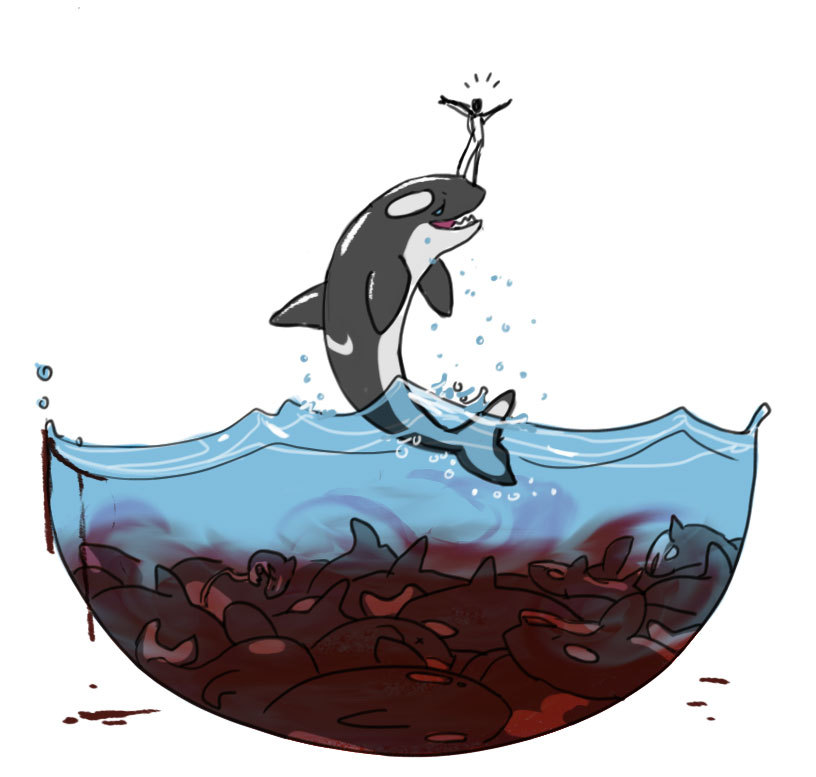
I did the sketch for this a few days ago and was going to make a more finished version for today, but my week was a little interesting.
So have the quick-colored and cleaned-up sketch.
Happy 50th Sea World. I’m bringing out the reality of that celebration. 50 years of piling up dead Shamus for human amusement.
Such an occasion, right?
You’re an ignorant fool if you believe this picture.
Orcas in the wild average a lifespan of 60 to 70 years. They can and have been recorded living to 100.
All captive orcas have died under the age of 32.
The average death is below the age of 10.
(often below even 3)As of December 2013 159 orcas have died in captivity since orcas started being captured in th 1960s. The oldest of which was 32, her name was Nootka 5.
(note that these do not include stillborn calves, misscarriages, or other unsuccessful pregnancies. Which are rampant, and many of the listed Orcas died due to pregnancy complications.)13 of these deaths are Seaworld Japan.
16 are Seaworld of California.
12 are Seaworld of Florida.
10 are Seaworld of Texas.That means of the 159 Orca deaths in marine parks worldwide, a total 51 are in Seaworld parks.
Not including Seaworld affiliate parks, or parks where Seaworld sent calves/adults.There are currently 53 living captive Orcas, 19 of them wild captured, 34 captive born.
The majority of them being owned by the Seaworld parks, with 55% being in the U.S.
( 2 in Seaworld Japan, 10 at Seaworld California, 7 at Seaworld Florida, 6 at Seaworld Texas.)I won’t go into the deplorable living conditions, but if you want hard statistics without opinion, here you go.
Of the 212 killer whales in captivity since the 1960s, 159 are dead. All of them below the age of 32, all due to illness, injury, or complications. The majority of which at Seaworld parks.
This does not include other marine mammal species, such as dolphins, other whales, etc.If handed any other animal with this statistic would you continue fighting for the practice for the sake of public entertainment?
Further reading:
The wikipedia article on the subject.The wikipedia list of deceased orcas. It provides the causes of many, which are certainly horrifying. A warning to any who reads it.
A Cracked article written by a former trainer.
I urge anyone to do their own research on the subject.
Don’t be swayed by just what I have posted, but also do not be swayed b ywhat is being fed to you by the very organizations who use these animals for profit. As we all know, when presented with criticism any company will do their best to downplay it.

 BettSplendens Tumblr Evac