I found this article while researching that ‘reptilian speech’ ask, and just had to share. Yes, the scientists actually had alligators inhale helium to measure their calls. Yes, it was legit science and actually gave us really good information. It’s also just ridiculous and I adore it. TL;DR, the frequency of an alligator’s call is a reasonable indicator of the size of the animal producing it.
I also learned from this (and the linked article within it) why helium makes your voice sound squeaky! In short, it’s actually the density of helium gas that makes the different. Helium is about seven times less dense than air, so your vocal cords can push on it faster and therefore the wavelength of the sounds they create is faster.
Imagine how confused those alligators were, though.
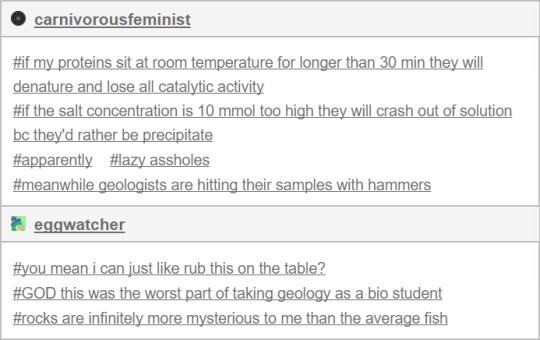
Fun fact: the guys at our college’s geology department prop out the doors with their samples. I totally understand why but as someone whose work with samples is necessarily super delicate and sterile it fucks me up so bad
lol idk if you watch nautilus live at all but watching them process bio & geo samples side by side evokes exactly this Thing (the descriptions are gold too… “here are the 30 steps we use to preserve bio samples, and as for rocks, well, we let them dry, bag them, & put them in the Rock Box)
Good to know there’s enough Biologist Salt™ to go around
Paleontologists occupy a weird and highly uncomfortable slice of this Venn Diagram
in my own experience with geology most precautions with samples are to preserve the life and safety of the geologist, most of the rocks are fine.
i am continually reminded of one of my colleagues, who wanted to collect a sample of gypsum on a field excursion but was too lazy to take off his backpack and get his rock hammer. so he said “eh, it’s soft enough” just fucking punched the rock until a piece fell off like it was fucking minecraft
Golden tortoise beetles can change color depending on the season or even their mood using the liquid beneath their transparent shell. Underneath the shell are three layers of cuticle, each covered in tiny nooks and crannies that appear smooth when covered with liquid, and reflect light perfectly like a mirror. But when a golden tortoise beetle is agitated or under attack from a predator, it contracts the spaces between the layers of cuticle and forces liquid out of the grooves — doing away with the iridescence and usually revealing a brownish-orange color.

 BettSplendens Tumblr Evac