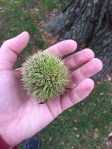
1. was walking to work (i work at a service seed lab). right outside the building i find this Absolute UNIT of a seed, laying alone on the ground, nothing else like it around it. i look around and see no contenders and i am DYING to know so i bring it inside whilst being pricked by the 954352345 spines on this defensive spike ball
2. the seed lab’s function (understandably) comes to a grinding halt at the presentation of a Strange Seed. it’s even more strange because it looks like it wasn’t even ready to drop- like it’s not ripe yet, whatever it is. my boss, a seed technician trained in Many Seed Ways, thinks it might be a sycamore but it doesn’t quite look right. our plant pathologist asks for me to show him the offending tree.
3. i bring him to the tree under which i located the 🅱️ehemoth and we look around a little bit before confirming that, indeed, there are no trees in the immediate surrounding area that could have heaved this ball of hate from the heavens. people look at us strangely because he’s wearing a lab coat and we’re both tugging on low hanging branches looking for more offending artillery
4. we go back inside and my boss has cut it open and determined from her Extensive Seed Knowledge that it’s not only a fucking chestnut, but a ball consisting of one (1) Very Large fucking chestnut accompanied by two (2) smaller neglected chestnuts. chestnuts. i had no idea that that’s what chestnuts looked like right from the tree like that is VERY threatening, like imagine this roasting over an open fire and shit like…….how is this considered festive? why? (note: technically this is a seed from the chinese chestnut tree, Castanea mollissima. apparently not all species look exactly like this)
5. the mystery deepens as our pathologist recalls that due to the chestnut tree’s susceptibility to various fungal diseases, there is only one (1) chestnut tree on campus. it is not near our building. somehow this Very Ominous Seed teleported across campus and materialized in front of the seed science building like a foreboding omen. my best guess is that it fell on top of somebody’s car and got carried here but holy shit its like….sizable, like this seed was meant to Drop And Stay There
6. it is now in my possession. i was poked like 453254 times getting it into this plastic thingy because i am A Dumbass that cannot take evolution’s copious hints to Not Touch The Seed seriously. i have no idea what im going to do with it but i sure do have it now
and after discussing the Just Really Big Corn more with the person in question, I have some more information about the offending Really Big Corn (the pic is coming up dont worry):
-for those who are new to Exactly How Fucked Up Corn Is, corn, or Zea mays, is comprised of many varieties (called ‘landraces’) native to central and south america. They were first bred by the native peoples in the region from an ancient grass called Teosinte that’s still around today. theyre really fucked up. i cant talk about it here but trust me there’s a reason some people devote their entire lives to studying it
-the lab in question is a maize genomics lab, and does a lot of work with these landraces. sometimes this work involves bringing various kinds up to their lab at my university in Iowa to grow in test plots for experiments. you can see where this is going
-so the supercorn itself. the supercorn in question is actually a collection of a few different landraces from the valleys of mexico and south america. they are naturally taller than what we would consider ‘normal’ corn in their native environment, but like corn generally is when brought to Iowa, they’re really fucking happy here and are a little bit taller than their natural height to show for it (we get longer days here then they get where they’re from, resulting in the plant getting slightly different growth signals, so on so forth)
-i got the height wrong in the tags on the original post. my friend is 5 foot 7, not 5 foot 5. this corn is over 20 feet (6 meters) tall. they were grown from seed in this test plot. she says the stalks are as thick as bamboo to compensate for the sheer height. behold the image that’s haunted me for literally months:
hot take: brace roots, where they occur, are one of the most terrifying plant organs. they just look too much like little squiggly arms seeking strength in the ground….like i think they’re weird and lovely but also im terrified
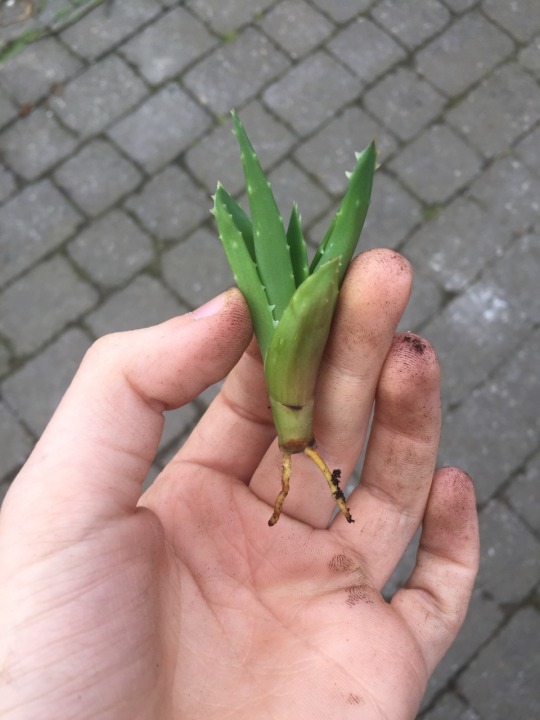
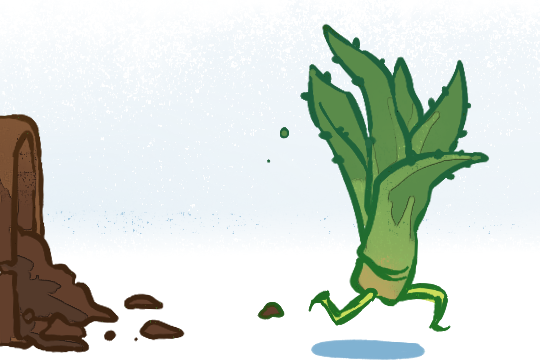
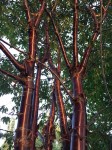
this species is called the ‘walking palm’
*shudders*
I’d never seen brace roots in person until I grew corn this year. It was a nightmarish heart attack to behold!
tbh i didn’t know about them either until I worked my first manual labor cornfield job and started looking down and noticing that my feet were mere INCHES from the alien arms slowly extending into the surrounding soil day after day and I was like ‘hey what the fuck’ and asked one of the breeders.
it’s one of those things about maize that you don’t notice until you really experience it up close. it’s an incredibly alien plant.
Walking palms move! They put down new roots on one side of the plant, and the old roots on the other side gradually die off. We can tell when their seeds arrived to Hawaii by measuring how far the plants are from the coastline. The first seeds grew plants and those plants moved inland a bit, then dropped seeds, and those seeds grew plants that moved further inward, and so on.
They can ‘walk’ out of garden beds, too. I’ve seen where they’ve done that, some roots planted inside the bed, new roots going into the ground outside the bed. They move to get to new, fertile soil or better light when they’re in less than optimal conditions. Ones that are in perfect conditions don’t move at all.
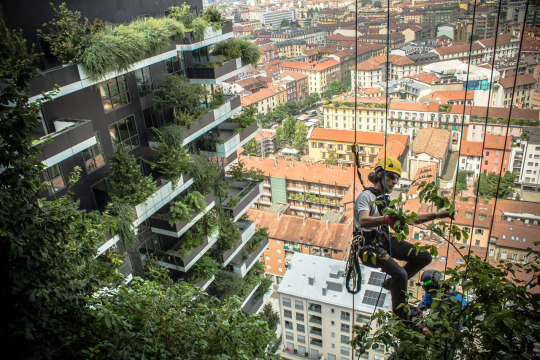
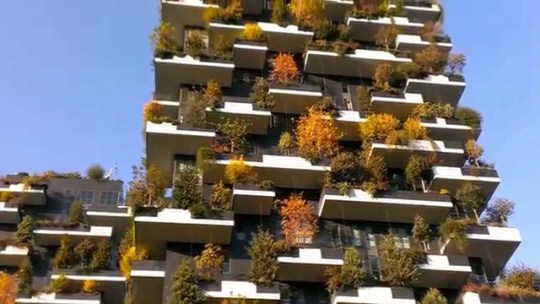
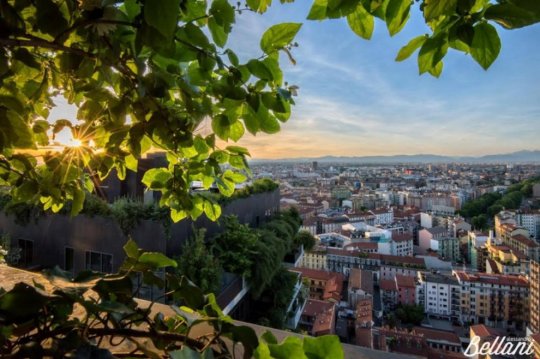
A vertical forest is expected to be completed this year in Milan. There are two tower apartment complexes which contain a total of 400 residential units. The facade of the buildings will be covered with 730 trees, 5,000 shrubs, and 11,000 perennial plants. It is expected to have the same ecological impact as 10,000 square meters of forest.
Aside from fighting smog and producing oxygen, the foliage is expected to provide insulation to the residential units.
It’ll be really cool to see how these trees grow in order to maximize access to sun, water, and nutrients. Also, a step towards a sci-fi solar punk future – I’m in.
I sure hope the structural engineers planned for the buildings to increase in mass as the trees grow.
Well, or else for maintenance labor to keep the trees rigorously trimmed to prevent too much increase in mass. Or both? (The wikipedia article says the engineering team consulted botanists and horticulturists in planning how much weight the buildings could bear, so it seems likely that the fact that trees grow would have come up.)
This is a pretty cool idea regardless and I hope they get it right. I wonder if anyone will do anything like this in New York.
This falls in the “I really hope they do it but I’ll believe it when I see it” category for me.
It’s been up for 2 years, inaugurated in October 2014, and still going strong. It’s won multiple awards.
The beautiful looking flowers of the Utricularia (or bladderworts) almost hides what happens below the surface. The roots of these plants contain bladder-like traps which can suck in tiny bugs to feed themselves. The bladderworts you see here are some I would like to own myself one day: U. bisquamata, U. sandersonii, U. longifolia, U. subulata, U. fulva and U. reniformis.
Good news! The first three are easy to keep, and I”m pretty sure they all are, I just can’t vouch for the rest. They can’t tolerate minerals, though, being carnivorous plants. To keep them happy, pot them in rinsed sphagnum moss (for the larger ones) or rinsed sphagnum peat (for the smallers) with a big handful of perlite mixed in. Not Miracle-Gro brand, it all has fertilizers which are toxic to carnivorous plants.
Keep them very wet with rainwater, distilled water, or RO water, and occasionally put in a big pinch of dry leaves or similar to fuel the growth of microorganisms for them to eat.
At least one of those is probably aquatic, in which case it should be kept in diluted pondwater in at least a gallon-size container. They need moderate to bright light, and should be kept wet at all times, soggier than you’d keep just about any other plant. Seriously, my U. Sandersonii likes to be watered so much the surface is submerged about once a month. U. Longifolia prefers a fluffier substrate with larger components like sphagnum moss, and likes slots in the sides of its container like it’s an orchid, but likes to be kept very wet as well. U. Bisquamata is a weed in carnivorous plant collections, pretty much any combo of “very wet, no minerals or fertilizers, good light” should grow it.
The best part, IMO? Aside from U. Longifolia (too big) and the aquatic ones, bladderworts can happily be grown in teacups. They don’t need any drainage at all, in fact I don’t put mine in actual pots because it’s easier to keep them wet that way. They look adorable in teacups, tiny little leaves and itty-bitty orchid-like flowers. You’d never know about all the bug murder under the surface.
Trees, like animals, can also experience albinism, though it is extremely rare.
the reason it’s rare is because without chlorophyll, the plant can’t get energy, and dies shortly after sprouting unless it has some other source of food. so if you see a plant as big as the one in the picture that doesn’t have any green in its leaves, it’s getting its nutrition from the roots of a neighboring plant of the same species, feeding on the sugars created by the other plant’s photosynthesis.
albino plants are basically vampires.
thats metal af
That or the neighbouring plants are helping to keep it alive.
There has been research saying plants can share resources with one another, such as carbon and nitrogen, when one is deficient, so this plant likely has an abundance of mycorrhizal fungi on its root system that isn’t so much parasitizing from its neighbours as it is borrowing.
It’s not a vampire. It’s a disabled plant being supported by a community of healthy individuals who have more than enough nutrients to share.
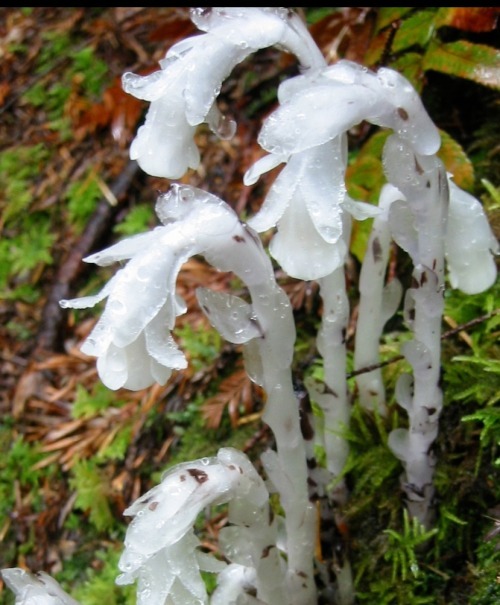
The real vampire plant is actually Indian Pipe, which lacks chlorophyll and sucks out nutrients from photosynthetic trees, meaning they can grow in dark places without much trouble. They look badass as well.
this is the coolest thing, because every plant is connected to every other plant by underground fungi! scientists now hypothesize that fungi actually evolved long before plants, so plant root systems evolved with fungi that were already in the soil. fungi aren’t just useful for the survival of plants, they are essential for the survival of most vascular plants! (vascular plants = those with root structures)
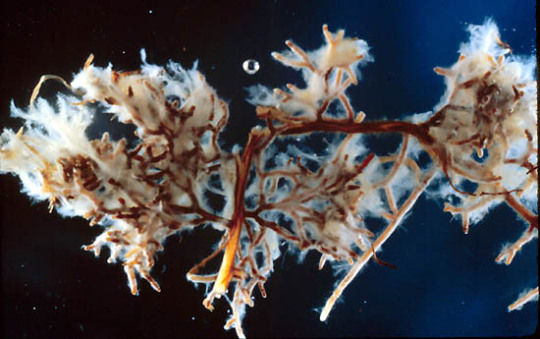
networks of fungi under the ground can cover miles and miles, and each fungus sends out very long branches, called hyphae. these hyphae can surround the root tips of a plant (these are called ectomycorrhizae, because ecto = outside, myco = fungus, rrhizae = root), which looks something like this:
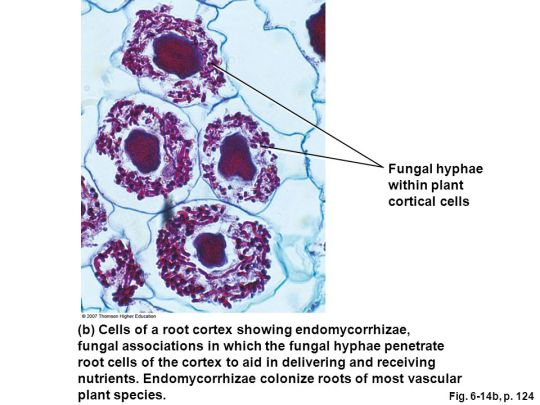
(picture source) alternatively, plant roots can be colonized by endomycorrhizae (endo = inside), which are WILD, because they essentially just bust through the plant cell walls and, like, chill directly inside of the root cells? like HI here we are we’re moving in now! that looks like this, on a cellular level:
(picture source) despite the occasional door-busting, this is a good, codependent relationship for both parties, because plants provide the fungi with sugars and energy, while fungal networks can grow even farther than plant root networks, so they transport essential nutrients to the plants as well as helping the roots to gather enough water. fungi are also the world’s greatest decomposers, and break down rotting organic material in the soil to increase the amount of carbon surrounding the root networks!
fungi are uniquely disposed to transport materials and to communicate over long distances because they have a supercool cellular structure! so fungal hyphae are only sort of composed of individual cells, but they’re cells with serious boundary issues. most species of fungi have septate hyphae (septum means boundary or partition), where individual cells have dividers between them, but these dividers have, like, GIGANTIC ass holes in them. the concept is kinda like this:
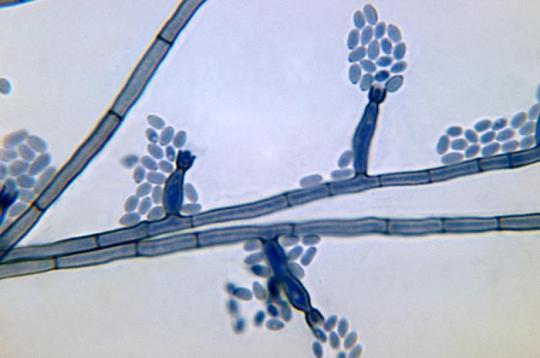
(picture source) these pores are so ENORMOUS that they can fit entire organelles through them! so one cell can just pass its entire nucleus or mitochondria through a pore to its neighbor, which is WILD! you can literally see these septa when you look at fungi under a microscope, like look at this beautiful bullshit!
(picture source) something like 90% of vascular land plants are colonized by mycorrhizae, so when you are standing outside, know that literally every plant around you, every blade of grass beneath you, is connected to every other plant by a vast network of fungal friends, roommates, and helpers! sometimes a SINGLE fungus will be connecting all of these plants to one another! ALL THE PLANTS ARE HOLDING HANDS.
there are these incredibly intimate, cooperative relationships going on beneath your feet that allow plants to help each other and communicate with one another (or compete with one another), and there is NO WAY that we would have enormous trees like we do without fungi to help them expand their reach and weather different soil conditions! the plants are talking to one another, y’all, and we’re the only ones who can’t hear them.