My opinion is a ‘family pet’ is going to be cared for primarily by the adults, so the ‘best’ family pet is one that the adults will be able to care for well, and remain interested in.
Even if the ‘intention’ is to have the kids responsible for part of its care, ultimate responsibility must remain with the adults. Adults don’t get to put any blame on the kids for what happens to the pet if they forget to do something, or if the pet gets sick. They can’t expect kids to be completely responsible for the pet’s entire life.
It’s depressingly common how often I see families that expect an 8 year old to be making serious decisions about a pet, or who have just thrown kids in the deep end with pet care and expect them to ‘learn’ when things are going wrong. This is unfair for everyone involved.
So the ‘best’ family pet is something that the adults are prepared to take on.
You also shouldn’t be choosing an animal based on its ability to survive neglect. You should be taking measures to ensure the animal is not neglected in the first place. You MUST monitor whether or not the animal is being given proper care. The responsibility is on you, the adult, it is not on the child.
If you want to make your child completely responsible for a living thing, pick something that can’t mentally suffer if neglected. Maybe a plant. Maybe a video game animal.
My cat, Storm, is an indoor/outdoor cat, because we believe he deserves that freedom. He’s smart, tough, and always comes home (we lock the cat door after dark when he comes in). But he is a tomcat and gets into fights with the neighborhood cats.
Sometimes when he does get into fights, he gets abscesses from his wounds (this has happened twice).
The first time I was in eighth grade and I saw something white in his fur and so I got the tick spoon thinking it was an engorged tick. Only for it to start oozing. I screamed and ran to my mom who was in the garage and we had to clean up all the pus. He stayed in the dog crate overnight until we took him to the vet and they drained it.
The next time was this summer and I was lying in bed with him and saw a large lump on his hip so I told my mom and scheduled a vet appointment. The next day we took him in and they sedated him, lanced the abscess, and put tubes in and a cone on his head. He spent the week in a dog crate in my room.
That week was utter hell.
He would cry in the middle of the night and bang on the crate bars and pull at his cone. I didn’t get a wink of sleep. He eventually pulled out the tubes while I was walking my dog and he got the cone off.
Then he decided to be an asshole and pee on my favorite shirt.
Jerk.
Not sure why you chose to submit this after reading the FAQ, since this isn’t where to send questions and this doesn’t look like a question anyway, but allow me to offer you some feedback.
Your cat is not a ‘Jerk’ for peeing on your favourite shirt. He probably doesn’t understand ‘favourite’ and in any case cats don’t pee on things out of vindictiveness or revenge. They urinate in unusual places, like sinks, bath mats, beds and clothing on the floor when they are stressed or have a urinary tract issue. He is not a jerk, he’s just a cat, and you’ve misunderstood him.
It would be ideal for your cat to not be getting into fights on a regular basis, whether you secure the yard, build an enclosed catio, or consider harness training. The ‘freedom’ you have decided he ‘deserves’ has been the freedom to get into fights, putting himself and the other combatants at risk. While this certainly drums up veterinary business, it’s not ideal for the cat. He will probably not come home one day, even if he is ‘tough’ and ‘smart’ he only has to be slow or foolish once.
He should also, if he has not already, get a Feline Aids test. And if he’s positive, he should not be permitted to free roam and infect other cats, which he will do.
This situation does not look like one of a cat being an asshole to me.
That was a week of your cat being in pain and trapped in a small box with no comfort or entertainment of COURSE he was upset! You have a very stressed cat.
Get your cat neutered. Stop letting him outside to get in fights. Something is going to kill him, no matter how tough or smart he is. If he manages to survive, he is going to be in pain many times in his life, and he is going to spend a significant amount of time in serious distress, which you may not even know about because of how good cats are at hiding their pain.
He may be tough, but there are wild animals that are tougher, and there are animals that move in packs. All it will take to take him away from you for good is a particularly fast raccoon, a large dog that catches him off guard, several dogs that corner him, a coyote, a large owl or othe bird of prey, a car that comes out of nowhere, a human who hates cats, a human with a rifle who mistakes him for a pest animal, a lingering infection from an abscess you don’t notice, bleeding to death from eating poisoned rats, and the list goes on and on.
In addition, he’s killing small animals, slowly, violently, needlessly, because that is what cats do when allowed to go outside.
Since you haven’t neutered him, he’s probably responsible for a lot of litters of feral kittens that are going to live short, violent lives, and may not even make it to adulthood.
You need to take better care of your cat. There are many ways to keep a cat happy indoors, where he won’t come back with massive abscesses or potentially never come back at all. Start acclimating him to spending more time indoors, and start setting up your house to work properly for an indoor cat, before you lose him.
I’ve noticed that many of the ratblr related tags are filled with people mistreating and not properly caring for their rats. First of all, I’m not going to sugar coat anything; It’s a sign of a bad pet owner to buy a pet without having done your proper research into what it requires to care for that animal.
Getting pet care information from a pet shop is dangerous and more often then not, the information they give out is just plain wrong, as well as the products they sell that are marketed for “rats” often don’t meet the basic requirements for rats. The people that work at these shops want to make money, and most often they have no prior animal specific training or education. So it is up to you to properly research the care required for rats.
Since I see a lot of people apparently incapable of doing their own research, I’ll be walking through the basic requirements for pet rats. Note that these are only the BASIC requirements, and you should be providing above this.
THE RATS
First of all, you should NEVER ever have only one rat. There is no excuse to housing only one rat (save for temporary medical reasons or behavioral issues). If you only want one pet rat, then I’m sorry rats are not the pet for you! Rats are highly social animals, they require large social groups. Most would suggest having at least TWO pet rats at a time, but to be quite honest I feel that you should have at least THREE rats at one time.
Your rats should also be kept in either female or male groups to avoid unwanted pregnancy and fights. Unless the rats are desexed, in that case mixed groups of rats do really well together. There’s both pros and cons to having either female or male rats, that you should take into consideration.
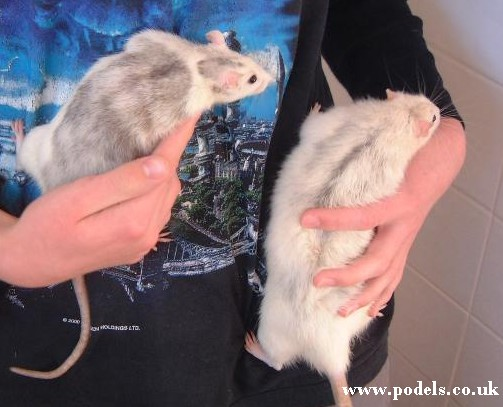
Male rats tend to grow MUCH larger, so keep that in mind. The rat on the left is female and the rat on the right is a male.
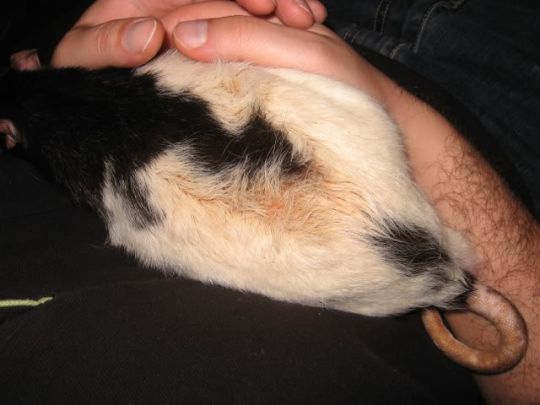
Male rats also tend to be much more lazy and cuddly, and will spend some of their time napping and eating. They secrete buck grease (orange-y in appearance, as shown below) that can often cause their backs to be oily due to their levels of testosterone.
Female rats are much more “active.” They tend to want to run around, play and explore a whole lot more then male rats do. They’re also a lot smaller then the males (and minus the huge balls that male rats have. If you don’t like the idea of huge naked rat balls dragging over you, you may want female rats instead). They also go into heat often, so will get a little rowdy; mostly this just includes lots of humping between the cage mates. (if your female rats are humping each other don’t worry. It’s normal and there’s nothing you can do to stop it. And you shouldn’t aim to stop normal, healthy, behaviours if it’s not hurting the pet).
Also keep in mind that your pet rats need to be handled daily, and let out of their cage for a run around / social time with you. So you’ll need an area that is safe for your rats to free roam (under supervision). This means, making sure there isn’t anything they can chew through (wires, clothes, shoes), escape from, or get into, that you don’t want them to.
CAGE
Okay this is the biggest issue I see people have with their pets. So this is going to be a long one, so buckle down.
SIZE
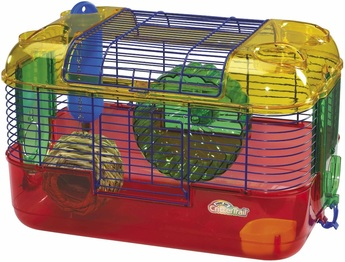
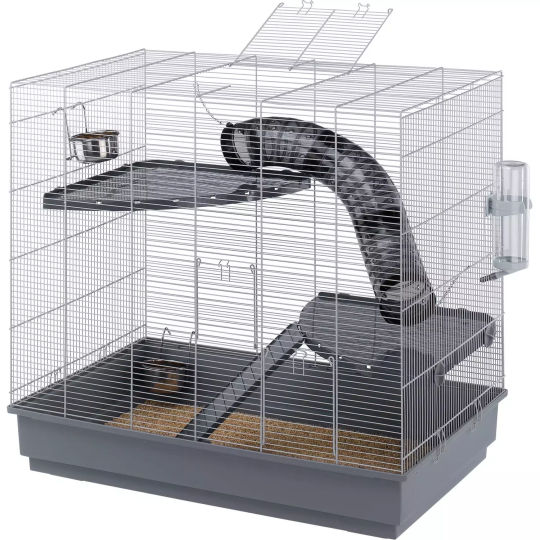
Firstly, the size of the cage. Those cages that pet shops market as “rat” cages are not at all suitable for rats.
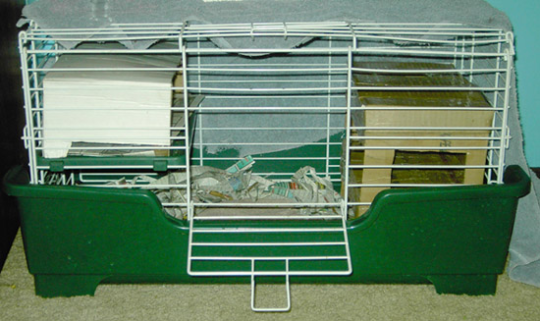
These cages are not at all big enough for rats. The rule of thumb is that each rat requires 2 cubic feet per rat. This rat cage calculator is a great tool, where you can either put the dimensions of a cage or the number of rats you have, and it’ll calculate their how many rats you can fit into that cage, or the size cage required.
Rats need a lot of space! A rat cage like this one (below) can only fit two rats.
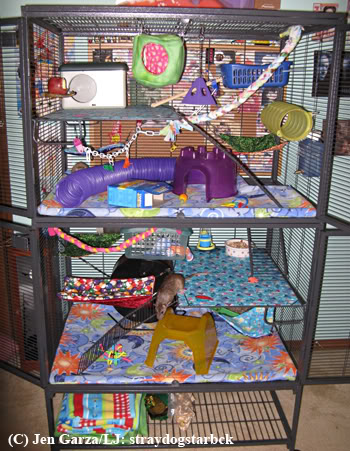
This cage could probably only fit about 4-5 rats
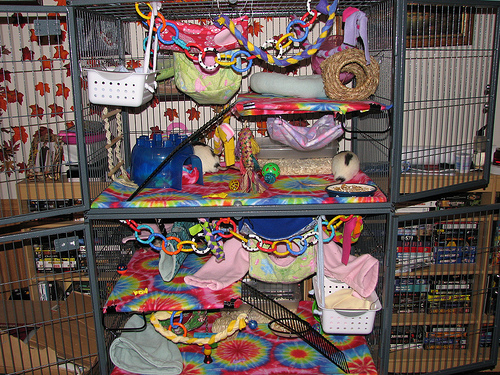
While a large cage like this one (below) could fit up to 6-7 rats!
TYPE – wire, plastic, glass?
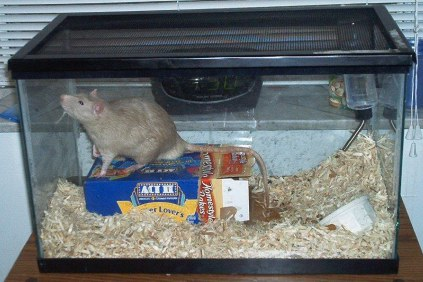
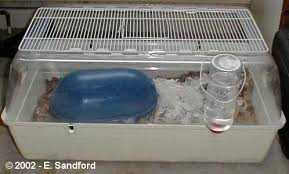
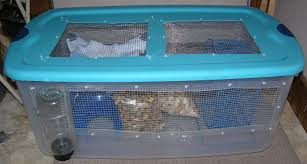
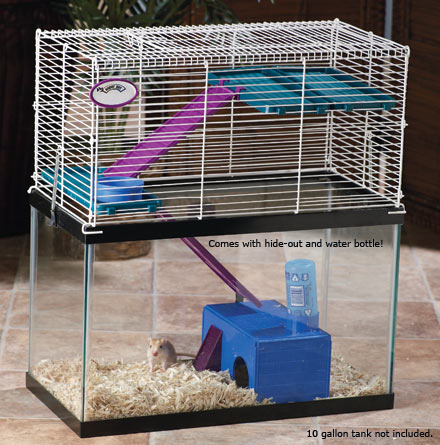
Rats should be kept in wire cages. Glass and plastic tanks / cages (shown below) are all bad enclosures (for a whole number of reasons but we’ll focus on the type for now).
Glass and plastic tanks don’t have enough ventilation and can result in a build up of ammonia (from urine), smell and temperature. Not only that but they don’t offer the rats any way to climb (as well as all of these being too low in the first place).
Rats like to climb, and wire cages offer them the ability to do this, as well as having better air flow and less risk of them chewing through the cage and escaping.
SUBSTRATE
This is another big one, that I see people not doing correctly. Rats are very prone to respiratory infections and this tends to mostly be caused by the type of substrate used in their cage. The above photos all use wood shavings / straw as a substrate. Wood shavings are terrible for rats, they are filled with dust, mites, parasites, they don’t really help soak up urine and they tend to make the smell worse.
Some alternatives include covering the floor with fabric, that can be washed. This in my opinion isn’t the best, as they tend to get really dirty within the first few hours after cleaning the cage. They’re also not fun to wash.
Another opinion is paper kitty litter (like the one below). It’s good for soaking up urine and helps a lot with smell in general.
I personally use newspapers to line the cages. My rats also like to rip it up and use it as bedding for their nests and it’s cheap and easily available.
COVERING PLATFORMS
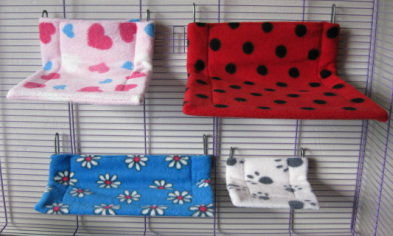
Another huge thing I see rat owners do is have uncovered wired platforms. You need to cover all the platforms that are not solid (aka wired). These can be covered in fabric (again I tend not to use fabric anymore personally, as they get dirty quickly and my rats loved to chew the hell out of it), paper, or some sort of plastic covering (though you need to make sure your rats aren’t chewing the plastic, in case they swallow any).
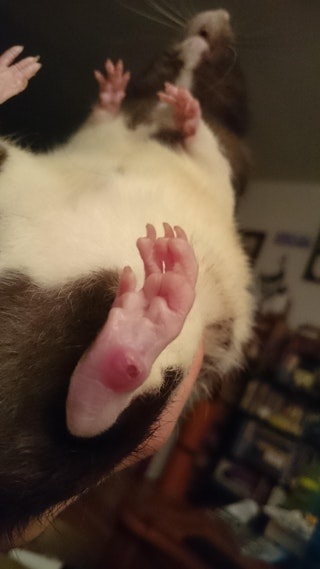
If wired platforms aren’t covered, your rats will have a good chance of developing bumblefoot; a painful condition caused by the inflammation and/or infection of the surface and connective tissue of the feet (as shown below).
TOYS, BEDS AND HAMMOCKS
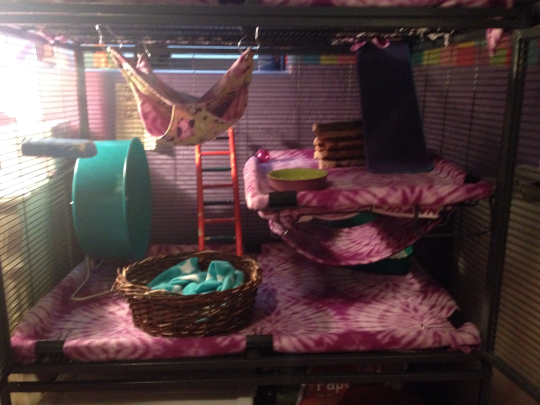
Again, most of the photos shown in rat related tags have pretty bare cages. You cannot put a few platforms, one hammock, water bottles and a food dish in a cage and call it a day. That’s lazy and bad pet care.
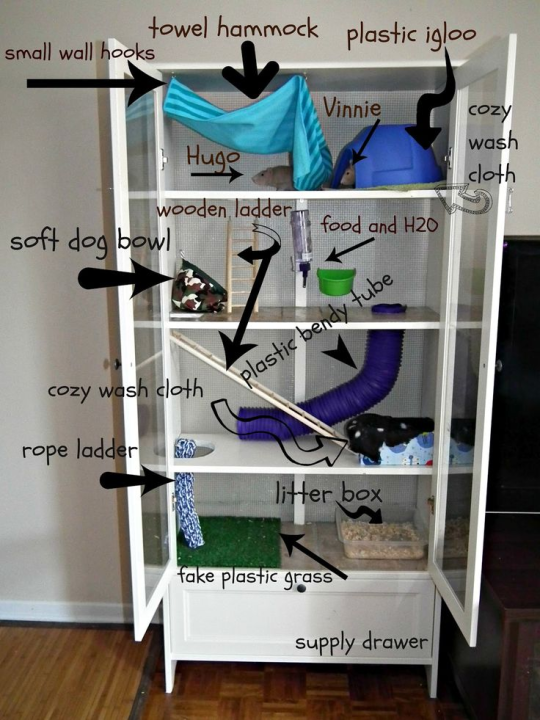
Rats require lots and lots of toys, beds, hammocks, places to hide / sleep / nest and chew / destroy. (as well as litter boxes if you’d like to litter train your rats, which I suggest you do. It’ll make cleaning easier).
All the above cages are really good examples of cage set up’s that rats require. And no these cages aren’t “over the top”, these cages are the basic requirements for rats. if you can’t provide these sorts of set ups, then pet rats aren’t for you.
HYGIENE
Rats can be destructive. They’ll like to tear things up and chew through everything, flick food everywhere and pee on literally every part of their cage, including their cage mates. So you need to be cleaning their cage out at least once a week but ideally twice a week, depending on how messy the cage gets.
The rats themselves don’t really require much bathing. Rats themselves are actually pretty clean, and spend a lot of time grooming themselves and each other. However they will pee on each other and they can get dirty (especially males with lots of buck grease). You shouldn’t really be washing them any more then monthly. When washing rats, use only a tiny bit of something like baby shampoo, and make sure that you don’t get their ears wet, as it can lead to ear infections.
FOOD
Feeding rats can be quite expensive. They require high quality specific rodent feed / lab blocks (low quality feed will have fillers like corn, which aren’t that great for your rats, and are often pretty dusty which can cause respiratory infections). On top of the feed, they require (often daily) fresh veggies, fruit, protein (eggs are a good source. And it’s fun watching your rats eat their way through a hard boiled egg) and carbs (such as pasta).
Male rats cannot be fed any sort of
citrus fruit; it’s bad for their health in the long term, often leading to cancer or UTI’s.
ILLNESS AND DISEASE
Rats and really prone to disease and illness. Most commonly respiratory infections, cancer, tumours, UTI’s, bumblefoot. They will require trips to the vet, so if you cannot afford to take your pet to the vet; and this often means a specialised small animal vet (as not every vet will be able / have experience with rats) then you should not have or be considering getting a, pet.
EXPENSES AND MONEY
Lastly I want to get mention expenses and money. Most people will use the excuse of not taking their rat to the vet because of lack of money, their parents won’t let them, ect.
I’m going to be brutally honest. You shouldn’t have a pet then. This obviously doesn’t include people going through sudden financial crisis or are hit with a sudden very expensive vet bill, ect.
But if you cannot afford to buy a cage, toys, proper food, equipment, and vet bills to provide your pet rats with their basic care, then you aren’t ready to have a pet and you shouldn’t have one. To buy a pet, when you know you are unable to properly provide it with care, is selfish.
That’s a great mindset to have! To my way of thinking, a millipede in the wild has a range far larger than any recommended enclosure size. As long as it’s properly furnished and its not having trouble finding the things it needs (like food, water, heat, etc) there’s no reason you shouldn’t be able to provide a space that’s larger than minimum size requirements.
A 10 gallon tank is an excellent size for just about all millipedes. If you want a particularly small kind, you can split the tank in half and keep a different species on each side.
But yeah, there’s no such thing as an oversized enclosure for most species. The few exceptions are small babies of some species (esp. tarantulas) that do best when in tiny spaces so they can easily find food, and some filter-feeders best kept in smaller enclosures so it’s easier to be sure the concentration of food is high enough for them. Pygmy seahorses, for example, are best kept in a tank under 10 gallons or it gets hard to keep them properly fed. Barring those, even extremely timid species can’t be kept in too large of an enclosure as long as they have enough hiding places.
You’re funny Anon. Why don’t you show your face and we’ll have a civil discussion, and meanwhile I will continue to keep my cats indoors and advocate against letting them free roam.
Okay, so fuck anon for being shitty in framing, but I am kind of curious, why do dogs seem to get restless and want to go outside/exercise in general more? It seems dogs generally have a higher activity level in their preferred lifestyle, does that have something to do with how they “naturally” are or is there some confirmation bias going on where cats are more active and I just don’t know?
Well, my dear anon decided to not come back, so I guess we’ll have to have this discussion without them. There is a lot to talk about, in both your question, the anon’s phrasing and the whole picture, so bear with me in this essay.
Cat territories
Let’s start with ‘cats have territories miles wide’. It’s true that feral and entire (not desexed) cats will roam over multiple kilometers, this is particularly true when resources are scarce and less true when resources are abundant. In areas and times when there is lots of food and shelter available (eg mouse plagues) the area of perceived cat territories actually shrink. This suggests that what’s important to the cat is not how big the territory is in terms of space, but rather how much stuff is in it. In non-desexed cats, one of the resources they seek is potential mates, so their territories will be larger than a desexed one.
So what does this mean for indoor cats? That potentially being restricted to indoor only will be an adequate territory, providing the house is equipped with enough of what the cat needs.
Dog territories
While conventional wisdom is that dogs do require more space, that seems to not always be the case. With the rise of apartment living we do see more indoor only/mostly dogs and with adequate socialization and exercise they don’t seem to be any worse off.
Taking a dog for a walk isn’t really about extending or establishing its territory. It’s about physical and mental stimulation and you could manage both without going for a walk, it’s just that walking the dog is easy, enjoyable, socially acceptable and ingrained in our psychology as ‘what you do’.
Dogs are not permitted to free roam
We walk our dogs on leads, except for designated off-leash areas. Society’s dogs are, or are expected to be, under control at all times.
The way we’ve traditionally treated cats, just opening the door and letting them do whatever they like, going to other people’s houses, hunting and killing, fighting each other, etc, would be unacceptable and outright prosecutable if we did it to dogs.
Cats can be leash trained
Nothing stopping anyone from teaching their cat to walk on a leash and take it for a walk, nothing but effort really. Some cats though do not want to go out, but that can also apply to dogs.
Toilet habits
Dogs tend towards walking then pooping, while cats tend towards finding somewhere discrete for pooping. So we humans have developed this habit of taking the dog for a walk to make it poop, while for cats we seem perfectly happy to let them poop in somebody else’s garden.
Tradition
An awful lot of how we perceive the needs and care of our pets is based upon tradition and what we’ve always done. This doesn’t necessarily mean it’s best for them. Dogs and cats have different characters in the eyes of society. Think of how often we head ‘this cat is like a dog!’ or vice versa when it’s really not, the cat is like a cat, it’s just the person telling the story has a particular preconceived notion of how cats and dogs are and was surprised.
Cats are predator and prey
A dog of any decent size is going to walk through the world like it owns the place, barking at anything, chasing anything (even cars!) and generally not being concerned about being eaten, because other than for very small dogs there are usually not things about that will eat them.
Cats are both predator and prey species. They hunt and kill huge numbers of small mammals and birds when given the chance, but they will also be hunted and killed themselves: dogs, hawks, owls, snakes and other larger carnivores to name a few. You wouldn’t let your bunny free roam, it’s just as dangerous for your cat.
Free roaming cats are at bad for the environment
Cats which are permitted to freely roam have significant effects on wildlife (feral cat autopsies revealed they may be killing up to 50 small birds, mammals or lizards a day and they’re not just hunting because they’re hungry, they only eat the tasty bits when they’re hunting this much), can transmit toxoplasmosis (pooping in the neighbors garden or veggie patch), they will fight each other and stress each other out with unwelcome presences at windowsills.
Free roaming is bad for the cats
The world is not kind to cats. Road vehicle accidents, some deliberate and some accidental, deliberate and accidental poisonings (paracetamol in milk, lily plants, antifreeze), altercations with wildlife, extreme weather and getting washed down storm water drains, getting accidentally locked in garages and not found for days…
And all the cats that just Never Come Home.
I am a working vet. We see the cats that come home injured, poisoned or sick, the dead ones off the side of the road, and all the phone calls from hopeful owners wondering if anyone happened to bring their cat in. The world is not kind for cats.
Alternatives
Preventing your cat from free-roaming outside might mean a strictly indoor lifestyle, but it doesn’t have to be. Leash training is an option, as is securing your yard or part of it in an enclosure so you cat can still be ‘outside’ but remains protected and secure.
Some cats are more active than others. Trash Bag likes t play fetch for hours each morning, which is a nice bonding activity for both of us. I’d much rather play with my cat and take responsibility for him than let him roam free and let Dog knows what happen to him.
Yeah, definitely illegal on the possum front, good call. Raccoons and possums are both extremely attractive as pets, but it’s not good for them or for you.
As for frilled lizards, I have to admit I know very little about keeping lizards. I’m a snake and amphibian care person. If there’s anything inherently wrong with keeping them as pets, I don’t know.
The big thing I can imagine being a problem is space; they need pretty big, specifically-filled vivariums to thrive.
It’s a lot to take on for a first pet. I would suggest getting a simpler, more “first-time” friendly lizard to start. Learn about lizard care, and then eventually move up to more complicated reptiles. Geckos and Bearded Dragons require research too, but it’s much easier to find accessible, reliable information on their care.
I know when your heart is set on a specific animal, it can be disappointing to wait to get it, but take a page from my book. As a kid, I wanted nothing more than a red-eyed tree frog. I finally got one without knowing much about its care, and it quickly died.
Had I waited, and had my parents waited, we could have owned a long-lived, healthy frog.
So yeah. That’s my suggestion. Start Smaller. But if your SET on it, reach out to frilled lizard owners online. i’m sure there are forums and blogs about them. Talk to those people. I really don’t know anything about them.
Small fuzzy animals and, to a slightly lesser extent, dogs and cats are more my area but I’ll reblog this to @petcareawareness and see if anyone has anything to offer.
Does anyone have any helpful information on frilled lizards?
Frilled lizards get over 2 feet long and need a lot of space to climb. You’re looking at an enclosure at least 5 feet long and 6 feet tall, minimum. They also need a lot of live insects as their food. Yes, you can keep them healthy in captivity, but you basically need a zoo exhibit to manage it. That’s going to be extremely expensive. Also, they only flare their frill when extremely stressed, so you shouldn’t be seeing them flare.
May I suggest dart frogs, if you want a striking herp pet? They require plenty of research, but can be kept in an enclosure only a couple feet square with no problems. They’re tiny, will happily live and breed in a well-structured, planted enclosure that size. They’re hands-off pets, but gorgeous, and can be fed flightless fruit flies that you grow in jars.
If you want a lizard, bearded dragons. Big and calm, so great for handling. Enclosure needs to be 3 feet long by 2 feet deep/wide for happiest pet, but that’s a lot smaller than a frilled lizard enclosure, and they’re much easier to keep. They eat live insects and various fruits and veggies.
Crested geckos are neat, can live in a smaller enclosure than a bearded dragon (2 feet tall and a bit less wide is fine), can have their enclosures planted beautifully, and can be fed a prepared diet that includes no live insects. Not so good for handling, too jumpy, but pretty and fairly large.
Leopard geckos can live in an enclosure about as large as a crested’s, but on its side, and are great for handling. Live insects as food.
Do your research, whatever you pick! As much research as your brain can hold. There are lots of good lizard options, and lots that are smaller than a frilled lizard.
I suggest going to a reptile show/convention and looking around, see what gets your attention. Do /not/ buy based on impulse or only advice from the seller, just use the show as a showroom of sorts. Go in, look for something you like, take pictures and notes on the name, ask for some advice, and go home to do your research. I don’t know one off the top of my head, but there’s probably a lizard common in the hobby (you want common, it means available captive-bred) that resembles a frilled dragon.
I am by absolutely no means an expert, and before you get any animal, it is advised that you do an adequate amount of research so that you can care for it properly. Please do not rely on only my sources to care for your animal, as you will need to do a bunch more research. To impulsively buy an animal without knowing anything about how to care for it is wrong and irresponsible on your part. What works for me may not work for you, and you will learn this through trial and error. (This is not my original image, credit to the original photographer also DONT PUT BEARDIES OF DIFFERENT SIZES TOGETHER, the bigger one will eat the small one and you will not have a good time)
Bearded Dragons
Bearded dragons are some of the most easily available pet lizards you can get. While they can be rather expensive while getting all the supplies and the actual animal, it is well worth it if you are looking for a personable animal that you can bond with very easily. Not only are they personable, but also easy to care for once you get the hang of it. They aren’t particularly needy and in my opinion, in the top 3 easiest to keep lizards you can find. These animals do require more than the regular leopard gecko, however they are pretty much tiny, scaly dogs.
Experience Level: Beginner
Origin: Australia
Temperament: Docile, usually very food driven.
Size: Around 2″ of hatching out of the egg, but can easily reach 20″-24″ as adults.
Expenses: Overall, you will spend anywhere from $300-$400 on everything (not counting monthly food). The initial bearded dragon cost will normally be on average $50-100, but can fluctuate depending on where you buy from, and what color morph. Please understand that it is very expensive to house any animal, and you should not buy an animal if you can not support it.
Heating/Lighting: Unlike other beginner lizards or snakes, bearded dragons require both UVB and UVA lighting. If UVB (essentially sunlight in a bulb) is not provided, your scaly friend can develop Metabolic Bone Disease (MBD). UVA comes with a regular day light basking bulb, and is essential to provide heat so that your bearded dragon can function properly and pass food. There shouldn’t be a need for a UTH or red/blue/night heat bulb, unless you are looking to heat up a very cold part in your Bearded Dragons enclosure, or at night in the winter, however it is best to have a wide range of temperatures within the enclosure and these heat sources should not be needed otherwise. PLEASE NOTE: Do not buy the “swirl” UVB bulbs for your bearded dragon, they are too bright and can burn your bearded dragon’s eyes. The strip bulbs from Repti-Sun is a very good brand.
Temperatures: As babies, bearded dragons should have a basking spot of around 92-95 degrees Fahrenheit, and the cool side of the enclosure at room temperature (68-74 degrees Fahrenheit). As sub-adults, you can increase this basking temperature to 100-102 degrees.
Humidity: Because bearded dragons are originally from the desert, they are not in need of any special humidity. Ideally, humidity should be around 30-35%, and just having a water bowl should meet these needs. If your humidity is too high, it can lead to an upper respiratory infection (URI). Stay away from glass or plastic lids to your enclosure, and be sure there is plenty of ventilation. (Often times, Beardies enjoy baths!)
Housing: Because of the size difference in baby to adult, there will be some required “upgrading” of tanks. If you put a baby in a 40 gal breeder, it will be less inclined to eat and bask and more likely to hide away. Because of this, as a baby you will be good with a 10 gallon, as a juvenile a 20-25 gallon, and as a sub-adult you can upgrade to their final needed size, a 40 gallon breeder (yes, you can go larger on an adult if you would like). If you happen to have a German Giant beardie, you will need somewhere around 60 gallons. Because bearded dragons will spend most of their time on the ground, it is important to find an enclosure that has more floor space than it does height. Males should never be kept with other males or other females, however under the right circumstances, female bearded dragons can be kept with females (NOT RECOMMENDED FOR BEGINNERS).
Substrate: Many people keep their bearded dragons on sand (calci-sand is just as bad), claiming they can just “bask it out”, however you are still putting your bearded dragon at risk for impaction (not being able to pass food, and getting sick and possibly dying). Bearded dragons use their tongues to get used to their surroundings, so even if you are not feeding on the loose particle substrate, they will still ingest it. Because of this, you should not keep your beardie on any sort of loose-particle substrate that is small enough for them to ingest (sand, calci/repti sand, moss, etc.). Ground coconut fibers is generally okay, but you are not in need of excess humidity, and it is hard to keep up with and messy. Your best options are paper towels, newspaper (the ink will make them dirty), tiles, or reptile carpet.
Diet: Bearded dragons are omnivores, meaning they need both vegetables and protein in their diet (meaning insects). There are a lot of safe and unsafe vegetables and fruit that bearded dragons can and can’t digest. As babies, they should have 35% veggies and 65% insects, and as they get older, around 40% insects and 60% veggies. The main intake of their vegetables should be dandelion greens, mustard greens, and cauliflower greens, however things such as romaine and iceberg lettuce have no nutritional value (good for getting babies to stay hydrated, though!). Bearded dragons also should get Calcium with D3 on their salads and on their insects. Staple insects include crickets, dubia roaches, phoenix worms, and superworms (only for sub-adult+!), treats include wax worms, butter worms, and horn worms (sub-adult+). Mealworms should never be fed to baby or juvenile bearded dragons because of the worm’s hard exoskeleton makes it hard to digest and can lead to impaction. Here is a list of safe and unsafe food: http://www.thebeardeddragon.org/bearded-dragon-diet.php
Common Illnesses: Please take your animal to the vet if you notice any of these things happening to your animal. Impaction is when your animal ingests small fibers or something and cannot digest it, so it may clog and get stuck in the lining of the intestines, which can lead to not pooping, bloody poops, lack of appetite, non-digested foods, and can lead to death. Metabolic Bone Disease is when your animal is not getting enough sun, vitamins, or calcium and it causes the bones to essentially turn into jello, the muscles spasm uncontrollably and you may notice a lack of movement, can be fatal if left untreated. Upper Respiratory infections are caused when there is too much humidity, smoke/residue in the air (do not burn candles or incense or spray anything in the air), or dust (from sand). This can lead to eye crusties, nose and mouth bubbles, mouth rot, and if left untreated, death. Blood Mites (VERY CONTAGIOUS) are also sometimes an issue, mites are sneaky little buttholes that hide under scales, in noses/ears, or vents (butts) of your animal, that if left untreated, can kill beardies. They are small black or brown dots that are caused by unclean bedding/enclosure, leftover food, other animals, etc. When you are buying from anyone, run your hand along the entire body in one swipe and check in all the spots they may be, before placing into the enclosure/buying if you can. Luckily, mites are easily treatable (as in you can go to the pet store to buy it), however difficult to get rid of. Parasites are an issue, and if you see lack of appetite, bloody stool, or lack of gaining weight, take them to the vet IMMEDIATELY with a stool sample that has been passed within the past 24 hours.
Unmentioned/Fun Facts:
Where to buy: (Please be sure to know how to tell the difference between a healthy and unhealthy animal before buying) When buying any “exotic” animal, it is best to stay away from mass producers such as PetSmart or PetCo. This is because the majority of the time, you are buying a sick or unhealthy animal and you never know the history of the parents. The employees are also told to essentially bullshit their way through the conversation, just to make a few extra sales (majority of employees are like that, not all, just 99.9%). The best places to get animals from are rescues, adoption agencies, or (the best option for beginners) BUY ONLINE FROM A BREEDER! Not only are you guaranteed the health and background of the animal, but you also get a better selection. Breeders to stay away from are Underground Reptiles, LLLReptiles, and Backwater Reptiles. Remember to do your research on the breeders themselves as well! I recommend Daichu Dragons, Fire and Ice Dragons, and Atomic Lizard Ranch.
Again, please be sure to do your research before you get any animal! Good sources are on YouTube and across the internet! Don’t be afraid to ask if you have any questions!
I’m not touching anything else in all of this, but Fire and Ice Dragons is a terrible breeder. She sells to minors and ships at unsafe temperatures (my personal experience, as well as many others- but she sold me a dragon when I was fourteen and didn’t talk to my parents, shipped him in a snowstorm- oh, and he wasn’t the color she’d said he’d be, which… I mean, I loved him to pieces, but on the other hand, she took like, 300 dollars from a minor and sent me an animal worth less than a third of that), misrepresents the animals she sells, and then there’s her Board of Inquiry post– seven years of shitty customer service and misleading animal care.
I’ll touch on some of this other stuff. There’s a lot here, so others feel free to address any misinformation I haven’t.
A 40 Gallon Breeder Is Fine For A Juvenile. It’s cheaper than starting at a 10 Gallon and going up, your baby will probably appreciate the room. It’s also difficult to appropriately mount a UV tube in a 10G, most use the T8 which needs to be 8” – 10” away from the lizard, a 10G is usually only 12” high so this wouldn’t allow for a proper basking spot. To my understanding, a T5 is also best mounted inside and needs to be 13” – 15” away. The basking temperatures suggested are also too low, basking temperatures should be at 105F – 110F. Another source I respect is BeardedDragon.org and cited 95F – 102F for adults.
4x2x2 Enclosures are increasingly becoming suggested as the minimum. A lot of places, and a lot of people, cite a 40G Breeder tank as the minimum for an adult but if you see a full grown dragon in one there’s not a lot of room. I won’t say using 40G is wrong, but I’m of the opinion that bigger is better.
Bearded Dragons cannot live together. It doesn’t matter what the dragons sex is, they are solitary by nature and housing them together offers no benefit to the animal. The only benefits, such as saving space, is to the owner and is selfish. You can have a pair, or more, together for years and then one day have a dead Beardie. That’s what happened to this dragon, warning for graphic images in the link. You can find hundreds more examples like this.
Bioactive and naturalistic enclosures are becomming increasingly popular, this means loose substrate. I think loose substrate can be done right, but this isn’t the same as throwing sand or calci-sand in and calling it a day. I generally advise solid substrate for beginners! Calci-sand is especially bad and, in my opinion, never appropriate. HerpCenter used to have a really good article on it but the site seems to be dead, but @followthebluebell did a good write up on the issues with it here. Kaijutegu, who I reblogged this from, did a good write up on why sand isn’t a ‘natural’ substrate for Bearded Dragons. If you’re interested in a bioactive or naturalistic enclosure do your research, here’s some writing on little discussed aspects of bioactive by @tser and the group Reptile and Amphibian Bioactive Setups on Facebook can be helpful.
Bearded Dragon Newbies on Facebook and BeardedDragon.org are good resources for newbies. For more advanced care Bearded Dragons Network is a good group on Facebook. I do not necessarily agree with everything said on each of these sources, but I do believe each have value and utilizing multiple resources is important when researching.
This belief has come from livestock management, where for parasite control (particularly worms) has resulted in drug resistance in many species of worms, so rotating the drugs used based on testing is recommended. Horse owners typically rotate for the same reason, but also because not all anti-parasite products treat all things.
Fleas, to date, haven’t been proven to develop anti-parasite drug resistance. Yet.
There might be some benefit long term (like, 20, 50 years long term) to rotating the flea products you use, but based on their active ingredients rather than the brand. Fipronil, in particular, seems to have this slowly growing reputation for being less and less effective.
The manufacturers want you to use the same brand forever, of course. I’d just like you to use what you’ll remember to use, as the typical pet owner only uses flea control for 6-9 months of the year, and forgets the rest of the time.
Basically, the point of this is that fish produce ammonia in their waste. Ammonia is highly toxic, burns their gills, and will kill them. There are bacteria that convert ammonia into less toxic nitrites, and then there are bacteria that convert those nitrites into even less toxic nitrates, which plants can use. This is how you get them useful bacteria so your fish don’t die slow, painful deaths.
Also, don’t ever wash your gravel or filter in tap water. Those are what all your good bacteria live in. They don’t live in water, that’s a myth.
You can potentially bypass the wait by adding filter media or gravel from an established tank. You still have to do all these steps, but you might not have to wait for the bacteria to show up and grow.
Rabbits shouldn’t be confined to a cage. (Especially a dog cage..?) Rabbits are curious creatures that need to jump, run, chew and play to be healthy. Keeping them locked in a cage 24/7 as a toy for your kids will make them sick or develop aggression from stress. Healthy rabbit lifespans are 6-10 years, probably even more on very good health and genetics. Rabbit cages should only be a place for your rabbit to use the litterbox and sleep after a long day of exercise and play. Also, rabbits greatly benefit in pairs, but never keep two rabbits together unless they are fixed. Rabbits are territorial and they will either fight to the death or mate rapidly when intact. Up to 14 babies every month. Spaying and Neutering a rabbit also eliminates hormonal behavior like aggression and marking territory and almost all cancers. My sister lost her rabbit to testicular cancer because we never knew rabbits could be fixed. This is the proper set up for a rabbit.
I’m cringing at that rainbow “my mommy got me a cute hamster” rodent cage. These are small creatures that need to run around and explore.They need to burrow and chew, they need dust baths and enough space to tunnel. These animals are solitary and stress out if kept together. This is the proper set up for a hamster or other small rodent.
The “Kritter Keeper” tubis great for traveling, but should never be used as a confinement for a small pet. I can only imagine how stressed a rat or hamster would be in such a small carrier.







 BettSplendens Tumblr Evac