Both parrots and crows are intelligent enough to be evil, but only parrots align themselves with it. Crows are culturally chaotic neutral.
Coopers hawks are chaotic chaotic. Herons are lawful evil. Vultures are neutral good.
I have never had an unpleasant interaction with a Canadian goose. I have charged at them many times and they have merely honked reproachfully at me and slowly waddled away. Apart from making a mess, I have not personally observed them acting like dicks… parrots, on the other hand, love to spread terror and will cackle evilly to express their sadistic pleasure.
When geese act like dicks, it’s usually out of an overabundance of protectiveness or territorial nature. Generally because they see you as a threat of some sort.
Parrots, though? Well. There’s a reason the parrots at my local exotic pet shop (surrenders only, no breeding/wild captures) all have signs on the cages warning people not to get too close. Parrots will bite you and laugh, or learn to call your various other pets over in order to bite them, or rip your keyboard up. Basically, they like to bite things and yell, and seem to find it fun to bite other living things.
aviculture is the reason the sexual maturity of most macaws is bumped back as severely as it is. aviculture is the reason a 36″ x 48″ x 60″ cage is considered the “minimum” rather than “outright inhumane.” aviculture is the reason “get a baby for your first bird!” is such a popular statement, and it’s the reason adoption is considered “risky” or otherwise not worth it. aviculture is the reason that the opportunity to exercise through flight is seen as “optional” rather than a basic need every capable parrot should have. aviculture encourages and profits off of neglect if not gross abuse on a mass scale and it doesn’t matter if the breeder in question is industrial for pet store supply or a just a full time private breeder. they all support the same bad practises because those bad practises make an impossible to keep bird seem “easier” and that means they get more customers.
it is not possible to ethically, morally, etc. make a full-time living by breeding animals who when left to their own devices are very slow breeders even at their most “”successful.”” that’s why the only domesticated parrot, the english budgerigar, has a markedly shorter lifespan than its wild counterpart. similarly it does not matter how happy or well cared for that baby parrot is when behind her is the common and industry-accepted practises of splitting mated pairs, depriving pairs of enrichment so they have nothing better to do but mate (or get extremely aggressive with each other and/or kill one another, as is common with cacatuids for example), and creating tasty new hybrids regardless of the health risks those hybrids run (e.g. military crosses and their markedly smaller livers).
even the best breeder will cut many corners to make a profit and even the hypothetical not-interested-in-profit breeder is still actively and shamelessly flooding the already-inundated market with more parrots than there are homes to care for them. that’s why bird shelters are always overstocked and understaffed.
parrots, objectively, do poorly as common pets. you have to build your life around them to manage them well and that is in no way shape or form an exaggeration. ones that are properly cared for are in the extreme minority because people will buy these birds for the novelty of it and they’re goaded on by misinformation that’s leagues more popular than the actual standards by which they should be cared for. i don’t see it as fair to the birds themselves to point at a well kept cockatoo and say “don’t generalise! this is the face of parrotkeeping!” when the real face of it is a ratty, shaky, half-plucked bird who is no more than nine and yet doomed to live the rest of her 50+ years in the shelter she was dropped off to.
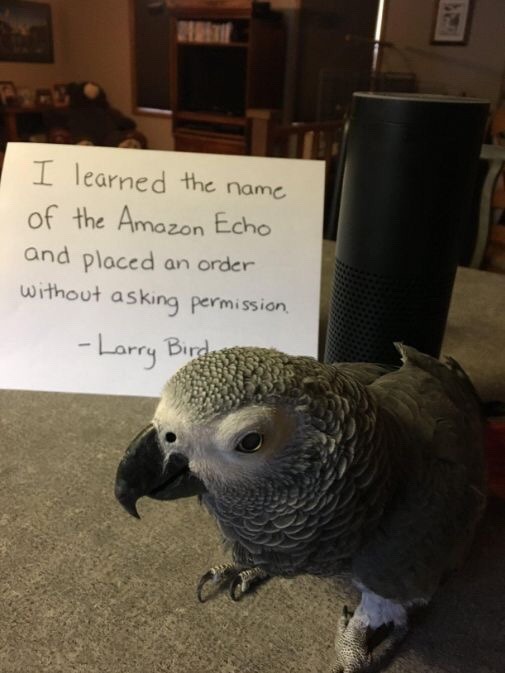
I read an anecdote from someone whose African Grey didn’t particularly get along with her Amazon parrot, Paco. One night she was preparing cornish hens for dinner, while the grey hung out with her in the kitchen. He got a closer look at one of the hens, looked his mama dead in the eyes and asked, “Paco?” Then he laughed.
that is one sadistic bird
I am slightly afraid now.
I love birds?
African Grey Parrots are one of the smartest birds, and seems they can be known to play “jokes” or “pranks” on their owners or any visitors.
I was visiting a friend of the family one time and I was just casually watching tv when I thought I heard the water running. I go into the kitchen but everything’s fine. the parrot looks at me and says “gotcha”.
Parrots are awesome.
I have an African Grey named Loki and he lives up to his name.
He likes to scream and mimic the sounds of things falling off the shelf and when we run into the room to see what’s happening he says “The cat did it! Bad Sammy!” and laughs.
Whenever he gets mad at me he flies away from me, but since he can’t fly very well, he always crash lands. And the first thing he says when I go to pick him up, without fail, is always “You need to vacuum,” in a very bitter grumble.
Loki likes to call our cat to him. He’ll sit there for minutes saying “here kitty kitty kitty.” The cat will come, walk up to the bird, get bit and then Loki will laugh as the cat screams and runs away. This goes on for hours.
If it’s late at night and he’s tired, but I’m still up with the lights on, he’ll say “Loki go night night.” It’s starts of in a normal tone and then gets louder and louder until he’s screaming “LOKI GO NIGHT NIGHT!”
If he sees my dad fall asleep, he screams like a little girl to scare my dad awake. And then laughs. He’s kind of perfected that evil laugh.
But the best one was when I brought home the man who has since become my ex for the first time, Loki looked him dead in the eyes and said “I’m going to bite you.” My parrot was the first one to see what a bad person my ex. He was smarter than us all.
African Greys are like the greatest animal on the planet
When I was a kid, we had a rescued african grey called Dodi, and once I was arguing with my mum about my bed time, and the parrot (who had some very foul mouthed previous owners) just shouted at me “for fuck sake go to bed!”
also whenever we hoovered he’d call us “yoooou dusty cunts”
I’m looking into getting a bird. The place I’m looking into getting a bird from suggested getting a hand raised cockatiel or green cheek conure. I’ve never had a bird before, but done a lot of research on both kinds of birds. I know cockatiels are usually quieter but conures are smarter and cleaner.
In your opinion, what is a better bird to get for a first time bird owner? Are their personalities comparable? Any opinions/advice you have would be much appreciated!!
First: don’t get a baby bird. Baby parrots are adorable and cuddly at first then they’ll hit sexual maturity and will be hell. For first time bird owners, this is just not something most people can handle. You want a stable adult. If you must get a parrot, I suggest adopting from a rescue, parrot specific rescues will work to match you up with the best fit.
Second: if you just want a bird, and not specifically parrot, then don’t get a parrot because even budgies and cockatiels aren’t domesticated. Pigeons, chickens, ringneck doves, ducks, and a few others are excellent DOMESTICATED pets with much simple care and often a more rewarding experience than a parrot.
ALL parrots are highly intelligent, a cockatiel will require the same amount of enrichment and stimuli as a green cheek, just as a budgie will require the same amount as a macaw, simply in different forms. There’s no such thing as a starter bird…all birds are indivuals and will require different care than a bird of the same species.
You don’t want to be asking what’s the best starter bird, but what’s the best bird for your situation. Do you want a cuddly companion who’ll love you no matter what? Get a pigeon or chicken. Do you want a bird that’ll entertain you but be more independent? Get a pair of ringneck doves, pigeons, or perhaps a species of finch. Do you want a bird that’s highly trainable? Pigeon or chicken. Do you want a bird that’ll be okay while you’re away but love you unconditionally when you get back? Pair of chickens or pair of pigeon hens. Do you want a project that’ll keep you busy day and night, that is estentially like having a hyper child that you can’t accurately communicate with for the next 15-90 years depending on the species? Then consider getting a parrot.
Most of what people want out of a pet parrot isn’t what they are. They can be cuddly at times, they can be incredibly loyal, they’re highly intelligent and don’t just mimic speach but can actually know what they’re saying…but for the average person, you don’t want what a parrot actually is, which is a wild animal that’s only domesticated to the point of color morphs. Pigeons and chickens are these things, just as intelligent but FAR easier to manage, these birds are like dogs in that they love humans on a genetic level. They come in an array of amazing colors, shapes, and temperaments, with the bonus of being readily affordable and accessible enrichment. You can get them from babies and they grow fast enough that their teenage stage isn’t a problem, or you can adopt a rescue bird which can be very easy to tame if it’s not already, given enough time and love.
Okay, pigeons and chickens are cool and all but legit as someone who has owned multiple parrots and has an uncle who breeds parrots who I help, they are nothing like what you are describing, ESPECIALLY if you get a baby. If you get a baby you get a cuddly companion for life who’s gunna want all the head scritches and cuddles. Every parrot I have raised from a baby (for myself and for others) has been this way with the exception of my budgie who was abused at the hands of some horrible house sitters. And even then, he’ll interact with me and cuddle in his own special way. He loves playing with my glasses, trying to groom me and pressing his bean to my nose to have some very serious chats. Adult parrots that have come into my home however have had some of the above issues. You are right though, parrots need enrichment and lots of attention. There’s no such thing as a ‘starter’ bird or an easy one, but parrots really aren’t that hard, particularly the breeds specifically mentioned here (cockatiels make great introductory parrots because they’re mellow and comparatively calmer than some more high strung breeds). If you’ve done your research like OP has, you get them young so you can socialise them and you put in the effort like any good pet owner should, then you get a happy, cuddly friend.
Pigeons and chickens may not be everyone’s cup of tea, but parrots are certainly a very, VERY specific taste. They are not domesticated animals, and most people will realize they made a mistake and abandon their parrot. This can be avoided by getting a bird that doesn’t scream, can’t rip of fingers or ears, won’t destroy everything…I do not dislike parrots, I adore them, but even a dedicated bird lover like me cannot handle them, and I am not the minority in this scenario.
I did my research when I got my green cheek. I read everything I could…yet it still ended up being a mistake. He hit sexual maturity, and between mental illness and my abusive dad, I couldn’t handle it. The fact that parrots are known for self mutilating, not just plucking feathers but literally tearing at their skin should tell you something. These are animals that don’t readily adapt to captivity even when they’re raised in it.
Please, don’t put another parrot into the cycle of being abandoned. I and my brother were lucky to find good homes for our parrots, but most end up just being abandoned over and over again. And if you get one, ADOPT. Shelters aren’t overflowing with pigeons and chickens from breeders, the biggest problem for them is the meat/egg industry which can be helped by keeping them and showing them as pets instead of utility. Parrot rescues are overflowing and they’re getting more birds than they can adopt out. They’re in debt because the birds are expensive and difficult, and people just keep buying baby parrots instead of adopting from a rescue, and then those baby parrots just end up in the shelter.
Parrots are awful pets.
I say that because the vast majority of people are incredibly unequipped to properly house a parrot. They are not creatures that are ideal for captivity, nor are they creatures that can adapt to captivity. Truthfully, they’re in the same category as monkeys as far as suitability for pets, namely “NOT”.
Please get a domestic bird that will do well in your house. Domestic birds can be happy as pets with relatively simple care, and they are not destructive. They also tend to be much quieter, and less prone to screaming ear-splittingly loud for no particular reason. They also can’t remove any parts of your body no matter how angry you are.
Do not get a parrot unless you are 100% certain you can handle what is basically an eternally bad-tempered toddler with wings and knives, and, if you are certain, ADOPT.
i know way too much about how large psittacids are bred to ever support the pet parrot industry
consider the blue and gold macaw, Ara ararauna. b&g macaws reach full sexual maturity within the first five years of their life, though their breeding age in the wild (though variable) tends to be anywhere from 15-30 years old. they will typically raise one clutch (1-3 eggs) about every other year. like (almost) all larger psittacids, they’re monogamous and have incredibly long lifespans.
going by their natural reproductive habits, the blue and gold macaw is impossible to profitably breed. even a super active, 100% successful pair would only produce three chicks a year, which is a pathetic payout when you factour in the costs of food, equipment, veterinary care, etc.
breeders know this, and they know they cannot change the nature of those birds, but they can tweak the environment their birds are in to maximise profit and profit exclusively. enter the current standard practise for breeding: stimulus deprivation. when you put two birds in a wire cage with nothing but a nest box and perches, the only real stimulation they get is from interacting with one another, and ultimately that leads to more mating. so, too, is the reason for the breeder’s minimal contact with the birds past the provision of food and water – bonding and interacting with one or both birds from a breeding pair significantly lessens the chance that they’ll breed. in addition to that, breeding pairs are often
coerced into breeding at a younger age, with the “advisable” window being 4-12 years,
separated from their mate if production is slowed down, then paired up with more active/virile birds,
and often deprived of the ability to hatch their own chicks, but if they are allowed to incubate and hatch, the chicks are taken from them within the first week.
as it stands, the profitable average for large parrots is 2-3 clutches per year, or about 8-10 eggs annually, with 4-6 breeding pairs of each bird available being the general standard to maintain a regular and available stock.
at the end of the day, the basic living requirements for these birds (food, clean water, space to move around, a sanitary environment, veterinary access) are met, but the birds are far from properly cared for. missing toes, bald heads/breasts, obesity, and stereotypies are rife in medium- and large-scale breeding facilities. more unfortunate still, however, is that parrot breeders aren’t measured by the treatment of their breeding pairs as much as they are by the cleanliness of the establishment and the treatment of the chicks. that “lots of love” standard that these breeders always seem to brag about never extends past the animals they intend to sell, because that’s an active danger to the profitability of their business.
so i repeat: there is absolutely no way to breed macaws, amazons, cockatoos, etc for a profit while also keeping their health in mind. there is no way to make a living off of breeding them without ignoring their needs and effectively exploiting them. it is impossible to make any money off of breeding them unless you compromise their health.
(since i’m obligated to say it, parrots are not pets. all psittacids, with the debatable exception of the english budgerigar, are wild animals and not suited for household life. the appeal of sweet baby parrots or a smart “talking bird” or some high-class exotic is not worth the intensive care these birds require. and contrary to popular belief, the “pet” parrot industry does not support captive breeding and reintroduction efforts, and as a matter of fact, the rising popularity of hybrid macaws and excessive “pet” parrots flooding the market makes things worse.)
If you’re referring to pepperandpals’ post, I agree with it. Had you asked me this question a few years ago I would probably say otherwise but after all the experience, knowledge and dedication I’ve put in to learning I no longer believe that parrots should be sold in the pet trade under most conditions.
You haven’t a clue how many birds get mistreated, left with dowel perches, no UV lighting, small cages, seed only diets, forced to aggress, get placed in homes with teflon products, and end up living miserably with these people up until their lives end way earlier than they should have. Too many people think that exotics are just that, exotic, a decoration, something to brag about and end up not actually caring for it as much as they should. Too many people believe that they’re doing right or don’t need to be doing more and as a result the bird suffers.
When it comes to people who do do their research, have previous hands on experience and really care for a bird the best they can, it’s rarely ever enough when you compare, and the average person is not able to provide that sort of lifestyle for them. Using myself as an example, I spend all day with my birds, I spend all my time adding things to environment, switching up diets, giving them exercise, mentally stimulating them, cage cleaning, rearranging the bird room, it’s no exaggeration when I say I spend a solid 12 hours that they’re awake caring for them and then spend the whole evening trying to think of ways to improve the care I’m giving them for tomorrow. Despite how hard I try, how much research and how much i provide it never feels like enough. because it isn’t enough.
I do my best to show you guys all the work I put in to caring for my little girls, I constantly receive messages telling me how amazing I am for giving these birds this life and all the work I put in to them but in all honesty, you guys don’t see the half of it. You don’t see the thousands of hours of research I put in to every aspect of their life, their diets, their housing, their natural foraging experiences, safe plants, cleaning, moulting habits, behavioural situations, space division, possession, territory layouts, and so much more go on on a daily basis. You don’t see all the work I have to do to make sure that these highly territorial species doesn’t fight and kill one another so that I can continue to have them both out as much as possible, only having them out one at a time would take away so much space and enjoyment from their lives. You don’t see the vet bills, the preparation, the stress reducing, you don’t see the costs, the time, the energy that goes in to trying to keep them happy. You all seem to have this idea that the care I give my birds is way beyond exceeding expectations but let me tell you something, what I do I consider to be bare minimum.
All the effort, expenses, time, and work is absolutely necessary for them to be content with a captive lifestyle, if I was away at school or work full time I would consider this care to be subpar, to be inadequate, they would be unhappy with that lifestyle because that’s not what they’re designed for. They are not meant to live this way and not everyone has the time, space, personality or tolerance necessary to care for them the way they deserve.
Can you look at those and tell me that they can possibly be perfectly content and happy this way without the time and effort I put in to it?
Can you tell me that a bird so intelligent, so so smart can be removed from that environment and so perfectly adapt without any problems?
Can you look at this bird and tell me that they’re happy with this lifestyle?
Plucking is a behaviour that only happens in captivity it has never been recorded in the wild. Plucking is a behaviour caused by boredom, understimulation, stress, inadequate diet, and sometimes even happens just because they’re depressed.
You can not tell me that parrots are happier this way, you can not possibly tell me that taking something so perfectly adapted to a single lifestyle, perfectly designed to fly forever is okay having that removed. You will never be able to convince me that something perfectly designed to work with flight will be happy to have them chopped off for human enjoyment. My own Mia used to be clipped because she was from a store, my own Mia was depressed because of it, she did not move very much, she did not want to play with toys, she did not want to interact with people, she was miserable that way. But people wouldn’t notice that, they would dismiss it as the bird’s personality or just adapting or some other excuse to ignore the fact that the bird is having a horrific time. You will never be able to convince me that this:
you will never convince me that being captive is healthy.
Parrots are a full time job, they are not a pet, they are not a decoration, they are not a toy, they are not a phase, they’re a commitment and a hell of a big one. Birds should not be readily available in pet stores, owners should have to go through tests to see if they’re capable of providing a stimulating environment for the ones that already stuck in this trade. I think that breeding should be focused on maintaining health and maintaining the survival of species such as the endangered blue throated macaws and I think that species such as hyacinths, or cockatoos shouldn’t be in homes at all. Keeping those birds isn’t a matter or giving them an enriching life, it’s a matter of doing your best to prevent them from suffering.
In this world ignorance is bliss, a few years ago I would have thought just the same as you, I believed it’s just a bird it’s sold in a store it will be just fine. But as soon as you learn, as you soon as you see all the harm and the suffering these birds go through you’ll change your mind.
If you are a dedicated owner, if you have the experience and knowledge you should have before you even get a bird a pet store wouldn’t even be an option. There’s a reason that every reputable person, blogger, trainer, or other animal worker will always consider adopting before all else, it certainly isn’t a coincidence that the most educated refuse pet stores. Breeding has resulted in so many god damned problems, I’m certain you’ve heard of the feather duster budgies caused by poor breeding or the numerous parrot hybrids, while pretty they serve no purpose.
I’m certain some of you saw this post going around featuring the feather duster budgies? Do you have any idea how many comments said “I want one”? These birds are a genetic failure, their feathers keep growing and never stop until they die, they either die from overheating, they can’t breathe, they can’t walk to make it to food so they starve or are generally crushed under the weight.
The fact of the matter is that birds aren’t designed for this lifestyle, they are not domesticated they are wild they retain all that natural behaviour all those natural needs, they bite, they scream, they fly, they make a mess, they destroy things, they’re active, and demanding, the average person, and I’d go as far as to say a solid 70% of most bird owners, can not handle their care. How many times have you read “my bird won’t stop screaming”, “I’m considering getting rid of my bird”, “my bird won’t stop biting”, “my bird only likes one person”, “my bird hates me”, “i can’t afford this vet bill”, “I don’t want to buy a UV light or a filter”, a lot, right?
All of those problems happen because people didn’t do their research, they didn’t know how to handle the bird, how to react to the problems when they started showing up, they didn’t know what to look for they were unprepared for the care that they need.
The majority of birds from pet stores and breeders suffer, by the time they make it to 2 years old and they start acting like proper adults they get sent to shelters. When they become adults they don’t take shit from anyone, they have 0 tolerance for your foolishness and lash out when you ignore their body language. People don’t want a bird that wants to be treated with respect, they want one that will sit there, do tricks, talk, and look cute when they want it to, they don’t want mutual trust, they want obedience and don’t want to work to get it.
I don’t care how good of an owner you think you are, once you stop blocking out everything you’ll see the damage the pet trade has on these birds and your mind will change. It’s not a coincidence that the most educated or experienced will advise you against buying pet store birds or breeder birds and I sincerely hope you listen to them.
I know I will certainly never purchase a bird from a breeder or a store, I hope you won’t either.
If you want a bird, get a chicken or a pigeon! They are domesticated, won’t outlive you, and are well adapted to captivity. They come in lots of colors and varieties, and in my opinion its way cooler to be able to say “i have a chicken in my backyard” or “i have a pigeon in my house” than to say “i have a parrot”
I definitely do not believe in parrots being sold in pet stores. I hate it. Most of the people coming in to get a budgie/parakeet (the only kind we sell) admit to me it is a spur of the moment thing, or that they have done little to no research whatsoever. Its heartbreaking.
I’ve rescued five cockatiels now, and I know I’m giving them the bare minimum of care as to what I want to give them. But for three of the five, the care I’m giving them is the best they’ve had in years, in the case of the old men its decades.
Most people should not get a bird. If my boyfriend were not with me, he would never get a bird because he can’t handle them on his own. He loves them dearly but he wouldn’t have birds if we were apart. I’ve had birds my whole life, growing up with a rescued cockatoo who was so neglected in the care he truly needed he screamed loud enough to get the cops called on us because someone thought we had a child in the basement.
Parrots need so much and we, as owners and bloggers, aren’t trying to gatekeep. We are trying to protect the creatures we love so much by educating potential owners on the real story behind these cute blogs.




 BettSplendens Tumblr Evac