This month I’m in North Dakota banding Northern Saw-whet Owls.
1.
The owls make this face the entire time you’re handling them. Plus a bit of bill-snapping.
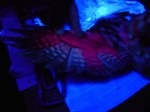
2. That pink pigment, porphyrin, fluoresces under a blacklight. We use it to determine the age of the bird. A bird born in 2018 (a hatch-year, or HY) will have uniformly colored feathers. A bird born in 2017 (a second-year, or SY) molts the inner primaries and secondaries (the large flight feathers in the middle) in one solid block. This bird has an interesting pattern. We aged her as an After Second-year (ASY) because she has a mix of feather age classes.
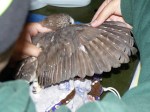
3. Here’s her wing viewed from above in normal light. I’m looking through the flight feathers to see the molt limit. If you look closely, you can see some feathers are light brown and others are darker.
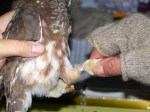
4. Here’s her band. Saw-whets have a lot of fluff all the way to the foot, so the band reveals the true size of her leg. Check out those talons!
We turn out the lights and let them readjust to darkness before release. Then it’s back to check the nets again.
Owl banding stations like this one, arranged in a network across the US and Canada, give us a sense of how the population is doing. NSWOs go through a boom-and-bust population cycle. So in some years, hundreds of birds are banded and most are HY, meaning the population structure is skewed towards juveniles. This year my station has only caught 10 birds, and only one of them has been a HY. Most are SY. What does that suggest about this population?
Multiple people with professional bird experience that I’ve spoken with believe so! One noted that a some birds get so “into the scritch” that at times they will lose their balance or cease being aware of their surroundings (as you can see in this video) but that we don’t really know why. It looks like this owl was having a super good scratch, ended up leaning a little farther back that the human was in a good position to support, lost his balance, and recovered. It’s all good and yes, actually cute.
(It’s worth noting, of course, that this is an interaction that can only occur because the person has a strong history with the owl and a lot of previously developed trust. This isn’t something you should ever consider doing with an owl you don’t know and haven’t been trained to work with.)
It looks like the raven really wants the owl to leave and is trying to intimidate it, but the owl doesn’t care because it knows the raven is all bark and no bite. Or all squawk and no peck. Erm…
Actually, it looks more like the raven is curious about the funny bird and wants to sit next to it, and the owl doesn’t wanna be friends :[ The raven’s body language isn’t aggressive at all — it’s backing down appropriately when the owl displays aggression. Notice the way it’s careful to draw back every time it gets too close to the owl. This is an animal that’s trying to establish it isn’t a threat.
Keep in mind there’s a huge intellect disparity here — ravens exhibit novel tool use and complex communication, whereas owls aren’t even as smart as ducks. We’re sort of trained to view crows and ravens as villainous, but really they’re very playful animals.
“HI YOU’RE PRETTY WANNA BE FRIENDS??”
“HISSS”
This is so cute ‘cause I can imagine the crow being the talkative, friendly one and he’s just like “hi gosh wow you’re pretty I’ve never seen a white crow before! How’d ya get your feathers so white? Do you eat a lot of marshmallows? I eat a lot of marshmallows! This human lady feeds me marshmallows–” and on and on and the owl’s probably just like “What no go away”
This is adorable
My whole childhood just got ruined by that “owls aren’t even as smart as ducks”
raptor_rehab_of_kentucky A.J., one of our educational Barn Owls, likes to supervise while we clean his mew enclosure. He is doing something called “Toe Dusting”. It is a territorial and sometimes defensive dance to make sure we know that this is his territory.
Leucism is a condition in which there is partial loss of pigmentation in an animal resulting in white, pale, or patchy coloration of the skin, hair, feathers, scales or cuticle, but not the eyes. Unlike albinism, it is caused by a reduction in multiple types of pigment, not just melanin.
Hello! I have met Luna in person and he is a beautiful boy who deserves all the love ever.
Please consider donating to thePeace River Wildlife Center, where Luna lives. They are a non-profit animal rehabilitation center with nearly two hundred permanent residents – birds and other animals who are unable to be re-released into the wild – and they admit about two thousand animal patients a year!
I’d highly recommend visiting if you find yourself in southwest Florida! There are so many good birds. So many.
Leucism is a condition in which there is partial loss of pigmentation in an animal resulting in white, pale, or patchy coloration of the skin, hair, feathers, scales or cuticle, but not the eyes. Unlike albinism, it is caused by a reduction in multiple types of pigment, not just melanin.



 BettSplendens Tumblr Evac