For the first time ever, stygiomedusa gigantea, a gigantic jellyfish was caught on video by scientists in the Gulf of Mexico. There have only been 115 sightings of this deep sea jellyfish in the past 110 years.
Cormorants are those birds that look like mini Loch Ness Monsters, the ones you see swimming in the water with just their head, neck, and a tiny bit of their back out. They stand upright when on land.
Baby birds are freaky-lookin’ things already when they aren’t baby waterbirds. These guys are just piling it on.
When wildlife photographer Kevin Ebi heard the bald eagle’s call, he knew exactly what was about to happen.
Ebi has spent years photographing wildlife in the Pacific Northwest, and he gained an extensive background on bald eagles while working on his book Year of the Eagle. But it was foxes he was hoping to photograph when he was in Washington State’s San Juan Island National Historical Park last Saturday. At this time of year, young foxes can often be seen in the region.
As the day neared late afternoon, one such young fox scampered across an open field with a rabbit, recently captured, dangling from its jaws.
Dive-bombing from above, a young eagle suddenly swooped down, wrapped its talons around the rabbit, and lifted it into the air, fox still in tow.
On the one hand, I feel kinda bad for the fox losing a meal.
On the other hand, that’s hilarious.
Am I wrong, or did the eagle call on purpose to make the fox turn around and accidentally present the rabbit as a target?
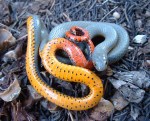
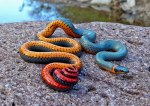
This colorful beauty is a subspecies of ringneck snake endemic to the southwestern United States and northern Mexico. They are among the larger of the ringneck snake subspecies, growing from 20 to 87 cm long. The regal ringneck snake is found in the mountains, not in the desert. The regal ringneck snake, unlike other subspecies, is almost exclusively ophiophagous, having a diet that consists primarily of other snakes. They have enlarged rear teeth and a weak venom that serves to immobilize their small prey, but is harmless to humans. Ringneck snakes are nocturnal, secretive snakes which spend most of their time hiding under rocks or other ground debris. If threatened, the ringneck snake typically hides its head and twists its tail in a corkscrew type motion, exposing its brightly colored underside, and expels a foul smelling musk from its cloaca.
In 2004, this giant Aldabra tortoise (Aldabrachelys gigantea) seems to have survived an ocean voyage from Atoll island of Aldabra to the east coast of Africa. That’s more than 740 km! The barnacles size suggests its trip took 6-7 weeks!
Despite the tortoise size, the trans-oceanic dispersal is supposed to be the mechanism where tortoises, and many other animals settle on islands around the world. This is the first direct evidence of a tortoise surviving a oceanic trip.
– Another record of a giant Aldabra tortoise off Alphonse Island, The Seychelles, December 2005. Photograph by J. Gerlach
Researchers believe that after torrential winds and hurricanes, tortoises are transported to the sea, left to its lucky. This is the classic model of oceanic island colonization. It is ironic that the first documented trans-oceanic movement of a tortoise occurred from an island to a continent, rather than the reverse direction that is so importantto island biogeography
Just a reminder: most tortoises CANNOT swim and should not be thrown into water! Try to avoid throwing turtles into water, as well. If you aren’t sure whether or not something can swim, put it next to the water and let it decide. Most tortoises will drown if you put them in deep water that they can’t wade out of in time.
Horseshoe crabs can lay between 60,000 to 120,000 eggs. These eggs are laid in the sand or mud in batches of a few thousand at a time, and take 2 weeks to hatch. Many are eaten by seabirds while incubating.
Cooperation among different species of birds is common. Some birds build their nests near those of larger, more aggressive species to deter predators, and flocks of mixed species forage for food and defend territories together in alliances that can last for years. In most cases, though, these partnerships are not between specific individuals of the other species—any bird from the other species will do.
But in a new study published in the journal Behavioral Ecology, scientists from the University of Chicago and University of Nebraska show how two different species of Australian fairy-wrens not only recognize individual birds from other species, but also form long-term partnerships that help them forage and defend their shared space as a group.
“Finding that these two species associate was not surprising, as mixed species flocks of birds are observed all over the world,” said Allison Johnson, Ph.D., a postdoctoral scholar at the University of Nebraska who conducted the study as part of her dissertation research at UChicago. “But when we realized they were sharing territories with specific individuals and responding aggressively only to unknown individuals, we knew this was really unique. It completely changed our research and we knew we had to investigate it.”





 BettSplendens Tumblr Evac