This is a tough question, and a very big question. Since it’s just about impossible to objectively explain why birds are amazing (they are, btw), maybe I can explain why birds amaze me and why they’re the focus of both my career and a significant portion of my recreational time.
1. Birds are dinosaurs that you can hold today.
Flashback to 2010, a time when little Redstart was thinking about applying to college. For a while I was convinced I would pursue animation and go be some awesome art director of nifty animated films starring animals. Then I realized that a) I wasn’t good enough or motivated enough to make it, and b) having art as a career would ruin creating art for me. So, then it was back to my other passion: paleontology.
I literally applied to college planning to be a geology/biology double major with a long-term career goal of being a professor of paleobiology. I doggedly pursued this game until my sophomore year of college, when I discovered birds.
Birds are dinosaurs. Just about everyone knows this now (thank goodness). The big, significant realization here is that you can study dinosaurs today. Think about the magnificent breadth and depth of scientific questions you can ask about an animal when it’s right in front of you, instead of turned into rock and shattered into a million fragments! Don’t get me wrong; paleontology is an awesome field. But instead of dedicating my life to recreating the world of millions of years ago, I decided to work on unraveling the mysteries of today’s dinosaurs.
2. Birds are Pokémon.
Stay with me, now! As a wee youth I was obsessed with Pokémon. Wait, I’m still obsessed with Pokémon. Well, it turns out that birding and bird banding are just about the closest thing you can get in real life to filling out the Pokédex.
Birds have the Goldilocks number of species, which makes them incredibly appealing to pursue, study, identify, and watch. Think about it! Mammals, while are certainly *~*~*charismatic*~*~*, are mostly nocturnal. There are also like 10 of them in the world (yes, that’s an undersell). Lame! Insects and other invertebrates are amazing, but there are too goddamn many for many laypeople to really get into (side note: my alternate field would probably be malacology because I love Mollusca). Fish have some good numbers and variety, but require getting into this whole aquatic sphere– a different world entirely and one that is not readily accessible to those of us who matured in NYC.
So there’s the numbers game and their incredible charisma at play here. Humans have trained their companion psittacids and cacatuids to speak, to understand; as intelligent social animals, we can feel a mysterious connection with birds in the same way that most humans feel an inherent connection with your typical charismatic megafauna, such as wolves and lions (*eyeroll*).
3. Birds are diverse.
Cassowaries are three-toed behemoths that can communicate in rumbling infrasound like elephants and kick a grown man to death. Woodcocks can see in 360 degrees without a single turn of the head. The booted racket-tail is a hummingbird about the size of a quarter with a tail three times its body length that goes torpid every night after its daily frenzy of foraging for nectar. The Chiroxiphia manakins coordinate sexual display in an incredible show of teamwork, after which only one male gets to mate. The bowerbirds build ornate structures that rival some human creations, and then dance and sing in front of them for a mate.
Albatross can maintain a pair bond for decades, and once their chicks fledge they may not touch solid ground for three years. Steller’s eiders from both North America and Russia winter together on the sea ice of the Bering Strait, where they fish for molluscs in the cold. Bar-headed geese fly over the Himalayas. Arctic terns breed as far north as the Arctic circle and winter all the way south in Antarctica, in the longest migration known to the animal kingdom. Martial eagles kill and eat small antelope by flying them up high and dropping them to the ground. Starlings and mimids can imitate hundreds of sounds. Numerous seabirds can go their entire life without a single drink of freshwater due to their advanced salt glands.
…And so on. The breadth of the bird world is absolutely incredible. With roughly 10,000 species worldwide existing on every continent (something that cannot be boasted by many other taxonomic classes), birds have evolved to occupy so many amazing niches.
4. Birds matter.
Now, this isn’t to imply that other animals don’t matter! It is incredibly vital that we keep a steady stream of funding to all biological sciences, but I must say that in my work with birds I have always felt that the research I’ve been doing plays its part in the greater scheme of things.
Birds are an easily seen indicator species; their high sensitivity can be informative about how the world at large is doing. As climate changes and anthropogenic disturbance increases, we can see bird populations shifting their range and phenology from year to year.
Since they are so prominent, birds have also been among the numerous species to face untimely extinction; take the story of the magnificent great auk, for example, which was rapidly hunted into oblivion due to its flightlessness and colonial breeding strategy. Carolina parakeet, passenger pigeon, Bachman’s warbler, ivory-billed woodpecker, Labrador duck: these are all species that used to be seen in North America that are nowhere to be found today.
And it’s through some well-timed intervention spear-headed by biologists and conservationists that we have avoided the loss of other amazing bird species. The National Audubon Society keeps an egret in their logo, a nod to the birds that were almost destroyed in the hat trade. The Atlantic Puffin was completely extirpated from the Gulf of Maine until it was successfully reintroduced on Eastern Egg Rock. And remember the shitshow that was DDT? It was birds that let us know how much of a threat that pesticide was; brown pelicans, bald eagles, peregrine falcons, osprey, and more faced steep declines thanks to the substance.
These reasons just brush the surface of why birds are amazing– and yes, why I am constantly amazed by birds even though I look at them every day in my backyard or as part of my work. We haven’t even mentioned feathers, or vocalization, their incredible physiology, or the way they have inspired artists for centuries.
Getting into birds literally changed my life; it was a turning point for my career, for my mental health, and for my outlook on this incredible world that we live in. I want others to have similar realizations about the natural world! That’s why I run this blog, and that’s why I’ll never stop birding.
ᵈᶦᵗᵗᵒ
There are twice as many bird species alive today as mammal species. And the vast majority of those 5000 mammals are either rodents (tiny things hiding in the dark, you know, like throughout the entire Mesozoic era), or bats (you know – bird wannabes).
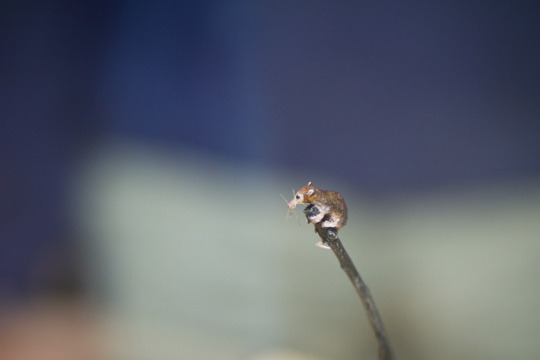
The smallest mammal that ever lived could be sitting right on your shoulder, and you’d hardly know it. Batodonoides vanhouteni (model pictured) lived about 50 million years ago in what is now Wyoming, and was so small that it could climb up a pencil. It also weighed as little as a dollar bill! Several slightly larger species of these mini-mammals lived between 55 and 42 million years ago, but they are now all extinct. Its closest living relatives are modern-day shrews and moles. Photo: randychiu
Scientists named the octopus cities Octopolis and Octlantis and I just – yes.
wow i hope they invite us to their parties
I saw a documentary about this. Climate change and habitat destruction, while bad, are forcing some octopuses to live closer together, potentially solving a problem that has kept them from being a far more dominant species. They are super smart and very capable of learning from each other but when they live alone, they never get a chance to learn from other generations because their parents leave or die. Now there’s older ones living with younger ones who can pass on knowledge.
Lol a bunch of octopuses just crawled up on a beach the other day for no discernible reason and it was like “meh, it’s 2017” and everyone kinda missed it. I found it funny as fuck and decided they were coming out here to tell us all to cut our shit out.
A Nicklin’s shoulderband snail (Helminthoglypta nickliniana anachoreta) chills with his salamander friend (a California slender salamander, Batrachoseps attenuatus) under a piece of fallen bark. Sonoma County, California, January 2017.
Fun fact: only one of these animals possesses lungs (hint: it’s not the salamander)
The nymphal stages of members of this assassin bug genus (referred to generally as “Masked Hunters”) exude a sticky substance that covers their entire body, including the antennae and legs, to which their environment (dirt, frass, plant fragments, etc) adheres to, effectively rendering them invisible. This affords them protection against predation, and allows them to function as ambush predators themselves.
In the top image, the nymph was a resident of a termite and borer infested tree stump, so carries a livery of sawdust and wood fragments. The bottom image shows another individual with a soil- and leaf litter-based coating. With the final moult into adulthood and the addition of wings for mobility, the assassin loses its cryptic capabilities and assumes a more conventional appearance.
i took a pic of me watching the pickle rick episode to piss people off but like somehow i managed to take the pic so that the frame on the tv was…. a different frame to the reflection on the desk?
cursed image
this is the most fucked up scenario that accurately depicts that movement of photons through space and time
Einstein would be so upset that you proved his theory in one moment, cause in his day it took fuckin months to setup an eclipse pic to prove relativity n you did it by accident, in ur living room. congrats.
this is actually called the rolling shutter effect!! the camera captures images in a rolling fashion, from the top to the bottom. so objects that are moving fast like a car, or a airplane propeller, or frames on a tv being reflected will always look distorted. the closer to the top of the image you get, the further back in time it represents, just by a few split seconds. all this means is that the frame reflected on the table was probably the one right after the one on the tv, and it changed before the camera’s rolling shutter had time to get to it.
here’s some more pictures with the rolling shutter; remember that the top of the image just represents a fraction of a second earlier in the action
rolling shutters also move side to side in some cameras, leading to more spooky imagery
I’ve always found the best rolling shutter images to be lightning.




 BettSplendens Tumblr Evac