There is a specific and terrifying difference between “never were” monsters and “are not anymore” monsters
“The thing that was not a deer” implies a creature which mimics a deer but imperfectly and the details which are wrong are what makes it terrifying
“The thing that was not a deer anymore” on the other hand implies a thing that USED to be a deer before it was somehow mutated, possessed, parasitically controlled or reanimated improperly and what makes THAT terrifying is the details that are still right and recognizable poking out of all the wrong and horrible malformations.
hey I totally fucked up and forgot the 3rd type, which is “Is Not Anymore And Maybe Never Was” monsters
“The thing which was no longer a deer and maybe never was” implies a creature that, at first glance, completely appears to be a deer, but over time degrades very slowly until you realize (probably too late) that it is not a deer anymore, and had you seen it in this state first, you wouldn’t have recognized it as a deer at all, and there’s a decent chance that it was never actually a deer to begin with but only a very good mimic, and what makes this one scary is the slow change from everything being right to everything being wrong, happening slowly enough that you don’t even notice it until its too late, as well as the fact that something now so clearly not a deer could have fooled you to begin with.
And the fourth type, which is, “I dunno, but it sure ain’t a deer.” Which implies complete confusion about what the creature could be, to the point that even a person as comfortable in this world as someone who would use the word ain’t unironically is uncertain, which should horrify you to the deepest depths of your soul.
one that i particularly enjoyed was the ‘nonesuch’, a beast which when you see it your brain convinces you ‘nope, no way that shit is real’. on some level it becomes less real after having been seen by someone who disbelieves its existence as well
May I propose the additional type of “that’s definitely a deer but deer are much more fucked up than previous realized”, because turning the corner on a trail and having half a dozen deer suddenly turn and look up from eating Thier companion’s remains is a special kind of spooky.
the woods are haunted, but not in the way youve been lead to believe by so many horror stories and whispered folk tales. the creatures within the trees just want to survive and see their home thrive, the trees are ancient and tired. they yearn for the gentle love of both the sun and the inhabitants of the world, outstretching their leaves to the sky in hope. when you stumble over roots and hidden paths with tears in your eyes, the ones from inside the woods are not following you to hunt you. they are not here to hurt you or kill you, instead they ache for you. they love you even from just a single glance and they know your pain. flowers spring up close to where you finally collapse, no matter what season it is. the woods is haunted, but not out to get you. it wants to heal with you.
So it turns out this is a really interesting question.
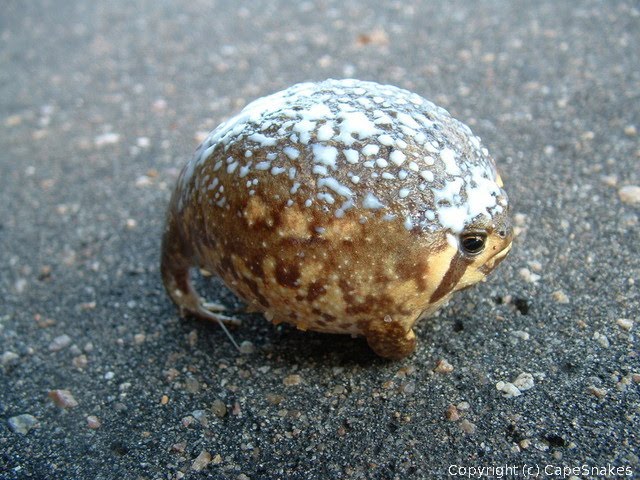
The first thing we must be aware of is that rainfrogs as we see them in videos of them squeaking are not quite the same shape as they are when at rest:
But you are quite right, they are very round. This is exemplified by the skeletal photo you refer to:
Well, firstly, note that the body cavity in these frogs actually envelops the femurs, such that only the tibiofibula (fused in frogs) and the tarsals and metatarsals are outside the body. The arms are quite similarly enveloped, but a bit of the humerus does extend outside the body cavity too. This predisposes them to a rounder body shape.
Next, note the ilia – the U-shaped bone in the pelvic region. These in some breviceptid frogs are synostotically fused with the sacrum – that is to say, they are bound by bone-based connections to the bow-shaped vertebra at their tips. This whole joint seems to be quite smooth, and as a consequence, the back of the frog is quite smooth. The other thing we can see here is that the urostyle (i.e. the frog version of a coccyx) juts quite far beyond the ischium and pubis. This extends the body cavity beyond the hips. Note also that the pelvic girdle seems to be largely below the spine, rather than the typical position for frogs behind it and continuous with it. This makes the legs sit below the spine, rather than at its end, enhnacing the vertical roundness of the animal.
Next, let’s talk some soft tissue. Now, I’m not as familiar with soft-tissue in frogs as I am their skeletons, so you’ll have to bear with me a bit (rawr). Beddard (1908!!) studied the soft tissue of Breviceps verrucosus Rapp 1842. It seems that the majority of the body of these frogs is actually muscle. Beddard noted that muscles join the leg at the knee that extend into the body cavity, such that the inclusion of the thigh in the body cavity is further accentuated by musculature. The rectus abdominalis muscle is unusually large, extending from the lower abdomen up and around the sides of the body. Indeed, this large size appears to be the pattern with all of the major muscles, though in the throat the typical arrangement of large and small muscles is somewhat reversed. On the lateral side of the head, there is a substance that is not muscle, but appears to be loose tissue in which sits what is apparently the thymus gland.
There is a very large gap between the end of the urostyle and the anus (one fifth of the total length of the frog), in which there are almost no muscles, save for the one surrounding the lower cloaca. On either side of this area, between the posterior-most muscles of the thigh, lie two large ‘lymph-hearts’, as described by Beddard. These are between one quarter and one third of the total length of the frog. A further lypmh-sac sits between these lymph-hearts and the skin of the femoral region, and they are thus probably analogous to the femoral lymph-sacs of other frogs.
I find it interesting that Beddard (1908) did not mention any glandular formations in the dorsal region. As is evidence from many images (see below), these frogs are able to secrete a white, sticky, noxious substance from their skin (which they actually have to use during amplexus, as the male is too small relative to the female to mount her properly, and so he sticks himself to her with his glandular glue… kinky).
These glands do not apparently take up a great deal of the cutaneous tissue, and so I suppose are of no consequence to the size of the frog, especially relative to its enormous muscles.
The diet of these frogs consists almost exclusively of hymenopterans and isopterans (ants and termites). Neither of these insect groups are particularly fatty, so it is little surprise that their bodies appear to contain no large fat deposits – fatty bodies extend from the gonads up to the lungs and heart, but these comprise only a tiny fraction of the frog’s mass, and don’t contribute to the round shape. Instead, their bodies are extremely muscular, allowing them to be adept burrowers, ideal for their fossorial lifestyle.
So TL;DR: rain frogs are little balls of muscle (maybe the largest muscle mass relative to body mass of any vertebrate? science just doesn’t know).
Ref:
Beddard, F.E. 1908. On the Musculature and other Points in the Anatomy of the Engystomatid Frog, Breviceps verrucosus. Proceedings of the Zoological Society of London, 1908:11-41 [x]
This also shows something interesting about frogs; they don’t really have ribs. They have little outcroppings to their vertebrae. I assume this is because they’d shatter their ribs every time they jumped if they had any, with how they land. It’s not just rain frogs, it’s frogs in general.
I love animals that are, like, the opposite of cryptids: we know for a fact they exist and have a clear idea of what they look like because we have photographs and individual specimens, but we haven’t the faintest idea where they’re coming from – they just keep showing up out of nowhere, and the locations of their actual population centres are a complete mystery.
I so want examples. anyone who knows of any should post them in notes
You know, like giant squid and such. We know the bastards exist, we have credible first-hand accounts stretching back thousands of years and dead specimens washed up on shore and such, but in centuries of searching we’ve managed exactly one well-documented encounter with a giant squid in its natural habitat. We have no idea what their native range is or what their life-cycle looks like, let alone how many of them are out there.
Are there any reverse-cryptids that /aren’t/ at the bottom of the ocean?
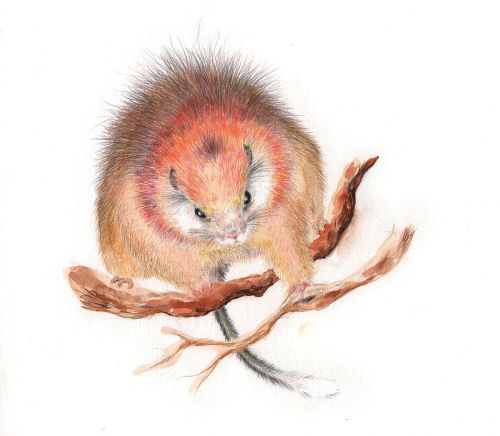
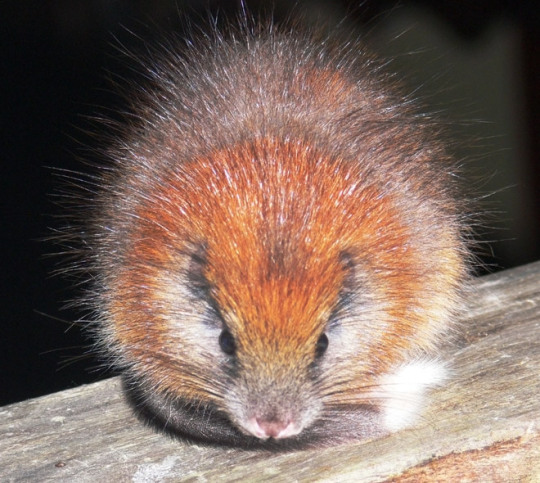
The red-crested tree rat, for one. There have been only three well-documented encounters since 1898, and they just plain disappeared from the zoological record for over a century. The only reason we know they’re not extinct is that one walked right up to a couple of wildlife research interns at a Columbian nature reserve back in 2011, apparently out of pure curiosity, and allowed itself to be photographed and observed for several minutes before disappearing again.
That’s genuinely pretty cool and all, but I absolutely need to talk about how the picture in that Wikipedia article looks like a tiny eldritch horror disguising itself as a peach.
To be fair, based on the actual photos from the 2011 encounter, they really do look like that:
That cat was certainly an oddball, and I don’t know what went wrong in hi head or with his nerves or both, but he hated his own tail.
He was an indoor cat, so when he presented for a cat bite abscess on his tail it was a bit suspicious, but he did live with another feline friend so it wasn’t impossible, even though the owner had never seen them fight.
So we treated the abscess. And that was fine.
But then he got another abscess on his tail.
This was a bit suspicious, so he was admitted to treat it surgically. He was placed in a hospital cage while he was waiting his turn.
There is something unique about the sounds of a cat fight, and when that cacophony of noise erupted from the kennel room, we all rushed in to see how the hell two cats had got access to each other.
Instead, we found this cat, on his own, backed into a corner of the cage throwing an evil look at his own tail, which was twitching in irritation as cats’ tails tend to do.
We watched as he growled, hissed, spat and then launched at his own tail, and screamed after he’d bitten himself again.
The cat was giving himself cat bite abscesses from repeatedly attacking his own tail.
In the end, we couldn’t curb this behavior even with medication, it was like he didn’t recognise the tail as his own, and he ended up having it amputated for welfare reasons. With only a stump of a tail remaining (too short to flick in his peripheral vision), he went on to live a normal life.
I don’t know if the cat had altered neurological sensation in his tail, or some sort of Body Integrity Identity Disorder, but he is one of the most unusual cases I’d ever seen.
Always incredible to witness something like this. Shoutout to everyone that pulled an all nighter to see this. Captured just outside of Wichita, Kansas.
It’s a trapdoor spider! They have a network of webbing along the ground around their tunnel, and they keep their feets on it so they can feel if something is nearby. If a bug is unlucky enough to come within grabbing range, they pop out and snag it, then duck back into their door.




 BettSplendens Tumblr Evac