cool-critters:

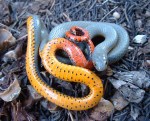
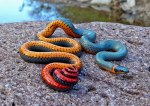
Regal ringneck snake (Diadophis punctatus regalis)

This colorful beauty is a subspecies of ringneck snake endemic to the southwestern United States and northern Mexico. They are among the larger of the ringneck snake subspecies, growing from 20 to 87 cm long. The regal ringneck snake is found in the mountains, not in the desert. The regal ringneck snake, unlike other subspecies, is almost exclusively ophiophagous, having a diet that consists primarily of other snakes. They have enlarged rear teeth and a weak venom that serves to immobilize their small prey, but is harmless to humans. Ringneck snakes are nocturnal, secretive snakes which spend most of their time hiding under rocks or other ground debris. If threatened, the ringneck snake typically hides its head and twists its tail in a corkscrew type motion, exposing its brightly colored underside, and expels a foul smelling musk from its cloaca.

photo credits: imexcursions, imgur

“I am POISON do not eat” 

dooblermain:

starkrevolution:

ruffaled:

rdjay:

one-piece-of-harry:

stanleyraymondkowalski:

antifasteve:

tony: i dont go down on women but i expect them to suck my dick and thats how KINGS live

thor a feminist:

this is fake news don’t EVER disrespect pepper like this

Didn’t he, like, canonically get pegged by gamora too lmaooooooo

Yes

Wait this was pegging? I HAD NO IDEA LIKE I WAS SO INTO THIS TONY GAMORA PANEL ALREADY AND NOW IT IS LIKE 5000000000000000 TIMES BETTER. AJSKALAKKAKAA.

I saw this and went: “Hang on now… I remember reading that. I did NOT think they were pegging.” Then I dug it out and had a closer look:

Panel two, bottom left corner — that is definitely a strap-on harness. This whole thing makes so much more sense now. I cannot believe I didn’t see that before.

Damn Gamora. Fierce.

That’s my fucking boy

What do you get when you combine two teens, two pre-teens, two boxes of large glowsticks, a nighttime backyard, and a dad with an expensive camera that can do extremely long exposure times?

This. 

Started out as glowstick waving and lightsaber fights, 

Devolved into glowstick-throwing fight, 

Then (thanks to brother managing to deflect glowsticks with his arms and me getting an idea) into throwing glowsticks for someone with a lightsaber to try and deflect, 

Then finally into a lightsaber fight while being pelted with glowsticks. 

Lemme tell ya, a glowstick that’s five inches long and half an inch wide makes a very loud sound when it bounces off the bicycle helmet you’re wearing. 

Today I learned that I can throw marginally better than my brothers can. This is still not well, none of us are athletic. I can do a less-than-terrible job of deflecting glowsticks, too, and I suspect we all could have done better if we’d been better at aiming the glowsticks actually at each other. 

[Images: various squiggles of colorful light against a dark outdoor area, caused by rapidly moving glowsticks and glowing toy lightsabers. Vague, transparent shades of moving people are visible in some.]

deadmutt:

roboticfennec:

lesbeonn:

gripthumb:

cool

RAT TRAIL

RatChain RatChain RatChain RatChain RatChain RatChain RatChain RatChain

These are actually shrews!! They all hold onto the base of each other’s tails and travel in a line so they don’t get lost from their mother while out in the open! ((What makes it even better; these little groups are referred to as caravans!))

cool-critters:

Sri Lankan junglefowl (Gallus lafayettii)

The Sri Lankan junglefowl is a member of the Galliformes bird order which is endemic to Sri Lanka, where it is the national bird. It is closely related to the red junglefowl (G. gallus), the wild junglefowl from which the chicken was domesticated. As with other junglefowl, the Sri Lankan junglefowl is strongly sexually dimorphic: the male is much larger than the female, with more vivid plumage and a highly exaggerated wattle and comb. As with other jungle fowls, Sri Lankan jungle fowls are priliminary
aTerrestrial animal. It spends most of its time foraging for food by
scratching the ground for various seeds, fallen fruit and insects.It is common in forests and scrub habitats, and is commonly spotted at sites such as Kitulgala, Yala and Sinharaja.

photo credits: Steve Garvie, Schnobby