1. When eurasian nomads first started making pants in the first millenium BC, they didn’t cut the cloth to shape, they wove the shapes they needed on the loom. Mostly rectangles, but still interesting.
2. Pants were a very elaborate garment at the time! When humans first started weaving and wearing cloth, clothes were pretty much “giant rectangle that you wrap around your body and sometimes a belt”. Then, people started making tunics and tunic derivatives, which is basically another rectangle, but this time with a hole for your head and sometimes sewn up the side. Now you have TWO pieces of clothes: the rectangle with a hole, and the bigger wrappy rectangle. This covers like 90% of ancient clothes, including the Roman toga and tunica. So pants, which covered your legs individually, were very ???? to ancient mediterranean people.
3. Otzi, an austrian guy who lived ~3300 BC, was found frozen in the Alps, wearing “pants”, consisting of two individual leg-sleeves made of animal skins with the fur inwards, and a loincloth. The legs of the “pants” tied on to a belt.
4. This is a similar setup to European medieval hose, except that hose didn’t have fur, and also had footies. Also, the whole separate-legged pants things is why our modern word ‘pants’ is plural, even though today it’s one garment.
5. Pants enabled a big leap in military technology- chariots to cavalry. Pants means you can ride a horse and still have your genitals intact afterwards. Turns out, sticking people on top of horses is much more effective than having the horses drag the people around behind them.
6. In like ~300 BC, the Chinese were having massive amounts of trouble with the pants-wearing, cavalry-having Eurasian nomads. Then, some guy had the brilliant idea of making everyone wear pants instead of robes, and proceeded to drive back the nomads and unite China.
7. The Romans and Greeks considered pants to be barbaric and feminine. But having muscular legs was very masculine. Some men were known for wearing ridiculously short tunics to show off their thighs. Marc Antony once mooned everyone by accident because he was wearing a miniskirt and no pants. Very manly.
8. Peter the Great decided that Russia had to be more like the rest of Europe, so he implemented some really strict policies, including a beard tax and mandatory pants. Yes, you could be punished if you didn’t wear pants.
9. The fashion designer Yves Saint Laurent was a major factor in making it acceptable for women to wear pants in public, which wasn’t really a culturally accepted thing until almost the end of the 60′s. In 1966, he debuted on the runway the first women’s tuxedo, which was met with a very ‘meh’ critical reception at the time, but is now considered one of fashion’s most influential works.
10. In the UK, ‘pants’ specifically refers to underpants.
bonus fact: it’s really not that hard to put pockets on pants, but so many designers seem incapable of figuring it out.
@scifigrl47 There are rules about pants. Rules that do not involve tying two tubes to your belt and hoping for the best.
And now there needs to be fic about people posting “FUN FACTS ABOUT PANTS” all over the tower in an effort to get DJ to care about pants.
It is a wasted effort, but everyone learns neat things about historical fashion!
oh that makes more sense ! still have no idea since i havent worked with them lmao but @neofeliis and @whitejenna know better than i tbh 🙂
This popped on my dash while I was sitting at a table full of lifelong cat keepers, so I polled the table. 🙂 How big cats respond to eye contact differs by species, by the body language involved, and by the individual.
We’ve talked about soft affiliative eye contact vs a hard stare with a number of other species on the blog before, and the rules for that generally still hold true. Soft eye contact or just looking at an animal’s eyes casually isn’t normally confrontational, but a hard or prolonged stare is rude at best and can be aggressive.
In general, they said, lions are much more sensitive to the type of eye contact and how you’re approaching them – especially male lions. The joke at the table was that it’s like the Godfather: you’re okay if you’re respectful about it, but you better come bearing gifts.
Tigers are much more variable than lions (and the people I spoke to said they wanted me to clarify they’re mostly talking about hand-raised tigers – they haven’t had a lot of experience with mother-raised tigers). Sometimes they can be super down for prolonged eye-contact, but a hard stare can and often well piss them off.
Leopards, jaguars and snow leopards basically interpret any eye contact as the fact that they’re visible – which is not their preferred operating state. Leopards and jaguars tend to not be stressed by a prolonged stare very much, but snow leopards will generally find it much more invasive. Everyone cautioned that forcing a hard stare with any of these generally invisible ambush predators is a great way to lose a couple chunks of flesh. EDIT: Not that doing a hard stare with a lion or a tiger won’t also be aggressive and potentially a provocation, but there was emphasis that the other species really don’t like it.
When asked, Ms. Frizzle denies that she “knows everything”
However, Ms. Frizzle always knows what her students are up to, knows the answer to every question they ask her, and never shows fear even when in extreme mortal peril, as if she’s experienced this all before
Although we know she was in a rock band called the Frizzlettes and was a Shakespearean actress, Ms. Frizzle’s childhood remains mysterious
Ms. Frizzle is EXACTLY the sort of person to travel back in time to teach herself, and is in fact the most likely fictional character to do so
Nobody is ever named “Valerie Frizzle” at birth
Ms. Frizzle dresses queerly and laughs at her own bad jokes
A lot of the series is about Arnold learning to take chances, make mistakes, and get messy – that phrase is more or less targeted at him as a student
Ms. Frizzle looks a lot like a grown-up Arnold
Holy shit???????
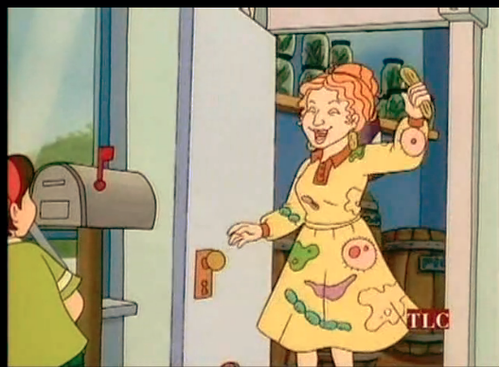
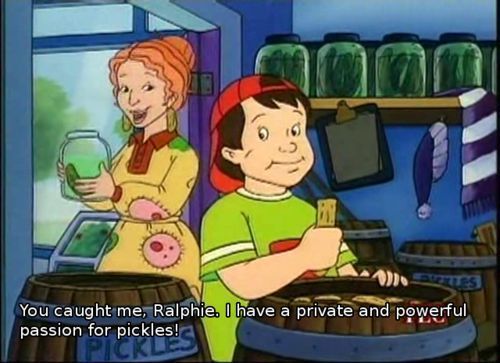
She literally has a giant storeroom full of barrels of pickles because she loves pickles so much what more evidence do you need
What relation do pickles have with the transgender community?
One of the medications used in hormone therapy for trans women (spironolactone, which counteracts testosterone) has the side effect of, putting it crudely, making you have to pee all the goddamn time. That causes dehydration and loss of electrolytes.
Pickles and pickle juice turn out to be a fairly convenient and flavorful way of satisfying an electrolyte craving. Those who’ve been on spiro a long time can develop a nigh-spiritual bond with ‘em.
dope
holy FUCK i knew ms. frizzle wasn’t straight but i never THOUGHT to consider that she wasn’t cis how could i be so BLIND
Octopuses are reclusive animals, and the gloomy octopus (Octopus tetricus) is no exception.
During the day, it retreats into its den in the rocky reefs of Australia, which it often blocks with rocks. It comes out most often at night, to catch lobsters, crabs, and other creatures with its meter-long arms. But in 2012, researchers reported that the species is surprisingly social. Diving in Jervis Bay, Australia, the scientists documented as many as 16 gloomy octopuses all living in a large pile of discarded shells—dubbed Octopolis—mating and fighting, even during the daytime…
A team of scientists recorded the cries of 60 newborns: 30 born into French-speaking families and 30 that heard German. And they found that French infants wail on a rising note [baby cry sound] while the Germans favor a falling melody [baby cry sound]. Those patterns match the rhythms of their native languages.
I was at Adeevka where the Ukrainians are trying to take a strategically-located overpass from the Separs (I was there as a peaceful tourist who never even touched a firearm, of course) and the positions there are about 400 or so meters away from each other, so if you scream loud enough the fucks on the other side can actually hear you.
Up to this point, I’d observed a guy dropping his phone like it was going to bite him when I told him the Bruno Mars song he was playing was gay, and could reliably make people leave the room by asking them “would you rather sit on a chocolate cake and suck a dick, or eat a chocolate cake while getting fucked in the ass”, so it’s at this point in the trenches that a flash of inspiration hits me.
In my best Russian (which was utterly broken but “proper” Russian grammar is barbaric caveman-speak anyway) I scream out “next guy that shoots is gay”. And I swear to whatever god exists that two solid minutes of silence followed. It was some guns-fall-silent Christmas miracle shit
i keep thinking about that tribe of baboons where all the alpha males died from eating poison garbage and then the baby boy monkeys were taken care of by the lady monkeys and never got socialized to be aggressive so they all just live peacefully and groom eachother instead of fighting and killing eachother and its been generations of that, it only took 1 wipeout of the aggressive males to change the whole social order of the species i am crying they must be so much happier
At the height of the Greek crash in 2011, staff at Viome clocked in to confront an existential quandary. The owners of their parent company had gone bust and abandoned the site, in the second city of Thessaloniki. From here, the script practically wrote itself: their plant, which manufactured chemicals for the construction industry, would be shut. There would be immediate layoffs, and dozens of families would be plunged into poverty. And seeing as Greece was in the midst of the greatest economic depression ever seen in the EU, the workers’ chances of getting another job were close to nil.
So they decided to occupy their own plant. Not only that, they turned it upside down. A bunch of middle-aged men and women who have spent their entire careers on the wrong end of barked orders about what to do and when to do it have seized ownership of their own workplace and their own working lives. They became their own bosses. And they immediately align themselves to principles of the purest equality possible.
“Before, I was doing only one thing and had no idea what the others were doing,” is how Dimitris Koumatsioulis remembers the factory when he started in 2004. And now? “We’re all united. We have forgotten the concept of ‘I’ and can function collectively as ‘we’.”
The other massive change that has taken place is between the factory and its neighbours. When the workers “recuperated” their workplace (to use the local term), they could only do so with the help of Thessaloniki locals. Whenever representatives of the former owners came to requisition their equipment, as a court had given them permission to do, hundreds of residents would form a human chain in front of the plant (I contacted lawyers for Viome for comment but, despite assurances, no statement was forthcoming).
When the workers consulted the local community about what they should start to produce, one request was to stop making building chemicals. They now largely manufacture soap and eco-friendly household detergents: cleaner, greener and easier on their neighbours’ noses.
Staff use the building as an assembly point for local refugees, and I saw the offices being turned over to medics for a weekly free neighbourhood clinic for workers and locals. The Greek healthcare system has been shredded by spending cuts, its handling of refugees sometimes atrocious; yet in both cases, the workers at Viome are doing their best to offer substitutes.
Where the state has collapsed, the market has come up short and the boss class has literally fled, these 26 workers are attempting to fill the gaps. These are people who have been failed by capitalism; now they reject capitalism itself as a failure.
Chakrabortty is on a whole other level to anyone else the Guardian has writing for it tbh
 BettSplendens Tumblr Evac