Aaahhhhhhh Belostomatidae!!! Also known as a Giant Water Bug, this is a family of very large (in size) aquatic hemipterans (true bugs). They are also predatory and are sometimes called “toe-biters.” They eat other aquatic insects, but also amphibians, fish, and some birds. And, yes, that’s right, they fly.
I have not been so blessed to meet a living one, but I did encounter them in a somewhat unexpected place:
They are good eatings, if you’re into that sort of thing! And look at how EXPENSIVE!
November 20, 2018
These guys aren’t technically dangerous, but have (supposedly, I have not personally tested this) the most painful bite of any North American insect, thanks to the digestive acid they can inject. It won’t cause you any harm, but it’s gonna hurt like heck if one gets you. They usually live in slow-moving, murky water with a lot of plants, which isn’t great to wade in anyway because there’s leeches, and they aren’t aggressive. They’ll just bite you if you step on one or put your toe right in front of a big one. Hence the name!
Also, they fly, and they’re attracted to lights. They can wind up pretty far away from water as adults.
If you have a very tight-fitting lid and the patience to wiggle their food in front of them on tweezers every couple of days, they make good pets! Just… in their own tanks. I had some for a little while, and can confirm that not even heavily-armored diving beetles are safe. And I just had a couple of babies!
Also, they are guaranteed to impress just about anyone you show them to. Who doesn’t run away first.
with some bugs it really does feel less like the larval stage is the ‘baby’ stage and more like its the ‘normal’ stage and the bug’s final form is just their extra special final form they use to fuck
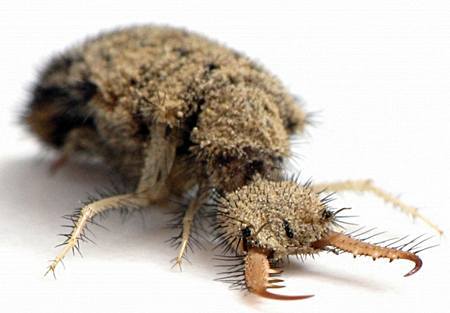
I was actually distraught as a child when I found out that an antlion was “just” a “larva” to something else but later I learned that they spend two to three entire years that way and the adult only lives for a couple of months.
Butterflies are also shorter lived than caterpillars; we can think of them more as the caterpillar dispersal system.
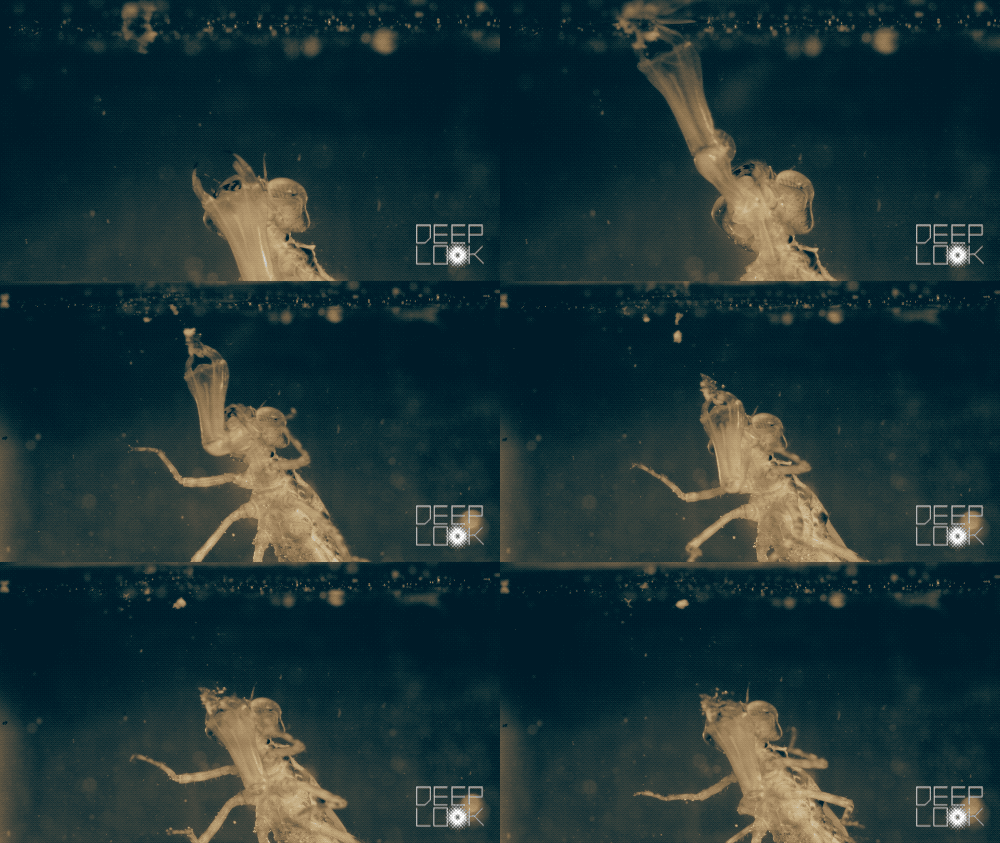
We also always hear about how “mayflies only live a few days” but that ignores the fact that they, too, spend years as aquatic nymphs.
same for dobsonflies, which live for maybe a week as adults, but for years as enormous highly predatory aquatic larvae called hellgrammites.
except with dobsonflies, all forms feel a bit extra. If they were pokemon they would be some late generation multi-form legendary
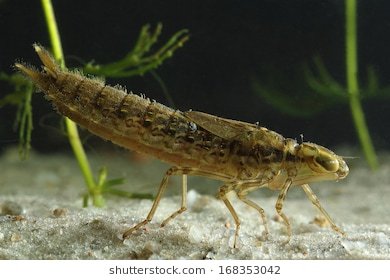
Pretty, graceful adult dragonflies live only for like seven months, but beforehand they spend five years as this
aquatic predatory incarnation of bullshit, which hunts other aquatic insects and even small fish with its big fucking xenomorph mouthparts.
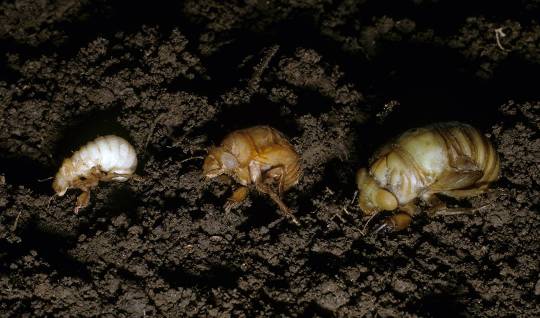
not to make a long thread longer but i think the ultimate manifestation of powered up final fuck form is 17 year periodical cicadas
like they arent just hibernating or something, they spend the length of a human adolescence as these nymphs living underground and feeding on fluids from roots. and after 17 years their population group emerges in eerie synchronization and they all molt into their adult stage, which only survives for a few weeks . like 99.5% of their life is spent in their “baby” stage and the final .05% of it is a powered up flight capable adult form that exists solely to scream and fuck
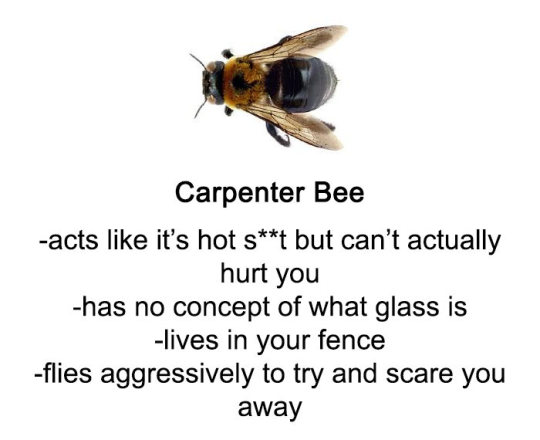
I’ve been stung by a carpenter bee. They’re usually pretty chill.
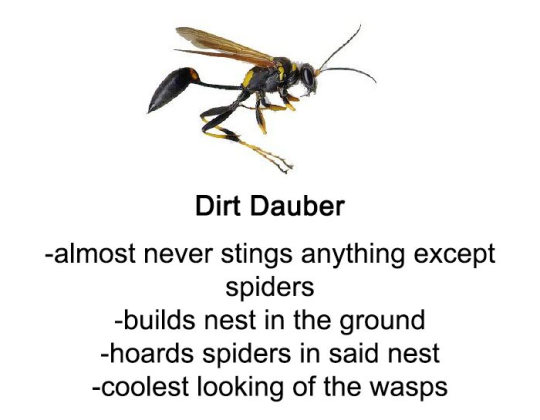
And dirt daubers are bros.
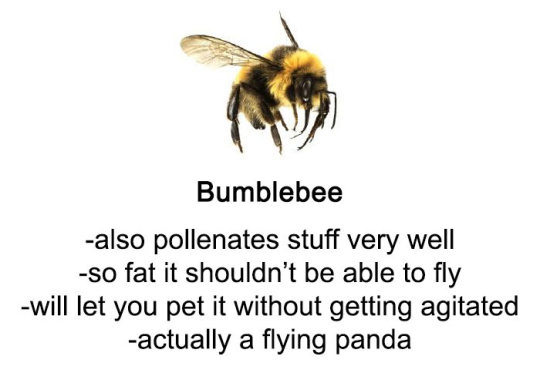
It’s true you can pet Bumblebees
you can pet any of them if ur not a coward!!
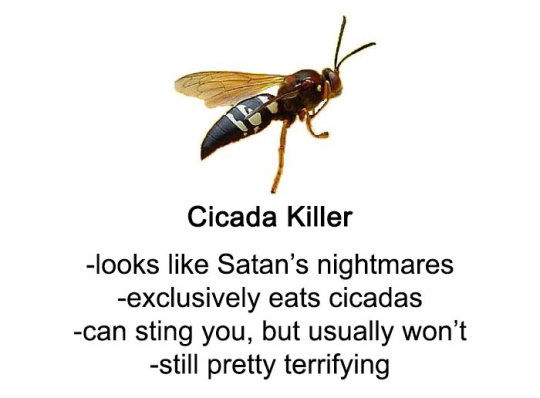
My rational mind knows that cicada killers aren’t a threat but when they appear they legit terrify me until I remember that.
They are a burrowing breed so they do tend to appear out of nowhere. They’re just curious when they fly towards you tho. You’re in their territory and they wanna make sure you’re not a wasp
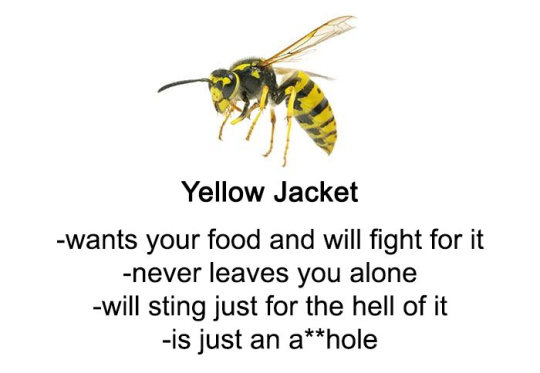
At a place that I go a lot me and my friends have to hide from fucking yellow jackets because THEY WILL COME AFTER ALL FOOD!
Man you just gotta be chill about them (note: i love yellowjacks so this is slightly biased)
But like you leave em a nice little sugar offering off to the side and dont jump too much when they land on you, and you dont let yourself get scared, and they really dont just attack if they can avoid it
The worst time i ever had with one was the time i had candy goo on my hands and it bit me thinking I was food. Nothing worse ever happened to me.
Although bees can smell fear, and it apparently causes them to attack, so that might be my own little ability to get along with em right there: I’m usually tol fascinated to be scared.
If you see those lil heaps of mud tubes on a wall with holes sometimes in one end, those are mud dauber nests. They build the tubes of mud, stuff caterpillars inside, lay an egg, and leave. Grubs hatch from eggs, eat caterpillars, grow up, and tunnel out.
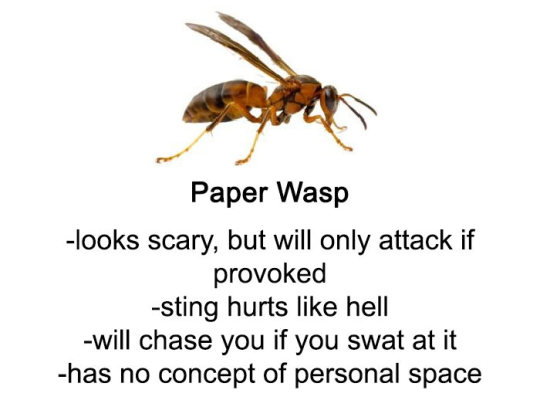
Paper wasps are the ones that build the paper-honeycomb nests where you can see all the tubes. The guy who invented paper got the idea from them. They’re pretty chill around humans as long as none of the humans nearby have done anything to them. If you see one starting to build a nest where you don’t want one, wait ‘till it leaves and remove the nest.
Termites are just cockroaches with a fancy social life
Reordering demotes one infamous insect group to being a mere branch of an equally infamous one
BY SUSAN MILIUS
Termites are the new cockroach… Literally.
The Entomological Society of America is updating its master list of insect names to reflect decades of genetic and other evidence that termites belong in the cockroach order, called Blattodea.
As of February 15, “it’s official that termites no longer have their own order,” says Mike Merchant of Texas A&M University in College Station, chair of the organization’s common names committee. Now all termites on the list are being recategorized.
The demotion brings to mind Pluto getting kicked off the roster of planets, says termite biologist Paul Eggleton of the Natural History Museum in London. He does not, however, expect a galactic outpouring of heartbreak and protest over the termite downgrade. Among specialists, discussions of termites as a form of roaches go back at least to 1934, when researchers reported that several groups of microbes that digest wood in termite guts live in some wood-eating cockroaches too.
Once biologists figured out how to use DNA to work out genealogical relationships, evidence began to grow that termites had evolved as a branch on the many-limbed family tree of cockroaches…
Thrips are tiny
insects, typically just a millimetre in length. Some are barely half
that size. If that’s how big the adults are, imagine how small a thrips’
egg must be. Now, consider that there are insects that lay their eggs inside the egg of a thrips.
That’s one of them in the image above – the wasp, Megaphragma mymaripenne. It’s pictured next to a Paramecium and an amoeba at the same scale.
Even though both these creatures are made up of a single cell, the wasp
– complete with eyes, brain, wings, muscles, guts and genitals – is
actually smaller. At just 200 micrometres (a fifth of a
millimetre), this wasp is the third smallest insect alive* and a miracle
of miniaturisation.
The wasp has several adaptations for life
at such a small scale. But the most impressive one of all has just been
discovered by Alexey Polilov from Lomonosov Moscow State University,
who has spent many years studying the world’s tiniest insects.
Polilov found that M.mymaripenne has one of the smallest
nervous systems of any insect, consisting of just 7,400 neurons. For
comparison, the common housefly has 340,000 and the honeybee has
850,000. And yet, with a hundred times fewer neurons, the wasp can fly,
search for food, and find the right places to lay its eggs.
On top of that Polilov found that over 95 per cent of the wasps’s
neurons don’t have a nucleus. The nucleus is the command centre of a
cell, the structure that sits in the middle and hoards a precious cache
of DNA. Without it, the neurons shouldn’t be able to replenish their
vital supply of proteins. They shouldn’t work. Until now, intact neurons
without a nucleus have never been described in the wild.
And yet, M.mymaripenne has thousands of them. As it changes
from a larva into an adult, it destroys the majority or its neural
nuclei until just a few hundred are left. The rest burst apart, saving
space inside the adult’s crowded head. But the wasp doesn’t seem to
suffer for this loss. As an adult, it lives for around five days, which
is actually longer than many other bigger wasps. As Zen Faulkes writes,
“It’s possible that the adult life span is short enough that the
nucleus can make all the proteins the neuron needs to function for five
days during the pupal stage.”
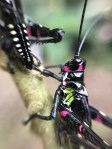
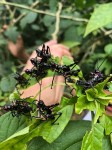
No idea what kind of bug these nymphs turn into but I do know that they made a beautiful display that I was not about to mess with. #arthropods #hemiptera #nymphs #insects #insectsofinstagram #arthropodsanonymous #CostaRica #CentralAmerica #rainforest #jungle #biodiversity #forest #ecology #evolution #bugs #truebugs #insectagram #gang #nature #travel #critters






 BettSplendens Tumblr Evac