Okay, seeing that there are no sources given here, I will add some. I am not an expert on ghandi, but here are some articels and books to give you an opinion about him:
Books: Sex and Power by Rita Banerji, On Pacifism by Derrick Jensen, The Collected Works of Mahatma Gandhi
People, if we discuss historical figures, let’s not throw our arguments unsourced around.
Ghandi had a magnificent impact on India and was undoubtedly important for the country. Without him, India might have not been freed of british rule and that colonialism is not good I don’t think I have to explain.
So, yes, Ghandi did great things and was/is important, but we should at the same time keep in mind that he was a deeply flawed person, not a Saint.
And to those who say, that we can’t judge a historical Person by modern Standards: even by the Standards of Ghandi’s time some of his actions went way too far and shocked his supporters, for example when he slept besides naked young women. That was not normal then and it is not normal now, so, yeah, we have a point by saying that Ghandi was flawed.
Also the thing is he’s not even special in terms of not having possessions? He has twice as many worldly possessions as every Digambara Jain monk? Digambara monks don’t even wear clothes?
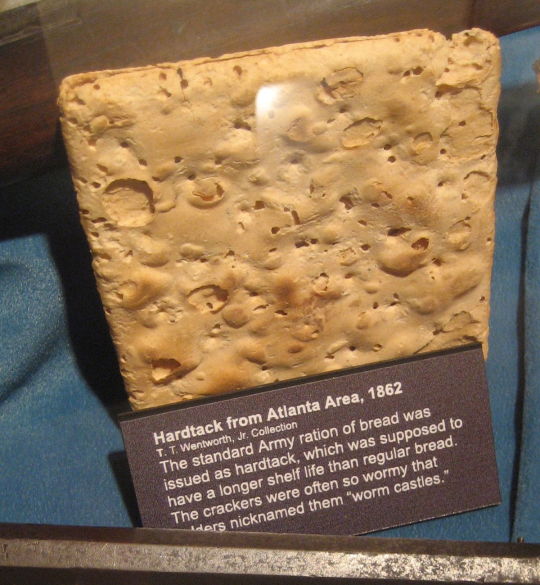
an edible cracker with just one side. mathematically impossible and yet here I am monching on it.
‘scuit’ comes from the french word for ‘bake’, ‘cuire’ as bastardized by adoption by the brittish and a few hundred years
‘biscuit’ meant ‘twice-baked’, originally meaning items like hardtack which were double baked to dry them as a preservative measure long before things like sugar and butter were introduced. if you see a historical doccument use the word ‘biscuit’ do not be fooled to think ‘being a pirate mustve been pretty cool, they ate nothing but cookies’ – they were made of misery to last long enough to be used in museum displays or as paving stones
‘triscuit’ is toasted after the normal biscuit process, thrice baked
thus the monoscuit is a cookie thats soft and chewy because it was only baked once, not twice
behold the monoscuit/scuit
Why is this called a biscuit:
when brittish colonists settled in the americas they no longer had to preserve biscuits for storage or sea voyages so instead baked them once and left them soft, often with buttermilk or whey to convert cheap staples/byproducts into filling items to bulk out the meal to make a small amount of greasy meat feed a whole family. considering hardtack biscuits were typically eaten by dipping them in grease or gravy untill they became soft enough to eat without breaking a tooth this was a pretty short leap of ‘just dont make them rock hard if im not baking for the army’ but didnt drop the name because its been used for centuries and people forgot its french for ‘twice baked’ back in the tudor era, biscuit was just a lump of cooked dough that wasnt leavened bread as far as they cared
thus the buttermilk biscuit and the hardtack biscuit existed at the same time. ‘cookies’ then came to america via german and dutch immigrants as tiny cakes made with butter, sugar/molasses, and eggs before ‘tea biscuits’ as england knew them due to the new availability of cheap sugar- which is why ‘biscuit’ and ‘cookie’ are separate items in america but the same item in the UK
the evolution of the biscuit has forks on its family tree
I love it when a shitpost turns into an actually interesting post.
Female figurine from the Hohle Fels cave near Stuttgart, about 35,000 years old. Interpreted as a pornographic pin-up.
“The Earliest Pornography” says Science Now, describing the 35,000 year old ivory figurine that’s been dug up in a cave near Stuttgart. The tiny statuette is of a female with exaggerated breasts and vulva. According to Paul Mellars, one of the archaeologist twits who commented on the find for Nature, this makes the figurine “pornographic.” Nature is even titling its article, “Prehistoric Pin Up.” It’s the Venus of Willendorf double standard all over again. Ancient figures of naked pregnant women are interpreted by smirking male archaeologists as pornography, while equally sexualized images of men are assumed to depict gods or shamans. Or even hunters or warriors. Funny, huh?
Consider: phallic images from the Paleolithic are at least 28,000 years old. Neolithic cultures all over the world seemed to have a thing for sculptures with enormous erect phalluses. Ancient civilizations were awash in images of male genitalia, from the Indian lingam to the Egyptian benben to the Greek herm. The Romans even painted phalluses on their doors and wore phallic charms around their necks.
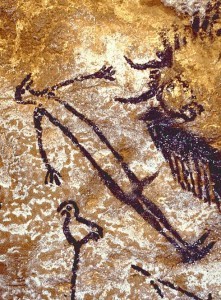
Ithyphallic figure from Lascaux, about 17,000 years old. Interpreted as a shaman.
But nobody ever interprets this ancient phallic imagery as pornography. Instead, it’s understood to indicate reverence for male sexual potency. No one, for example, has ever suggested that the Lascaux cave dude was a pin-up; he’s assumed to be a shaman. The ithyphallic figurines from the Neolithic — and there are many — are interpreted as gods. And everyone knows that the phalluses of ancient India and Egypt and Greece and Rome represented awesome divine powers of fertility and protection. Yet an ancient figurine of a nude woman — a life-giving woman, with her vulva ready to bring forth a new human being, and her milk-filled breasts ready to nourish that being — is interpreted as pornography. Just something for a man to whack off to. It’s not as if there’s no other context in which to interpret the figure. After all, the European Paleolithic is chock full of pregnant-looking female statuettes that are quite similar to this one. By the time we get to the Neolithic, the naked pregnant female is enthroned with lions at her feet, and it’s clear that people are worshipping some kind of female god.
Yet in the Science Now article, the archaeologist who found the figurine is talking about pornographic pin-ups: “I showed it to a male colleague, and his response was, ‘Nothing’s changed in 40,000 years.’” That sentence needs to be bronzed and hung up on a plaque somewhere, because you couldn’t ask for a better demonstration of the classic fallacy of reading the present into the past. The archaeologist assumes the artist who created the figurine was male; why? He assumes the motive was lust; why? Because that’s all he knows. To his mind, the image of a naked woman with big breasts and exposed vulva can only mean one thing: porn! Porn made by men, for men! And so he assumes, without questioning his assumptions, that the image must have meant the same thing 35,000 years ago. No other mental categories for “naked woman” are available to him. His mind is a closed box. This has been the central flaw of anthropology for as long there’s been anthropology. And even before: the English invaders of North America thought the Iroquois chiefs had concubines who accompanied them everywhere, because they had no other mental categories to account for well-dressed, important-looking women sitting in a council house. It’s the same fallacy that bedevils archaeologists who dig up male skeletons with fancy beads and conclude that the society was male dominant (because powerful people wear jewelry!), and at another site dig up female skeletons with fancy beads and conclude that this society, too, was male dominant (because women have to dress up as sex objects and trophy wives!). Male dominance is all they can imagine. And so no matter what they dig up, they interpret it to fit their mental model. It’s the fallacy that also drives evolutionary psychology, the central premise of which is that human beings in the African Pleistocene had exactly the same values, beliefs, prejudices, power struggles, goals, and needs as the middle-class white professors and students in a graduate psychology lab in modern-day Santa Barbara, California. And that these same factors are universal and unchanged and true for all time.
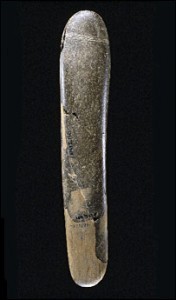
Hohle Fels phallus, about 28,000 years old. Interpreted as a symbolic object and …flint knapper. Yes.
That’s not science; it’s circular, self-serving propaganda. This little figurine from Hohle Fels, for example, is going to be used as “proof” that pornography is ancient and natural. I guarantee it. Having been interpreted by pornsick male archaeologists as pornography because that’s all they know, the statuette will now be trotted out by every every psycho and male supremacist on the planet as “proof” that pornography is eternal, that male dominance is how it’s supposed to be, and that feminists are crazy so shut the fuck up. Look for it in Steven Pinker’s next book. ***
P.S. My own completely speculative guess on the figurine is that it might be connected to childbirth rituals. Notice the engraved marks and slashes; that’s a motif that continues for thousands of years on these little female figurines. No one knows what they mean, but they meant something. They’re not just random cut marks. Someone put a great deal of work into this sculpture. Given that childbirth was incredibly risky for Paleolithic women, they must have prayed their hearts out for help and protection in that time. I can imagine an elder female shaman or artist carving this potent little figure, and propping it up somewhere as a focus for those prayers.
On the other hand, it is possible that it has nothing to do with childbearing or sexual behavior at all. The breasts and vulva may simply indicate who the figure is: the female god. Think of how Christ is always depicted with a beard, which is a male sexual characteristic, even though Christ isn’t about male sexuality. The beard is just a marker. Or, given the figurine’s exaggerated breasts, it may have something to do with sustenance: milk, food, nourishment.
The notion that some dude carved this thing to whack off to — when he was surrounded by women who probably weren’t wearing much in the way of clothes anyway — is laughable.
#reclusiveleftist #women’s history #porn #white men are stupid
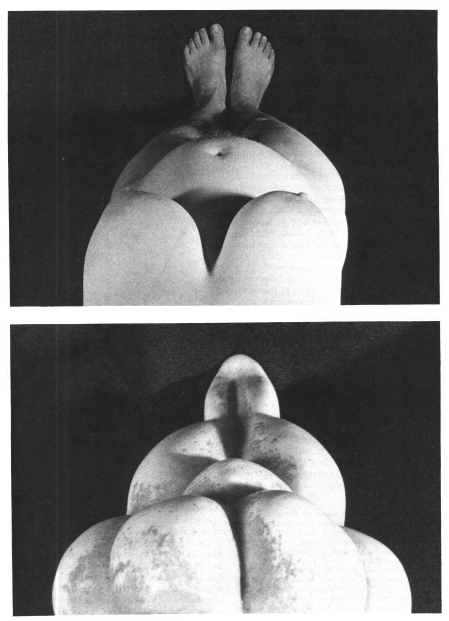
There was a post doing the rounds on tumblr a while back that I wish I could find, but most of it seemed to be taken from this study by LeRoy McDermott, Comparing Modern Bodies with Prehistoric Artifacts.
When looked at from above, as a woman observes herself, the breasts of PKG-style figurines assume the natural proportions of the average modern woman of childbearing age. For example, the dimensions of the breasts of the off-illustrated Venus of Willendorf are comparable to those of a 26-year-old mother-to-be with a 34C bust (see fig. 5). When foreshortened from above, even the apparent hypertrophic dimensions of the Venus of Lespugue and the best-preserved figurine from Dolní Vestonice enter into a reasonably normal, albeit buxom, range.
McDermott goes on to theorise that the reason most of these hyper-female statues are missing a head and hands is that the head, obviously, can’t be viewed by the sculptor without access to a reflection of some kind. As the hands are in a constant state of motion making the figurine, it would also be difficult to have a fixed reference to work from.
The whole thing reminds me of that oft-quoted Sandi Toksvig article:
When I was a student at Cambridge I remember an anthropology professor holding up a picture of a bone with 28 incisions carved in it. “This is often considered to be man’s first attempt at a calendar” she explained. She paused as we dutifully wrote this down. “My question to you is this – what man needs to mark 28 days? I would suggest to you that this is woman’s first attempt at a calendar.”
It was a moment that changed my life. In that second I stopped to question almost everything I had been taught about the past. How often had I overlooked women’s contributions? How often had I sped past them as I learned of male achievement and men’s place in the history books?
Working (loosely) in an archeological field for this past year has made me realise how much is taken for granted about ancient culture and to what degree we patch up the remnants of the past with modern values and notions of gender and sexuality. On a daily basis I’m asked – when in character – who my husband is, whether I’m a cook, why I’m holding a spear and carry a dagger and slingshot as part of my kit. These notions of a woman’s place are so ingrained that the children on school trips to the hill fort frequently can’t believe it when I tell them our Chieftain is a woman. Even if the only Iron Age Briton they can name is Boudica, they have a hard time getting their head around it.
I know I’ve reblogged this before, but I just can’t help myself. It’s way too cool.
oxford was built and operational as a college before the rise of the mayans and cleopatra lived in a time nearer to pizza hut’s invention than to the pyramids being built
I need a noncomprehensive history book that covers Known World History in time periods, like “in this century, all this shit was happening concurrently” and not just all spread out so I have to piece it together like some unpaid uneducated scholar
Mongols were fighting Samurai in Japan and Knights in Europe at the same time.
Star Wars a New Hope came out the same year as the last execution in France by Guillotine.
Abraham Lincoln and Edgar Allen Poe were friends in their early 20′s.
When the Great Pyramids were being built there were areas that still had Woolly Mammoths roaming.
Harvard University didn’t teach calculus in its first few years after being established because calculus wasn’t invented yet.
Nintendo was founded two years after the Eiffel Tower was constructed
This is the book you want: The Timetables of History – going year by year (or in the earlier sections, at least century by century) and showing you what was going on in various parts of the world in several categories (e.g. Politics, Literature, Science, etc.) Super useful for visualizing what events were happening at the same time.
Let’s say your matrilineal line is fairly consistent and everyone has their daughter at 25. So four women in your matrilineal line are born every hundred years. In a thousand years, that’s only 40 women. Like the math is so simple and yet ? You don’t think about it. So in 2000 years, 80 women. So basically, 0 AD started roughly about 80 mothers ago. That’s it.
I’m……… i’m a little drunk n cannot deal with this right now
Yep
The advent of agriculture around 9500BC was about 450 mothers ago
you can’t just say shit like that without a warning
Many, many mothers ago, when the world was new….
Many of the notes here are saying “But women used to have kids earlier”
Okay. So, assume every woman had her daughter at 20 instead.
That’s five mothers in a century.
Fifty mothers in a thousand years.
One hundred mothers in two thousand years.
That is five hundred and seventy five mothers since the dawn of agriculture.
Less than six hundred women, between you and the dawn of civilization.
You are never so far from your ancestors as you think.
Stone age toddlers may have attended a form of prehistoric nursery
where they were encouraged to develop their creative skills in cave art,
say archaeologists.
Research indicates young children expressed themselves in an ancient
form of finger-painting. And, just as in modern homes, their early
efforts were given pride of place on the living room wall.
A Cambridge University conference on the archaeology of childhood on
Friday reveals a tantalising glimpse into life for children in the
palaeolithic age, an estimated 13,000 years ago.
“Some of the children’s flutings are high up on walls and on the ceilings, so they must have been held up to make them or have been sitting on someone’s shoulders,”
I can’t. Every single sentence in this could not be more wrong if the author deliberately set out to be the wrongest person in wrongville. I just.
I don’t care what else might be useful in this book, if your introduction is as fundamentally incorrect as this, the reliability of everything else you’ve ever said and that your editor has ever touched is immediately thrown into question.
I… that is… such bullshit. Wool and silk are arguably the easiest fibers to dye. Cotton’s a stone bitch to color. (Let’s not even get into ‘change clothes irregularly’, that’s bullshit too.)
I know, right?? Protein fibres suck up dye like no-one’s business; it’s cellulose that hates it.
And as for the others… linen bedsheets, bitch. And linen and silk woven so finely as to be practically transparent. And I’d like to take my records of inventories with 100+ linen shifts for one person, because of multiple-changes-per-day, and shove them up his grant.
It’s like he assumes that without cotton we also wouldn’t have, like, modern inventions and techniques? “Wool is hard to clean” I mean yeah you have to use Woolite on the gentle cycle and air dry but that’s not that much harder than using normal detergent
wool being excellent to dye is its other great selling poin besides warmth- which is why ‘black sheep’ became a derogatory term, as black wool could not be dyed and thus was worth less as it would only ever be dark grey
historical perspective on the fabric alternate reality he proposes- linen was durable but not easy to dye, but you largely didnt care as it was undergarments or bedsheets where you wont be publicly showing off the linens- who other then nobility cares if their bedsheets are vibrantly colored? the reason you wore linen undergarments is that they breathe and protect you from any itchyness (wool that had been properly treated by a fuller {one of the worst jobs in history} would not have been very itchy either) of thick wool clothings and to keep you from getting sweaty or stinky, not to show off your bright red skivvies. linen is still freaking awesome, its comfortable, durable, breathes. i wish i had linen undies instead of cotton ones that get stretched out and threadbare after a few months. i wish i had linen and wool shirt options instead of only paper thin cotton shirts
the statement that sheep would require all the land ever- the deal with livestock through human history is that not all land is created equal, and livestock is how you used the areas that were sub-par. the fertile land you farmed crops, but there is far far more land thats unsuited for vegetables but grows grass just fine, as we cant eat the grass we set out animals like cows and sheep that CAN eat the grass and let them go wild chewin their cud and poopin on the ground while the humans are busy ploughing and harvesting on the more valuable land; allowing the ungulates to convert that grass into usable products like wool, cheese, meat, leather. there’s reasons some areas are covered with sheep and cows EVEN TODAY- either its not usable as croplands or the population nearby is so low that you couldn’t effectively organize labor to exploit farming. new zealand and australia have absurd numbers of sheep for this reason- the land is either too sparse, hilly, or remote, but wool can be exported for profit just fine. however areas like iowa and california have very few sheep as the land is better suited for grain and seasonal vegetables and using it for grazing would be less effective
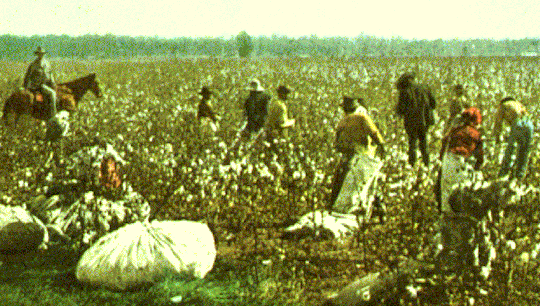
further the statement that wool and linen are more labor intensive then cotton- theres a reason the cotton industry historically relied on slavery when wool and linen were historically a cottage industry people did in their spare time while being a full time farmer. you let a sheep out on the lawn to do its own thing, it grows the wool, once a year you shave it and spin it into thread- it produces more sheep and tasty mutton as well. linnen is made from flax plants, which are harvested with a sickle and then left in some water to rot for a week, split open, and the fibers inside spun into thread- teams up well with beekeeping as flax produces huge fields of beautiful flowers. in both the hard work is done by animals and a pond, not human hands. cotton however required you to not only plant it but spend time to pick individual bolls off of the flowering buds after it went to seed in the summer sun one at a time instead of mowing with a scythe like flax in an afternoon, which then had to have someone pick all the seeds out of each boll individually before spinning, theres no side product and it depletes the soil like a sonovabitch
pictured- super easy, giving a sheep a haircut would be so much worse right? im sure the man on a horse with a whip and gun is there to make sure everyone is having a good time
and finally the primary dumb part of the highlighted segment- the
assumption that if cotton didnt exist you would sleep on a pile of
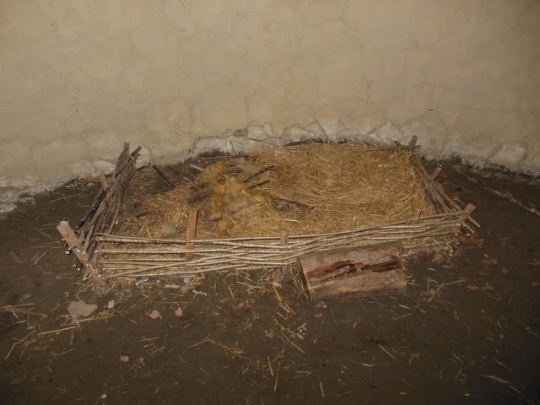
straw. what? is this talking today or talking medieval times again? flipping NEOLITHIC folks were bright enough to lay a blanket on top of their straw pile before they took a nap on it. even back
when straw beds were common you didnt lay on the straw, the straw was a
filling for a leather or canvas bag so that you didnt get poked, and even then chances are pretty good you stuffed your bed with
feathers because if theres something an agrarian society has more then
enough of its poultry. if you are talking today i challenge you to go to
a matress store and find a cotton filled bed- theyre filled with
springs or foam, and for all points and purposes the foam is just a high
tech version of straw that doesn’t rot. that, and any modern mattress
is synthetic fiber to combat body odor and sweat absorption
this is not how beds work
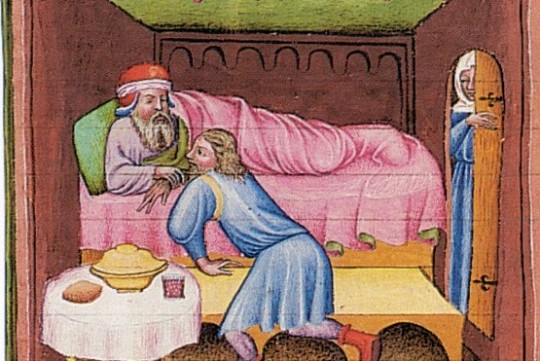
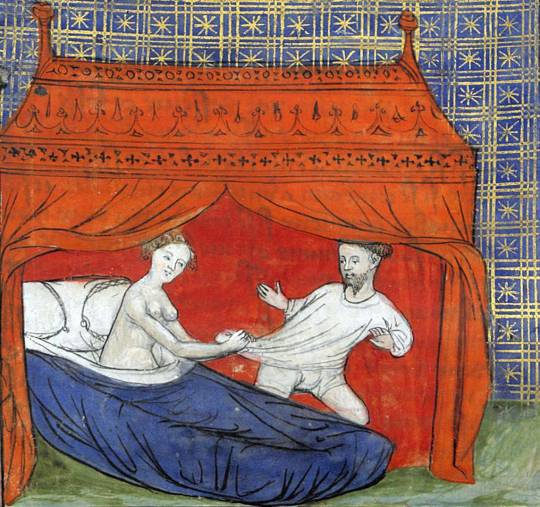
these pre-cotton folk seem to be pretty comfortable, even if they hadnt invented perspective yet. as there is no crown im pretty sure they werent importing their fabrics from india or egypt
oh, look, pre-cotton comfortable underwear, soft sheets, and a bed that looks excessively comfortable with no straw or furs in sight
a world without cotton isnt a world without soap either jackass
Archaeologists in Denmark have found evidence of a 3,000 year-old cooking mistake that casts some light into the everyday life of Scandinavian Bronze Age people.
Clear evidence for one of the most common mistakes in the kitchen – burning food – lay in a clay pot that was excavated in central Jutland, Denmark.
The clay vessel was found, upturned and in near mint condition, at the bottom of what was once a waste pit.
“The pot is typical for cooking vessels in this region of Denmark. It was accompanied by several other objects fitting the dating,” archaeologist Kaj F. Rasmussen from Museum Silkeborg, Denmark, told Discovery News. Read more.
[fucks up dinner and just straight-up buries the evidence] We’re Getting Ancient Pizza Tonight, Girls
one time when i was 13 i burned pudding and couldn’t get it out of the pot and i was so ashamed i buried it in the backyard so no one would know

















 BettSplendens Tumblr Evac