“Oh I love roses! I try growing them myself, but they never get very far.”
“Would you like to know the secret to healthy rose bushes,” I asked, knowing that she would not like the answer.
“Do tell!”
Grin. “Blood.”
The customer paused, waiting for me to say that I was kidding. But I wasn’t so it never came. She became nervous.
And before I could explain that blood meal is a common soil fixer and fertilizer, she put her hands up, spun around and said-
“Bye.”
You want to know the secrets to a beautiful garden? You better be prepared for some weird shit.
Well someone felt like being the ominous witch in the small, mysterious shop today.
.
…also, tomatoes like blood too.
My interest in plants extends beyond ‘oh look a pretty flower’ and straight into ‘plants are fucking metal.’
Evidently, you’re supposed to plant garlic in the same places as your roses because the garlic will repel a rose-specific aphid.
So what I’m saying is that between the romantic symbolism of the rose, the bloodmeal in the soil, and the fresh garlic all over the place-
You could really set yourself up for an encounter with some VERY pissed vampires.
Roses really love banana skins, too. Just… stick one in there before you plant a rose bush or spronkle around one that’s already in the ground. They’ll adore you.
Mmm… blood banana.
I made tiny ass Home Depot Petunias blossom like magic that they’re nearly overtaking the trellises.
How did I accomplish this?
Once a week I bury a small amount of leftover meat in the soil.
My morning glories loved the crap out of the charred chicken bones I gave them. They’re already an enthusiastic plant, but the blooms I had this year were extraordinary.
@thebibliosphere Well, if you ever get your allergies under some semblance of more control and want to get on Demon Rose’s good side, I guess
They also like fish too.
IMPORTANT PRO TIP: SOME OF THIS IS FOR OUTDOOR GARDENING ONLY.
Do not sprinkle banana peel on your windowsill garden, you will have fruit flies and A Smell. Definitely do not bury small chunks of raw meat just under the soil of your windowsill garden, you will have Much Worse Flies and A Very Smell.
Blood meal is probably okay, vampires can’t get in unless you invite them, but I would be careful about garlic since it is a pretty stinky plant even before you cook with it.
my grandparents have to lock their car doors when they go to sunday mass because people have been breaking in to unlocked cars and leaving entire piles of zucchini
i feel like i should’ve added more context when i posted this. my grandparents live in a rural area where farmers and casual gardeners alike are, at this point in the year, suddenly being hit with unexpectedly abundant zucchini crops. there aren’t just some random vandals leaving zucchinis in people’s cars for the hell of it, this is the work of some very exasperated, probably very elderly, folks who have more zucchini than they know what to do with
Yep. You can also expect to find a bag of zucchini on your porch.
My grandfather once found his neighbor stealing his tomatoes out of his garden at three in the morning. Red-handed, with a basket of the nearly-ripened ones. He thought he was going to find gophers or something, but no, here’s Henry, taking his tomatoes. The best ones.
There was a long pause between them.
My grandfather (allegedly) said, “Henry… it’s OK. You can take some tomatoes if you want them.”
Henry sighed in relief.
“But,” my grandfather said, “you have to take two zucchini for every tomato.”
There was another long silence. “That’s a harsh bargain, John,” said Henry. “But I accept. I’ll tell Joe up the street, too.”
My grandfather said, “Tell Joe he needs to take three.”
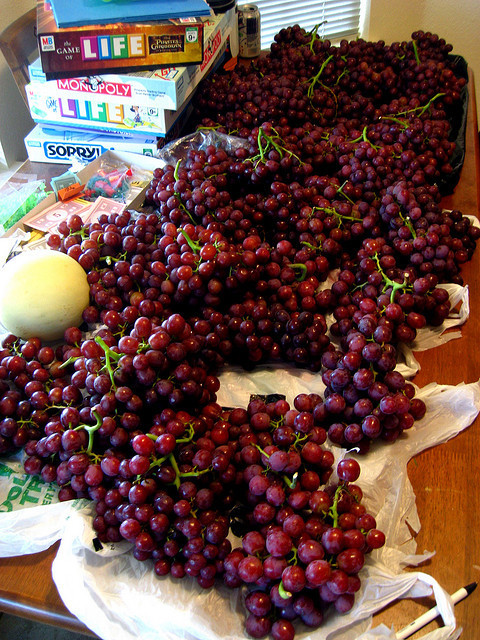
a friend of my dad’s came by in the middle of the night, he seemed very nervous when my dad answered the door. he wouldn’t come inside but he leaned in and whispered to my dad in spanish, “i have some fresh grapes for you.” and then this happened:
the melon was a special bonus.
MY DREAM
A friend of mine lives in a rural area and he has been surrounded by zucchini for most of May, June, and July.
At one point he was so done with the whole zucchini madness that he came to classes actively begging people to “Please please please!! Take some my family’s damned zucchini!! I’ve been eating zucchini for weeks!! I’m going insane!!!”
Having grown up in a rural area and having come home to zucchini on the front step or in the mailbox, i find it highly amusing the OP had to clarify. I’m sitting here nodding “yup.”
I have a friend with a garden in Oregon who literally made Zucchini Chocolate Chip Cookies and sent them to me in Indiana. I texted her back “I SEE WHAT YOU’RE DOING HERE”
I’m waiting for the day when someone will hear about my background in Botany and ask me for advice on what someone who’s just wanting to start exploring planting vegetables should try.
I know fuckall about gardening because my background is wild plants and not agriculture, but I’m gonna tell them
“Zucchini. Definitely try Zucchini. Just plant plenty of them and you’ll get a decent sized crop! They’re very rewarding to grow.”
It may be a bit of a long game, but I’ll enjoy their screams of despair from across the void as they realize that they will eat zucchini forever
This is NOT an exaggeration, guys. Zucchini (and most squashes, really) will outgrow you so fast. Let our tale be a caution– or an encouragement, whichever. You decide as you hear the story of Squish.
When we were so broke we had to choose between gas and store-bought-food (I think I was about 10?), we had a garden so we could eat regularly (we also had chickens and pigs and hunted, but that’s beside this point). One summer, we planted 6 rows of yellow squash and 6 rows of zucchini. Each row probably had 10, maybe 12 plants in it. We created this giant squash-block in our garden plot so it was all right there together in the middle, and the needier plants like tomatoes were on the outside of the whole plot. We thought we were clever, til the first crop started coming in.
The outside two rows of each squash, yellow and zucchini, were normal. High yield, of course (because squash), but standard size for both summer squash and Italian zucchini. The inner 8 rows, however, created this hybrid monstrosity that we called Squish. It was pretty– a nice swirly yellow and green combination that made it clear the squash and zucchini had interbred.
Squish became a living nightmare for us. Something about the hybridization caused them to forget how to stop growing, or at least how to grow at a normal rate because those suckers were longer than my dad’s forearm, and bigger around than my (albeit child-sized) thighs. They didn’t get all hard and nasty on the inside, either, for some reason, like most squash will at that size. And they just kept coming. I don’t even remember seeing that many flowers, but every day we were pulling upwards of 20lbs of Squish out of the garden, only for there to be more the next day, or sometimes by the end of the day if we harvested in the morning. I don’t know where they were hiding, but it was like some sort of squash portal had opened into our yard and started crapping out Frankenstein’s Squashes.
At first, it was great. We could eat all we wanted and not worry about rationing it. But the growing season in Arkansas is long, and we had incredible weather that summer, so those darn things kept alternating flowers and fruit. Pull off a few Squish, new flowers budded out, and they ripened super-fast in the heat. We were absolutely swimming in Squish, because they were so big that even gorging on them meant only 1 or 2 got eaten per meal. (I think I recall using a few particularly enormous ones as swords for a duel with my sister, if that says anything about their size. I cannot overemphasize how absolutely, heinously gigantic they were. You probably don’t believe me but I am not kidding. Those things were bigger than a newborn by several many inches and a couple pounds.)
We had (luckily) a big deep freezer, and someone gifted us a bunch of freezer ziploc bags, so we started chopping them up and freezing them as we pulled them off. We ran out of bags real fast, so we caved and bought a ton more. We filled that deep freezer near to bursting. It was probably 3-4 feet deep, (as I remember barely coming up to the edge of it), and at least 4-5 feet long, about 2.5 feet across, and we filled it to the top with Squish. And that’s while we’re eating fresh ones every day with dinner! But still more Squish came before the first frost, so we started packing the fridge. And my grandma’s freezer. And my grandma’s fridge. And feeding them to the pigs and chickens. And giving them away at church.
Do you realize how big a deal it is that people who were so broke that they had to choose between gas and the power bill were GIVING AWAY FOOD??? That’s how much gosh darn Squish we had. And little did I know, but apparently, my dad HATES squash. He only planted them because they were a cheap, quick source of food and my mom loved squashes. And he got stuck with the folly of his decisions. For over a year.
Yep. We had Squish in the freezer for over a year. Eating it regularly. It lasted for over a year. A family of 5, plus often feeding my grandmother, we ate off a single garden’s haul for over a year. Of just the Squish. I tell you, if we’d had a farmer’s market back then, that Squish could probably have single-handedly lifted us out of poverty. Well, maybe not, but you get the idea.
We never planted both again, probably because my dad would have combusted out of rage if he’d ever seen another Squish in his life. But man those were the days for thems of us what loved squash.
So survival tip: If you need an absolute crapton of food, plant you a row of yellow squash and a row of zucchini, and keep that pattern going for as many rows as you like. You too can drown in Squish and love it.
Oh wow.
The last story is well worth the read. It might be long but I found it absolutely delightful! Thank you for sharing your childhood Squish gardening adventures!
Meanwhile, people are starving to death.
Ands What do you expect poor rural farmers who just have excess zucchini to do about that exactly? Mail them to Africa?
I was just talking to a friend today about gardening and she said “I’ll plant zucchini for this project.”
“Oh dear… what’s your damage control plan?”
“Oh,” she said, intuiting what I meant. “Eating the blossoms. Love stuffed blossoms. Pumpkin, squash, zucchini. It keeps the crop down, and you get lots of mileage out of them. You keep a mixed crop that way, too. Plus, people don’t always welcome gifts of zucchini, but they find gifts of blossoms exciting.”
A store-bought bag of topsoil, a roll of landscaping fabric, or a bag of cedar chips doesn’t go very far if you have a large garden or a very limited budget. Here are some ways to create the materials you need for a beautiful, organic, productive garden, by both re-directing household waste, and foraging in your local area. I use a lot of these tricks in my garden to make it almost completely free for me to continue growing new things, and expanding the workable area every year!
For soil
Save your food scraps to create a rich compost for growing veggies and amending your soil. There are numerous options for every size of dwelling and yard. Small space solutions such as Bokashi and vermicompost work indoors and don’t produce bad smells, so you can keep them underneath the sink.Worm towers, compost heaps, and outdoor compost binsare a great solution if you have more space. The more you add, the more rich, nutritious material you can make for your garden. I like composting because it means I don’t have gross smelly garbage bags to deal with, because food waste is diverted. It seems like a lot of work at first, but it actually saves time, money, and transportation.
There are three things that are essential for plant growth. These are nitrogen for leaves and vegetation (N), phosphorus for roots and shoots (P), and potassium for water movement, flowering, and fruiting (K). Commercial fertilisers will give the relative concentrations of each of these compounds with and “NPK” rating. Plants like tomatoes also need calcium to produce healthy fruit. You can create amendments for your garden and soil at home so that you do not have to purchase fertiliser.
Human urine contains 12% nitrogen, and it’s sterile. Dilute before adding directly to plants.
Legumes such as beans, clover, peanuts, and alfalfa fix inorganic nitrogen into the soil with mycorrhizal organisms and nodules on their root systems. Plant these crops every few years in rotation with others to renew the soil organically.
For phosphorus
Human urine is also a great source of phosphorous and trace amounts of potassium.
Many plants are particular about what the soil pH should be.
To make soil more acidic: add oak leaves, pine needles, leaf mulch, urine, coffee grounds or sphagnum.
To make soil more alkaline: add wood ash, shell, or bone.
Mulch
Mulch is decomposing organic matter that adds nutrition to the soil, while simultaneously keeping out weed growth and retaining moisture. It also attracts worms, fungi and other beneficial creatures to your soil. Free sources of mulch include:
Leaves
Garden waste
Grass clippings
Straw (often straw bales are given away after being used for decoration in the fall. You can also plant vegetables directly in straw bales using a technique called straw bale gardening).
Wood chips (if you can borrow a wood chipper after you’ve collected some wood you can have attractive wood mulch for free)
When mulch isn’t enough to keep the weeds down, many people opt for landscaping fabric. It can be quite expensive and inorganic-looking. Free solutions that both attract worms and can be replaced in small segments as they break down include:
Newspaper*
Cardboard*
Egg cartons*
Printer paper, looseleaf, etc. in thick layers*
*try to make sure you are using paper that has vegetable-based dyes, so you aren’t leeching toxins into the soil.
Soil density/drainage
If your soil is compacted and you have plants that require low levels of water, or excellent drainage, add sand. I don’t recommend stealing it from the beach, but ask around and you’d be surprised at how easy it is to get for free. Sawdust also improves drainage. Adding organic matter and mulch encourages worms, who also till and aerate compacted soil.
If the area still needs drainage, dig a hole and fill it with bricks or rocks to create a “dry well”
For drainage in pots, add crushed bricks,terra cotta pot fragments, packing peanuts, small stones, marbles, orsand to the bottom under the soil layer. I find these in construction sites, on craigslist, or at flea markets.
Pots and growing containers
If you have space, raised beds are a great no-dig way to establish growing space. If you are pressed for space (like working on a balcony) there are many cheap or free options for container gardens.
Creating raised beds allows you to build up the soil without digging. Free ways to do this include using rocks or lumber (like my DIY “lasagna garden” made with the sheet composting technique), using the “wattle“ method with sticks and posts you have found, using discarded straw bales, old bricks,paving stones,cinder blocks or really anything else you have lying around.
Hugelkutur raised beds, which fix carbon and provide drainage, can be made by stacking sticks and untreated wood, and then piling soil or compost over it. (Thanks milos-garden)
Rubber tire gardens retain heat in the night and allow for great drainage. They can also be painted in fun ways.
Herb spirals (here is mine: 1, 2, 3) can be built with stones, bricks, and other found materials.
I often use old cooking pots, barbecues, teapots, or other found objects as planters.
If you can track down peat moss, cement, and vermiculite, you can make an easy Hypertufa planter in whatever shape you would like, provided you have a form in which it can dry.
Paving often requires a foundation of sand or another stable and well-drained substrate, and a covering of stones, bricks, or other weatherproof elements. Slowly collect stones over time, or free paving stone fragments to create a mosaic-type walkway. Often people give these things away on craigslist. I made a patio and fireplace out of free salvaged bricks, for example.
Save seeds from foods you like from the grocery store: consider growing peanuts, ginger, garlic, peppers, or a walnut tree: all of these and more can be planted from store-bought produce.
Learn to take cuttings. There is a tonne of info on the web about basic cutting propagation, layering, (like I do with rhododendrons) air layering, and numerous other techniques to take clones of plants you like. This saves going to a nursery and shelling out big bucks for all the variety you want.
For cuttings, willow tea and honey are great rooting hormones/antiseptics/anti-fungal agents, which can save you $40 if you were thinking of buying commercial rooting hormone.
I hope this helps you build your garden outside of the usual capitalist channels! It can be a cheap or free hobby if you are willing to think outside the box, and maybe put up with things that don’t look as clean or crisp as a hardware store catalogue.
If you have any further ideas, please add them! The more information the better.
Hügelkultur (German, meaning “hill culture” or “mound culture”) is the garden concept of building raised beds over decaying wood piles. Decayed timbers become porous and retain moisture while releasing nutrients into the soil that, in turn, promote root growth in plant materials. As the logs decay, they expand and contract, creating air pockets that assist in aerating the soil, allowing roots to easily penetrate the soil. This decaying environment creates a beneficial home to earthworms. As the worms burrow into the soil, they loosen the soil and deposit nutrient-rich worm castings, beneficial to plants. An earthworm can produce its weight in castings on a daily basis.
The best decayed wood for a Hügelkultur, according to A Growing Culture, comes from alders, applewood, cottonwood, poplar, maple and birch. Use wood products that have been in the process of decay for about a year (using green, or fresh, wood products will rob the soil of necessary nitrogen). Some wood products, like cedar and black walnut, should be avoided because they produce organisms that negatively effect plant growth.
They’re lovely, but they MUST be kept in a pot, or a raised bed, or on a good-quality leash with a chest harness, because mint and its cousins spread like… IDEK, like a rash. Like dandelions. They’re tough, hardy and highly motivated. Even a tiny root fragment will suddenly turn into a Mint Tree if you don’t tear it up. I swear I’ve seen new plants popping up from BURIED SCRAPS OF LEAF. Once they’re in the ground they establish a beachhead and spawn secretly, possibly through osmosis. I cannot advise you to stick a mint plant in the ground unless you are a bold and unconventional disciplinarian.
The joke is that after running around after the mint like a spaniel chasing a whack-a-mole for a year, Dr Glass then planted a plant that would do the same thing.
Great plants, hard to kill, keep them in a pot (ESPECIALLY where invasive)
I would really recommend against planting mint in raised beds, and also, if in a pot, DO NOT PUT THE POT ON SOIL. The pot needs to be on rock or concrete. Otherwise the roots will head straight for freedom through the drainage holes, and you will Never Be Free.
of course, on the other hand, if you’re at all inclined to pettiness expressed via herbology, mint makes a GREAT vehicle for plant-based vengeance.
i have absolutely thrown mint roots into the perfectly manicured lawns of people i hate.
An ever growing mint plant appearing in my lawn would seem like the opposite of a problem to me?
They’re invasive, which means if they’re anywhere in your garden or manicured areas they could ruin the other plants, I think? But yeah I’d love to have a damn mint plant in my yard sounds ideal.
Has anyone ever thought of just having a lawn of mint instead of grass? Like how you have moss lawns?
… I am not judging!! but I don’t think the people in the notes who are like “oh a mint lawn would be lovely!” have met mint!
You know what would be a lovely herbal lawn? Chamomile. Because it’s a damn compact, densely-growing, hardy, winter-green perennial that’s springy underfoot, smells nice when you walk on it, and has some basic manners. Lawn chamomile is plushy and soft and produces tiny pretty daisy-looking flowers. It naturally stays at pretty much the height you would want grass to be, and then you can cut it and it goes “fair enough.”
Mint is not any of those things. Mint is leggy, patchy, muddy and rampageous. It grows randomly and fitfully. It bullies other plants. It sends runners into the neighbor’s houses and across the street and it barks at the postman. Your mint lawn would look like a poorly tended graveyard AND THEN IN THE WINTER IT WOULD DIE, DRAMATICALLY, and ROT THERE. It would outcompete native plants and eat your vegetable garden alive. It is so wet and stalky that it would be dreadful to trim, and when you trimmed it, it would scab over and sulk. It would refuse to grow where it was put (the lawn) and would instead show up in places you don’t want it (the patio, the sidewalk, your intrusive thoughts.) IT IS AN INVASIVE PLANT, WHY WOULD YOU DO THIS TO YOUR FAMILY
It’s like asking why people don’t make lawns out of cabbages, or hyenas, or the cold virus. BECAUSE THEN IT WOULDN’T BE A LAWN OR A GARDEN
gardening has this reputation as a gentle and chill hobby but you know what?? gardening is actually a constant and brutal conflict between the human need for control and the will of life to spread – a battle between life and death itself, even. in the garden I am the Overlord Supreme, Peerless Queen of the Dirt, Arbiter Above All, the ultimate and final judge over who gets to live and who must die. I drowned an entire anthill today for daring to exist in my realm, and the blood of hundreds has soiled my soul. my thumbs may be green but my hands are black and deadly.
This explains more about Samwise Gamgee than anything else I have ever read.


 BettSplendens Tumblr Evac