Eleven green mantella froglets completed their transformation into frogs
from tadpoles just after the new year at the Houston Zoo. These tiny
frogs are smaller than a dice and gain their green moniker as they
mature. Native to the island of Madagascar, guests to the Houston Zoo
can spy these tiny endangered froglets in the Reptile and Amphibian
House and are saving them in the wild through their visit…
So it turns out this is a really interesting question.
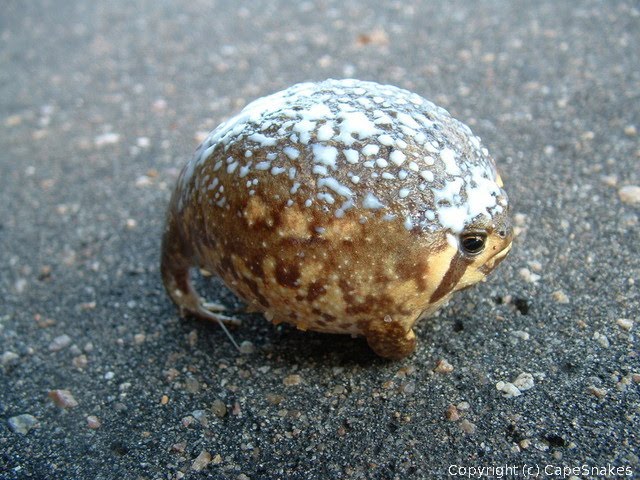
The first thing we must be aware of is that rainfrogs as we see them in videos of them squeaking are not quite the same shape as they are when at rest:
But you are quite right, they are very round. This is exemplified by the skeletal photo you refer to:
Well, firstly, note that the body cavity in these frogs actually envelops the femurs, such that only the tibiofibula (fused in frogs) and the tarsals and metatarsals are outside the body. The arms are quite similarly enveloped, but a bit of the humerus does extend outside the body cavity too. This predisposes them to a rounder body shape.
Next, note the ilia – the U-shaped bone in the pelvic region. These in some breviceptid frogs are synostotically fused with the sacrum – that is to say, they are bound by bone-based connections to the bow-shaped vertebra at their tips. This whole joint seems to be quite smooth, and as a consequence, the back of the frog is quite smooth. The other thing we can see here is that the urostyle (i.e. the frog version of a coccyx) juts quite far beyond the ischium and pubis. This extends the body cavity beyond the hips. Note also that the pelvic girdle seems to be largely below the spine, rather than the typical position for frogs behind it and continuous with it. This makes the legs sit below the spine, rather than at its end, enhnacing the vertical roundness of the animal.
Next, let’s talk some soft tissue. Now, I’m not as familiar with soft-tissue in frogs as I am their skeletons, so you’ll have to bear with me a bit (rawr). Beddard (1908!!) studied the soft tissue of Breviceps verrucosus Rapp 1842. It seems that the majority of the body of these frogs is actually muscle. Beddard noted that muscles join the leg at the knee that extend into the body cavity, such that the inclusion of the thigh in the body cavity is further accentuated by musculature. The rectus abdominalis muscle is unusually large, extending from the lower abdomen up and around the sides of the body. Indeed, this large size appears to be the pattern with all of the major muscles, though in the throat the typical arrangement of large and small muscles is somewhat reversed. On the lateral side of the head, there is a substance that is not muscle, but appears to be loose tissue in which sits what is apparently the thymus gland.
There is a very large gap between the end of the urostyle and the anus (one fifth of the total length of the frog), in which there are almost no muscles, save for the one surrounding the lower cloaca. On either side of this area, between the posterior-most muscles of the thigh, lie two large ‘lymph-hearts’, as described by Beddard. These are between one quarter and one third of the total length of the frog. A further lypmh-sac sits between these lymph-hearts and the skin of the femoral region, and they are thus probably analogous to the femoral lymph-sacs of other frogs.
I find it interesting that Beddard (1908) did not mention any glandular formations in the dorsal region. As is evidence from many images (see below), these frogs are able to secrete a white, sticky, noxious substance from their skin (which they actually have to use during amplexus, as the male is too small relative to the female to mount her properly, and so he sticks himself to her with his glandular glue… kinky).
These glands do not apparently take up a great deal of the cutaneous tissue, and so I suppose are of no consequence to the size of the frog, especially relative to its enormous muscles.
The diet of these frogs consists almost exclusively of hymenopterans and isopterans (ants and termites). Neither of these insect groups are particularly fatty, so it is little surprise that their bodies appear to contain no large fat deposits – fatty bodies extend from the gonads up to the lungs and heart, but these comprise only a tiny fraction of the frog’s mass, and don’t contribute to the round shape. Instead, their bodies are extremely muscular, allowing them to be adept burrowers, ideal for their fossorial lifestyle.
So TL;DR: rain frogs are little balls of muscle (maybe the largest muscle mass relative to body mass of any vertebrate? science just doesn’t know).
Ref:
Beddard, F.E. 1908. On the Musculature and other Points in the Anatomy of the Engystomatid Frog, Breviceps verrucosus. Proceedings of the Zoological Society of London, 1908:11-41 [x]
This also shows something interesting about frogs; they don’t really have ribs. They have little outcroppings to their vertebrae. I assume this is because they’d shatter their ribs every time they jumped if they had any, with how they land. It’s not just rain frogs, it’s frogs in general.
So it turns out this is a really interesting question.
The first thing we must be aware of is that rainfrogs as we see them in videos of them squeaking are not quite the same shape as they are when at rest:
But you are quite right, they are very round. This is exemplified by the skeletal photo you refer to:
Well, firstly, note that the body cavity in these frogs actually envelops the femurs, such that only the tibiofibula (fused in frogs) and the tarsals and metatarsals are outside the body. The arms are quite similarly enveloped, but a bit of the humerus does extend outside the body cavity too. This predisposes them to a rounder body shape.
Next, note the ilia – the U-shaped bone in the pelvic region. These in some breviceptid frogs are synostotically fused with the sacrum – that is to say, they are bound by bone-based connections to the bow-shaped vertebra at their tips. This whole joint seems to be quite smooth, and as a consequence, the back of the frog is quite smooth. The other thing we can see here is that the urostyle (i.e. the frog version of a coccyx) juts quite far beyond the ischium and pubis. This extends the body cavity beyond the hips. Note also that the pelvic girdle seems to be largely below the spine, rather than the typical position for frogs behind it and continuous with it. This makes the legs sit below the spine, rather than at its end, enhnacing the vertical roundness of the animal.
Next, let’s talk some soft tissue. Now, I’m not as familiar with soft-tissue in frogs as I am their skeletons, so you’ll have to bear with me a bit (rawr). Beddard (1908!!) studied the soft tissue of Breviceps verrucosus Rapp 1842. It seems that the majority of the body of these frogs is actually muscle. Beddard noted that muscles join the leg at the knee that extend into the body cavity, such that the inclusion of the thigh in the body cavity is further accentuated by musculature. The rectus abdominalis muscle is unusually large, extending from the lower abdomen up and around the sides of the body. Indeed, this large size appears to be the pattern with all of the major muscles, though in the throat the typical arrangement of large and small muscles is somewhat reversed. On the lateral side of the head, there is a substance that is not muscle, but appears to be loose tissue in which sits what is apparently the thymus gland.
There is a very large gap between the end of the urostyle and the anus (one fifth of the total length of the frog), in which there are almost no muscles, save for the one surrounding the lower cloaca. On either side of this area, between the posterior-most muscles of the thigh, lie two large ‘lymph-hearts’, as described by Beddard. These are between one quarter and one third of the total length of the frog. A further lypmh-sac sits between these lymph-hearts and the skin of the femoral region, and they are thus probably analogous to the femoral lymph-sacs of other frogs.
I find it interesting that Beddard (1908) did not mention any glandular formations in the dorsal region. As is evidence from many images (see below), these frogs are able to secrete a white, sticky, noxious substance from their skin (which they actually have to use during amplexus, as the male is too small relative to the female to mount her properly, and so he sticks himself to her with his glandular glue… kinky).
These glands do not apparently take up a great deal of the cutaneous tissue, and so I suppose are of no consequence to the size of the frog, especially relative to its enormous muscles.
The diet of these frogs consists almost exclusively of hymenopterans and isopterans (ants and termites). Neither of these insect groups are particularly fatty, so it is little surprise that their bodies appear to contain no large fat deposits – fatty bodies extend from the gonads up to the lungs and heart, but these comprise only a tiny fraction of the frog’s mass, and don’t contribute to the round shape. Instead, their bodies are extremely muscular, allowing them to be adept burrowers, ideal for their fossorial lifestyle.
So TL;DR: rain frogs are little balls of muscle (maybe the largest muscle mass relative to body mass of any vertebrate? science just doesn’t know).
Ref:
Beddard, F.E. 1908. On the Musculature and other Points in the Anatomy of the Engystomatid Frog, Breviceps verrucosus. Proceedings of the Zoological Society of London, 1908:11-41 [x]
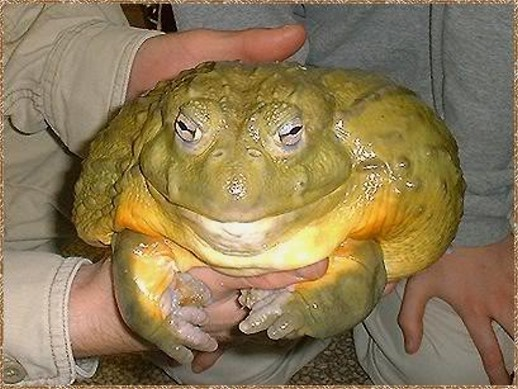
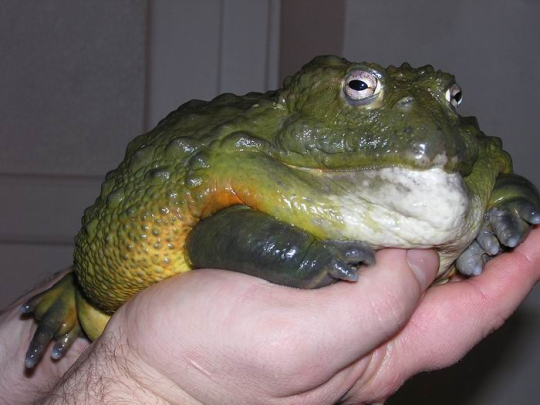
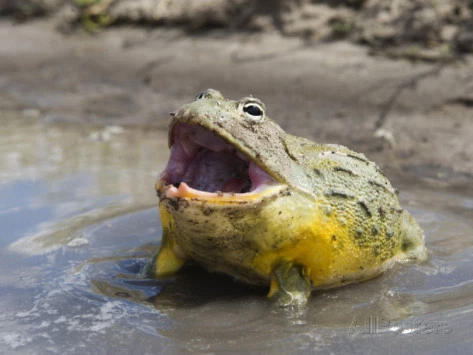
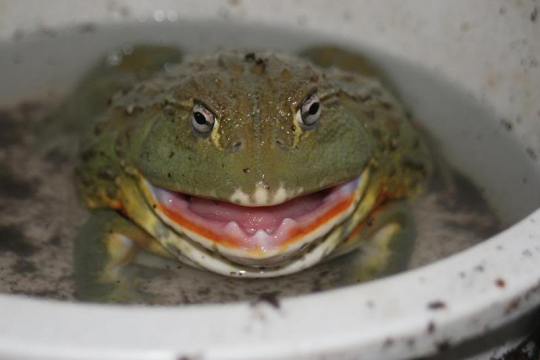
congratulations, you have been forcibly introduced to the African Bullfrog, also
known in pet-owner circles as the Pixie Frog.
look at his little hands!
while they are indeed adorable, the nickname actually derives from the scientific name of the species (pyxicephalus adspersus), and not any positive qualities they possess.
hoo boy they don’t have many of those, lemme tell you
found throughout much of sub-Saharan Africa, the Pixie Frog lives in wet areas where they eat pretty much anything they can fit into those ginormous mouths. (this includes fish, other frogs, bugs, snakes, lizards, other frogs, rodents, unattentive birds, other frogs, and probably you too if you hold still long enough)
this is a creature born with neither fear nor conscience
and it’s no idle threat either, because Pixie Frogs can grow to 10 inches long, which is well within ‘unreasonably huge’ for an amphibian. also, unlike most frogs, Pixie Frogs have fucking teeth
ALL THE BETTER TO EAT YOU WITH, MY DEARRRRR
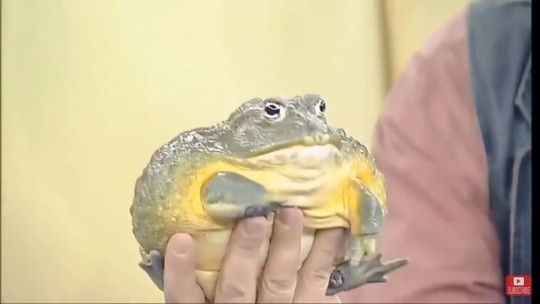
in spite of all of this, Pixie Frogs remain popular pet animals, possibly because they will allow you to pick them up and carry them around like a newborn.
and we can respect that.
she has four of them and they’re named after her grandchildren
just, you know, make sure you count your fingers after you hold one.
EXCUSE YOU BUT ALLOF THEIR CHARACTERISTICS ARE POSITIVE
also you forgot that they’re one of few frog species in which the male is larger than the female so in amplexus they look like this
haha frog stack
here’s a picture of Many of them because they get funnier the more of them there are
Other reason to enjoy them: if you have one, you can feed it things like very large roaches, huge worms, and entire dead mice in order to freak people out with how much it can happily eat.





 BettSplendens Tumblr Evac