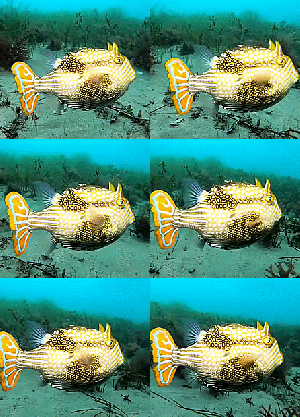
Anyone know what it is? I don’t think it’s a moray eel, it only looks like it has one row of teeth. I translated the comments on the source and the only thing I could find was a mention of “Murasaki sea snake”, which, when put into Google, only comes out with pictures of actual sea snakes. That’s definitely not a snake.
This is a pike livebearer! The gals get about as long and tall as a banana, the boys stay the size of the one in that person’s hand, and their fry are born alive (no eggs) and about the size of guppies. This is the largest livebearer fish we know of, and they will strongly attempt to swallow anything that’s not at least their size.
Apple snails get the size of your fist, do not recommend. Mystery snails stay smaller, but they do lay a lot of eggs and can result in lots of baby snails. If you want snails and not a bajillion babies, get nerite snails. Horn nerites are a favorite of mine. Small, and they do lay eggs, but the eggs don’t develop and hatch in freshwater.
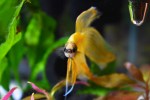
So! Basic aquarium setup for bettas. Note that this applies to all tank sizes.
You really just need a generic light for all of this. No need for anything fancy, the thing that comes with the tank in sets will work. Try an LED for lower heat.
A sponge filter is best for bettas. Nice and gentle. When it needs cleaning, take the sponge off and gently squeeze it in a bucket of tank water, then put it back on the filter. That gunky tank water (and any tank water) is great for houseplants.
You MUST have a heater. Go on Amazon and look for the one with the highest rating, applicable to your tank size. You need a guard around it, bettas are dummies who will slump on a heater and get burned.
You also MUST have a thermometer. Not a stick-on kind, one of the kinds that’s a tube that goes in the tank. Any of them is fine. Just keep an eye on it- bettas need to be at a minimum of 78F. It should be in the center of the tank, with the heater at one end, so the betta can choose where it wants to be.
You MUST have a lid that covers all the gaps in the tank, or keep the water level at least 4 inches below the surface. I recommend the former option, as I’ve seen fish get stuck to the side of a tank with a low water level. Bettas DO jump.
You MUST have the entire top of the tank open to the air. Bettas need to breathe air to keep their labyrinth organ healthy. By that, I mean the water shouldn’t touch the lid for more than 5% of its surface. The betta should be able to swim up at any point and take a breath.
Bettas don’t care what their decor looks like, but they need things to hide under and around. They also love to slump just below the surface of the water, resting on something. You can make betta hammocks with a plastic plant leaf and a suction cup, look ‘em up on Amazon to buy one, or just make sure there’s decor and such up near the surface. In particular, you need to make sure there are no sharp edges, betta fins shred easily. Plastic plants are usually sharp, silk plants are fine.
I suggest some live plants with bettas. Not a requirement, but highly, highly suggested. Java moss and Java fern are both very hardy, they grow happily under any tank light. Just throw them in, or tie them to something. Java fern, don’t plant the roots in the ground, they’ll rot. Anacharis is also pretty easy to grow- same deal. Java moss or flame moss is my highest recommendation.
Duckweed will block out the light and suck up a lot of nutrients, so that requires slightly brighter lights and possibly the use of some ferts if it’s not the only plant, but it’s great for sucking out nitrates and getting that live-plant benefit.
If you can, throw in some callippa leaves or oak leaves. Both release tannins into the water, which dim the lighting slightly, help to stop fungus from growing, soften the water very slightly, and add a more natural look. The leaves should have fallen off the tree naturally, and should already be brown. Pick up a few from an area without any sprayed pesticides or the like, throw ‘em straight in. You can remove them when they start to rot, or just leave them in and let them decay, either is fine.
Feed a small pellet food, or high-quality flake. The first ingredients should be things from the water, like shrimp and fish. Wheat and other land-based ingredients are OK, but shouldn’t be one of the first things. You can also get some frozen foods to use as treats. If you really want to spoil your betta, feed him frozen mysis shrimp and frozen bloodworms, alternated. Some bettas like freeze-dried treats, but you have to pre-soak those or they’ll expand in the betta’s stomach. Feed once a day, and keep in mind that a betta’s stomach is only slightly larger than its eyeball. I suggest missing a day once a week or so, and, if you can, feeding a small bit of thawed stuff from inside a frozen pea. This helps prevent constipation. Bettas beg, but don’t be fooled! They aren’t starving.
And that’s it! Generic light, generic sponge filter, good heater, good thermometer, things to hide in, stuff to lay on, decent food, some live plants, maybe an oak leaf or two. Very happy fish.
Now! Into the fancy stuff.
That tank has room for more than one betta. Betta sororities (female betta groups) do NOT work! They can hold sort of an uneasy peace for awhile, albeit stressfully for the fish, and will eventually collapse in a violent manner. Do not do this.
You can, however, divide a tank that size into 2 segments and keep a betta in each. 10 gallons each is a good deal for most bettas. The only domestic bettas that need that much room are the “king” bettas, like you see at Petco, the really big ones. Go to any craft supply store and find the embroidery section, there’s embroidery mesh there. It’s a stiff plastic that comes in multiple colors. Black is probably the best aesthetic option. If you tie Java moss to said plastic, it’ll grow through the holes, or you can leave it as-is. Ideally you’d silicone it into place so it can’t get shoved, but otherwise, you can probably finangle something to keep it firmly in place. Bettas may flare if they see each other through the mesh, but as long as they aren’t obsessing, that’s fine. It’s enrichment, in fact! They get to visually spar at each other for a bit, and then, when one flounces away, they both think they’ve won. If they obsess a bit, block their view with plants and other stuff. Note: do NOT do this with plakats, plakats are very fighty due to being closer related to fighting stock.
If you do that, you need a sponge filter and thermometer on each section. Make sure your heater isn’t near the plastic, but put it more towards the center than before. Also, you can swap bettas back and forth! Every couple months, I recommend swapping the half they live in, let them explore.
Or you can get a pair of wild bettas! If you can find them, a male and female wild-type (doesn’t have to be wild-caught, just not bred into the cup kind) would be very happy in there. Wild-type bettas aren’t anywhere near as aggressive. I know from experience that, if you plant that pretty heavily and offer lots of line-of-sight breakers, two pairs of B. albimarginata will do well in a tank that size. Call your local pet shops, or check Aquabid. Be sure you research your specific wild betta type, they all vary some, but they have the same general care as a domestic betta. They just need more space and tend to be more active.
Basically, you could definitely keep just one betta in a 20 gallon, but you can also do more!
Potential betta tankmates, if you keep it undivided, are listed below. Be sure you observe your individual betta, as what they’ll accept does vary by individual. You could also split the tank in half and keep a betta on one side, small fish on the other. If you keep a betta with small fish, expect him to chase a little bit- that’s fine, he won’t hurt them. If he isn’t obsessing and they can easily dart around something to avoid him, that’s no issue.
Corydoras cats by and large are not appropriate, they need colder temperatures. A couple species can tolerate the heat, but not any you’re likely to find, and I honestly don’t remember those species names at the moment.
Small tetras are generally good. Glowlights, neons, penguins, and so on. 7, at least. Those should all be fine in 10g of space.
Pencilfish are harder to find, but, again, good. Dwarf pencils would be fine in 10g, the larger ones need a bit more space.
Marbled hatchetfish are rare in the trade, but great. They need an even tighter lid, though! Hatchets jump like you wouldn’t believe.
My personal recommendation: divide that tank in half. Put a betta and your choice of small fish on half of it, see how they do. If the betta doesn’t get along with them, put him on the other side, and voila. If he does, add another betta to the other side. Or, if he gets along with other fish, you can deem him community-safe, take the divider out, and put in some other community fish.
Looks like, in the absence of things to move towards or away from, they’ve defaulted to the basic schooling fish “follow the nearest leader” instinct. Too bad we can’t also see it from underwater.
It involves an Animal Involved in Research (the Salmon in Question and its Remarkable Journey) and many people find that sort of thing upsetting and may try to kill you for it. I am happy to tell you in private.
Basically, some salmon-related Science was going to happen. I was asked if I wanted to observe this Science, which promised to be interesting, and obviously said yes. The Science did not go as planned. A series of logical decisions were made, each one building sensibly on the last, but the final situation suddenly seemed very illogical.
And then one finds oneself explaining this to an Authority, who is sarcastic and judgmental. The Salmon is sarcastic and judgmental also.
To be fair, important knowledge for the benefit of salmonkind has been discovered as a consequence.
Also some unimportant knowledge.
Years later, we laugh about it.
Ok I feel like I should add that the Transported Salmon did not suffer in the story. Well, it had to suffer the company of fools.
However! I have thought of an aspect of Salmon Story that is appropriate to share in public because
A) it’s so utterly Pure that even an animal rights terrorist couldn’t argue, and
B) none of it was my problem, so no Anxiety attaches.
Okay so you need a little background Science to appreciate this story. You need to know that salmon hatch in freshwater rivers and travel down to the sea, to live their adult lives in the ocean. Then they return to the same river where they hatched, to lay their own eggs and die of exhaustion. (This is oversimplified but you get the idea.) you’ve probably seen them on nature documentaries, flinging themselves up waterfalls, leaping from rock to rock, then finally reaching the top and getting eaten by a bear.
because Salmon are an important (tasty) commercial species, as well as being key parts of food webs, and also beautiful wild animals, we want them to continue doing this.
Damming rivers to generate electric power creates a rather big barrier to salmon laying their eggs. If you have seen a dam on a big river then you may have seen a fish ladder running up it. This looks like a rather brutal concrete staircase with water coming down it. The idea is that the fish can cross the dam by flinging themselves up the fish ladder, the way they climb waterfalls. Fish ladders are also useful where human activity has added other obstacles – diverted rivers, added water wheels or dead ends, steepened waterfalls, added flood barriers, drained estuaries, etc. They take different forms, including elevators that FLING the fish up to the next level, but the staircase design is the easiest to build. Ok now you’re all caught up
This part of the salmon story takes place in an indoor fishery, where one might go to obtain a young salmon. The fishery had many giant tubs, some of which had currents, so the fish swam around them in circles, really believing they were going somewhere. Anyway, we were concluding other business, and so I chatted to a local researcher, who seemed to like the attention.
“Would you like to see my new fish ladder design,” said the local scientist.
“Yes,” I said immediately.
It was a very nice prototype. Only a few steps of a full staircase but very attractive. He sold it to me – it was cheaper, more natural, less damaging, less intrusive. It was a very promising design of fish ladder. It was, the local scientist said, Fish Friendly. (That’s why this story is so Unproblematic, despite having Lab Animals in it – obviously you need to test a new fish ladder with actual fish.)
“Want to see a fish climb it?”
“Hell yes,” I said.
The scientist produced a fat young demonstration salmon from a nearby tank. We discussed the limitations of the demonstration. This was a baby salmon, not a tough old breeder; the conditions weren’t wild; the salmon had little motivation to climb the ladder. But, the scientist promised, the salmon was an expert and experienced demonstrator and had been carefully trained with snacks, which is why it was so fat.
He placed the fat young fish in the pool and stood back proudly and CHAOS!!! BROKE!!! THE FUCK OUT!
The man reeled back BLEEDING FROM THE FACE, there was a BANG, and the fish had VANISHED, it was just GONE,
Lights were reeling everywhere, everyone was stunned,
After determining that the guy was only stunned and bleeding because his glasses had been PUNCHED INTO HIS NOSE the question was WHERE IS THE FISH???? The question of “what the fuck had just happened” was a tertiary concern. THE FISH HAD VANISHED
Biologists love animals, so it was a case of everyone, including a stumbling stunned bleeding man, casting about wildly for the missing fish. Nightmare visions danced in our heads of this beautiful brave fish, this fat and beloved expert baby, suffocating in a dark dirty corner of the floor, or having perished in whatever the fuck just happened… we worked out that the fish had jumped up a step, then turned and used the fish ladder to push off in the other direction, and punched the guy in the face, so we followed that proposed trajectory.
Ok so we couldn’t find the fish, and then we all sort of looked up at the lights, and we all simultaneously wondered why the lighting had gone all chaotic. Everyone pieced it together at the same time. THE FISH WAS IN THE LIGHTS
we found it in a random direction, very far away, in an empty pool all by itself. It was swimming determinedly against the current, as happy as anything. It had somehow gotten into the fishproof overhead lighting, which had a kind of long cage over the bulbs, and had flipped itself along the ceiling until it dropped down into a pool.
We just looked at that fucker. It was happy. “Good puzzle guys,” it was saying. “It took me a while to crack it but the solution was worth it. I think I’ve definitely earned my snack.”
I’m not proud of this next part, but I turned to the guy and said “I think I’ve discovered a limitation in your study,”
this was so wrong of me, with my own filthy mouth I said this; to this good man, this sweet man, this gentle fish biologist with his face streaked with gore,


 BettSplendens Tumblr Evac