This, in and of itself is not such an issue but she is in possession of two Moderately Insane Dogs and a Definitely Mad Husband.
The dogs are, in order of importance, Sampson, a large German Shepherd that came from a police dog litter but was adopted out due to budget cuts. He’s still 90lbs of Intense Dog, and Very Protective of his house and family. In his mind, the robot is clearly up to something, and must be supervised very closely whenever it’s out cleaning the carpets.
The second dog is Ella, the kindest, gentlest elderly golden retriver you will ever meet, who has decided that the Roomba is her New Puppy, along with Sampson, who is her Older Puppy. the fact that her children aren’t getting along is very distressing to her, so she has to follow Sampson around and chide him every time he growls at the roomba, bopping him on the head to force him into a play-bow in the hopes that the two children will wrestle and be friends like good puppies.
This is upsetting to both dogs and also to Husband, who is a gentle being who can’t stand any conflict, so he’s taken lately to try and train the dogs to ignore the Roomba, only instead of doing the sensible thing and say, bribing them with food to sit and watch the robot, he decided for some reason that he ought to try to play with Sampson instead, crawling around on the floor after him, barking and play-bowing.
So my neighbor comes home from grocery shopping, to find her Husband crawling around on the floor, slowly going hoarse for fake-barking, two dogs kicking each other furiously and knocking everything over- including houseplants and a coffee table, all around a tiny robot, Oblivious to the chaos.
Neighbor has since decided on the sensible course of only running the roomba when Husband is away and the dogs are safely ensconced in the basement, but given that this is the man that faked a PR junket for Obama for funsies and made “Carp In A Blender” for our housewarming dinner this is probably far from the end of the Roomba’s adventures.
Text RACE to 73822 to tell Jack Daniels to stop supporting this abusive race
i think light n brief sledding is ok but many work these poor beautiful dogs to death!..I couldn’t let them sleep outside in the cold either, they would be in the tent with me..lol..I wish they could get rescued..I would love to save one!
I have been working with and running sled dogs in various aspects of the sport for a number of years and got into it because I love the dogs and the sheer delight they have for running in harness. I am always disappointed when it is misrepresented, which does happen from time to time. The Iditarod specifically has been targeted in this instance, although it’s only one of numerous races – albeit the one that is most commercialized and therefore in the public eye more.
Some days I’m content to let the misconceptions be and ignore them, secure in the knowledge that I am striving to take the best care possible for my dogs and give them a well-rounded, happy life with lots of attention, playtime, and mental and physical enrichment. Other days the misconceptions get to me and, being a musher who loves her dogs dearly and knows the amount of work and dedication that goes into a sled dog team, I just get overly frustrated and have to say something.
Today is one of the latter days.
Training sled dogs to run a marathon race is a matter of both dogs and conditioning. The dogs are huskies with both the genetic desire and the physical capability to run for long distances – and to do so happily. They have a thick double-coat like a wolf and, like their wild cousins, thrive in subzero Winters.
Conditioning starts with small training runs and gradually builds up miles so that the dogs don’t have difficulty running these longer distances. Last Winter the team was running 40-milers but this Fall we didn’t start with that. We didn’t even start with a 20-miler. Could they do it? Sure, but it would take a toll physically on them since they wouldn’t be conditioned to routinely run that distance. That would be working them too hard. So we started small, doing 3-mile runs with frequent breaks. After that we built up to 5-milers, then 7-milers, then 9. We did two back-to-back 9-milers this weekend and are now taking a few days break before our first 12-miler of the season.
As the dogs become more conditioned and in shape, doing 100-150-mile races in January and February will be no hardship for them. I’m not training for anything like the Iditarod this year (my race team, at eight dogs, is half the size of an Iditarod team) but those mushers who are have their own training and conditioning program to make sure their dogs are fit enough to run a mushing marathon like that.
In addition to a complete physical exam, any dog that is entered in the Iditarod must be microchipped, undergo an EKG as well as have blood drawn for a CBC, full chemistry and electrolyte panel before being allowed to race. This is more screening than the average “pet” dog undergoes before a surgical proceedure. The race’s veterinary crew is stationed at checkpoints along the trail during the race itself – and this hold true for any modern sled dog race, not just the Iditarod. Mushers are required to have a vet book with exam information on each dog in the team with them at all times in every mid-distance race I have been to and, at many races (including the Iditarod), this book must be signed before the team can leave a checkpoint.
Ironically, in the PETA video from the original post, there is actually footage of either mushers or veterinarians checking the health of the dogs. It’s not something someone unfamiliar with sled dogs would pick up on because you wouldn’t even know to look for it, but it definitely made me do a double-take since it’s so contradictory to the message the video clip is trying to push.
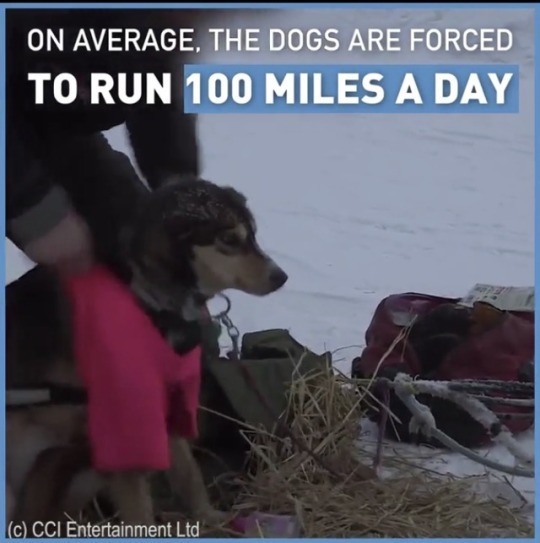
And I’m not just talking about the clip where we see a musher putting a protective coat on their dog.
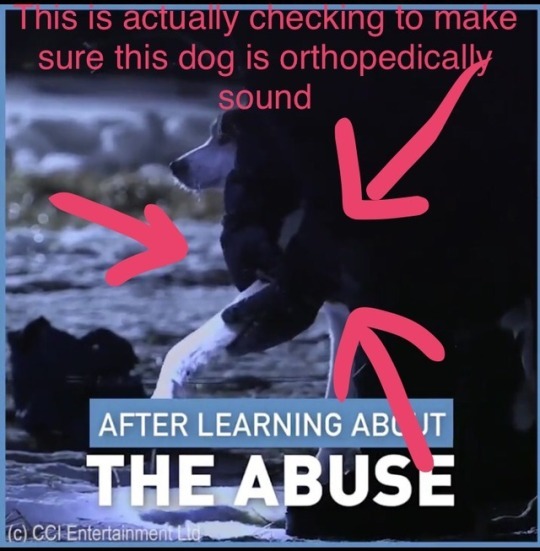
The two things that really stand out to me are actually after the dog-jacket clip. First we see someone extending a forelimb of a dog.
This is something we do a lot, both on sled dogs and on any patient where we want to check flexion and range of motion. With sled dogs, it’s very important to make sure they have good range of motion and that their legs aren’t painful when extended or flexed – especially after a rest.
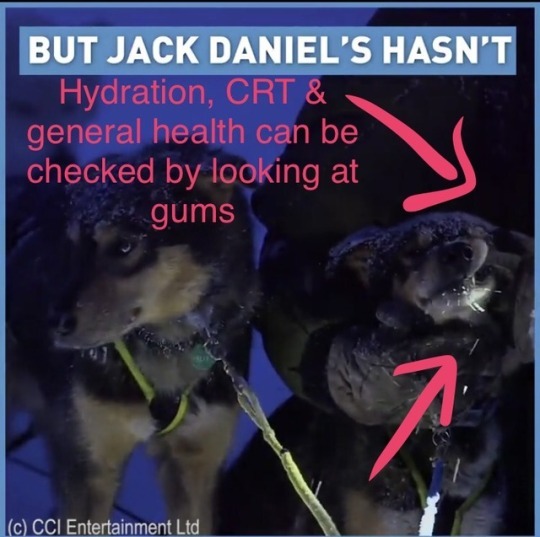
In the very next clip, there’s a blink-and-you’ll-miss-it moment where the musher or veterinarian lifts up a dog’s lip and checks the gum. This is a common method of checking hydration by making sure the gums do not appear tacky, and you can check CRT (Capilary Refill Time) by pressing on the gums and seeing how quickly the pink color returns. Checking the color of the gums is also important as abnormal coloration could be indicitive of a problem.
Veterinary care in all walks of life has improved over the past decades, and sled dog racing is no exception. Understanding of conditioning and the physiology of working dogs has lead to massive improvements in the Iditarod, whereas in the early 1970s when the race began, knowledge of distance racing was scant and resulted in a high number of dog fatalities – especially in the first two years of the race.
There’s a general rule of thumb in sled dog racing that you rest your team for approximately the same length of time you run them, so they are able to recuperate and continue. Every musher’s philosophy and schedule is a bit different of course and each race is different. The Iditarod requires designated amounts of rest time at certain checkpoints but most of it is left up to the musher and team since some might choose to rest at a checkpoint but others prefer to camp along the trail as it’s quieter for the dogs. This is why the amount of “required” rest (ie. rest at checkpoints) seems low.
“My dogs didn’t eat literally the one time when they were filmed in Rainy pass. Because it was warm. And they literally ate 15000 calories 5 hours previous and snacks 2 hours previous. Do you show that? No. Matt filmed me feeding once the whole Iditarod! Now I know why. Dogs don’t eat sometimes. Even house pets.”
It’s also worth noting that the Rainy Pass checkpoint is less than two hundred miles into the Iditarod, teams usually reach it on the second day of the race. No team has been racing for nine days when they reach that checkpoint.
one of my friends is a very pregnant dog and like 3 times a day i say to her “hello! you are full of several other smaller dogs!” and she wags her entire body at me like “it’s true!!! i contain multitudes”
i love that ur friend is the pregnant dog. what a nice friend to have.
ya she’s my buddy i love her!
update: there were five (5) smaller dogs inside my dog friend, but now they are all outside of her instead (!!)
My land lady is a 90lb 88 year old woman with 5 full grown Rottweiler boys. They sit around her when she gardens and watch her like the secret service. If you show up to pay rent they all stand up and stand between you and her.
It’s intimidating to have 5 pony size boys all staring at you until she stands up realizes it’a you and walks to you.
My favorite part is she wades through them like swamp water saying in her cute old voice ‘move’ ‘move please’ and each one she nudges to move wags his whole body at her touch and stumbles out of the way like he’s been knocked over by a truck. It gives me life paying my rent.
They failed to understand breed traits of the dog before they got it (y’know, since it was an impulse buy) and when you have a family with 6 kids and have strangers often over at the house due to that, having a dog that’s bred to be wary of and sometimes aggressive toward strangers is a FUNDAMENTALLY SHITTY IDEA.
Their dog even considered us strangers, even though she saw us every day, because we didn’t live in the house with them and would react with extreme aggression whenever she could see us out in our yard (which she considered ‘too close’ to her territory).
She reacted the same way to our dogs.
They have a 5′ fence, which she could easily clear, and did on multiple occasions, to chase people walking by–by chase, I mean she would have seriously injured them if she’d caught them, because everything she could see was ‘her territory’ and anyone even walking by their house was too close.
This was WITH professional training and extensive socialization. They at least knew they had to do that much because they have another large breed dog.
By the time she was a full sized adult, she was straight up a dangerous dog to have, especially since she could clear their fence, so they started tying her in the back yard when she had to go out instead of leaving her loose. She’d still bark excessively at anyone she could see and would try her hardest to bust the chain to get at anyone she could see walking past the house.
We started actually being afraid to be outside, not knowing when they were going to let her out, because she was so aggressively defensive and had charged at us in the past.
She also barked ALL THE TIME, because that’s what Tibetan Mastiffs do: Their primary ‘job’ in guarding their territory and flock is to bark until your ass comes out there to drive the threat off or the threat leaves on its own. Problem is, in a busy suburb, there’s always a ‘threat’ nearby in the dog’s mind, so she barked. Constantly. She even barked near constantly in the house. They tried a bark collar, but she just straight up didn’t give a shit (bonus: they’re also a stubborn breed and a breed with exceptionally high pain tolerance) and kept barking anyway.
They asked us what to do about a month ago after the first time she got out, attacked someone’s on leash dog, AND bit the owner of that dog (who said they didn’t want to press charges because the bite wound didn’t require stitches) because our dogs are well behaved and I was just, “You never should have bought that dog in the first place; that’s a dog that’s bred to be aggressively defensive about strange anything coming anywhere near its ‘territory’, which is anything even remotely close to your house. There isn’t anything you can do here, that dog is going to severely injure or kill someone or their dog at some point or injure or kill one of you or your kids or their friends in the process if you try to stop it.”
“…oh.”
“Seriously, read up on that breed a bit then tell me if you still feel confident you can safely keep her.”
She was gone 3 days after that conversation; they had her put down because, at this point, she wasn’t safe to really have anyone keep and had a bite history which made her a legal liability for anyone to keep (and would open them up to being sued if they failed to disclose the bite and behavior history and the dog ended up biting or killing someone or something else).
Our neighbor mentioned that, even on the way there, she nearly got away to lunge and chase after someone walking by or to go after people in the parking lot at the vet. It took them, the vet, and three assistants to get a muzzle on her and two of the assistants were bitten in the process.
This was not a ‘vicious’ dog, however, and her behavior–despite how it escalated–wasn’t atypical for the breed.
It was probably made a little worse as they didn’t know how to properly teach her the boundaries of their property or effectively curb her high guardian drive (which means she never should have been a ‘city dog’ in the first place). Some blame also lies with the breeder who was breeding and selling high drive working dogs for selling a high drive working dog to people who were looking for a laid back, large breed family dog.
Either way, because they impulse bought a ‘cute fuzzy’ dog, they ended up with a liability nightmare and the dog ended up dying because of it.
TL;DR: Don’t get a breed of dog because it’s “so fluffy!” or “so cute” or “looks like an adorable fuzzball”, actually research the traits of the breed of dog it is or is mixed with to make sure you can actually handle the animal properly and, if you can’t, stick to just looking at pictures instead.
These are Tibetan Mastiffs. The first photo is a dog that looks more like the AKC standard, whereas the bottom one appears to be more country-of-origin dog. They’re the huge fluffy animals that tumblr falls in love with (and yes, they’re the dog breed that being passed off in a Chinese zoo as a lion). They’re gorgeous animals, but they are not easy or good matches for ‘pet’ homes – @calleo‘s story is a prime example of why it’s so important to really research the breed of dog you’re getting before you commit.
I honestly have no idea. I would assume it’s based on at least tolerance (because a dog the animals fear couldn’t protect them successfully – it has to stay near them) but I don’t have any experience with working herding dogs. @animalsustainability probably knows folk who can answer this for us!
So first of all there is a misconception to clear up. People with livestock have two different kinds of dogs – herding dogs and Livestock Guardian Dogs (LGDs). The LGD is the one that protects the sheep – that’s 100% of it’s job. The herding dog, on the other hand, doesn’t protect the flock – it’s job is to move the flock where the human says so. That is 100% of it’s job. And they rely on two very different skillsets – while crosses do happen by accident (I know a lovely collie/pyrenees cross but he was very much unplanned), they’re bred to do two very different jobs and behave very differently. Pyrenees/Maremmas/Caucasian Shepherds (basically dogs of the big fluffy white variety) are LGDs. Collies, Australian Shepherds, Blue Heelers, etc – all herding breeds.
The LGD pretty much lives with the flock – if the dog is chill, the sheep are chill, and the sheep also sometimes use the LGD as a way of deciding if something is a threat or not. It is socialized to be around the livestock first, and view them as its to protect, against humans or other threats. They are always on duty for their flock and will not be friendly to strangers. They don’t really go off the clock, but I’ve seen them sleeping in the middle of a bunch of sheep on more than one occasion.
Photo: Case in point – here we have a LGD chilling with his sheep. He later got bored watching us silly humans and napped. Such fluff. Much chill. Wow. Photo credit: H.C. Dougherty (me)
Conversely, the herding dogs are often kept away from the sheep until it’s time to herd them. If they aren’t needed, they either chill with their people or with other herding dogs or in a kennel – they only interact with livestock when it’s time to herd something. So no, off the clock chilling doesn’t happen – it’s contrary to goals. However, the sheep aren’t supposed to be happy to see the herding dog either – the dog is supposed to be something annoying or mildly threatening to move away from in a controlled manner.
This is because the herding dog is a positive pressure to get the animals to move away from the dog and towards where the shepherd wants. As I heard a producer say at the most recent sheep festival, “If I don’t want the sheep to go somewhere, I put a dog there”. Because the sheep want to stay away from the dog, you use the dog as a way of getting the sheep to move somewhere else. This relies on using dogs to safely mimic predator behavior in a controlled environment – the sheep recognize the dog as something to avoid.
Image: A diagram explaining the flight zone of an animal and where you should move as a human to get animals to move one way or another. Dogs can apply similar pressure. Photo credit: Temple Grandin
Every animal has a flight zone – a bubble of personal space that if breached by an unfamiliar animal or human, they move away. Herding relies on using a dog to manipulate the flight zones to get the animals to move in a certain way – by making it so they want to move away from the dog or human. Flight zone is a function of familiarity – that’s why sheep are chill with LGDs – they see them daily. Herding dogs need to not be around the sheep as much so that they can be pressure on that flight zone.
A well-trained dog/human pair (or dog/human combo in general) knows how to apply and release positive pressure of the dog and human to get the sheep to go someplace with minimal fuss. The dog applies pressure to get the sheep to move, which is relieved when the sheep move. Repeat as necessary to get the job done. Ever heard a person say “that’ll do” to a dog? That’s the signal for ‘ok, ease off on the pressure’.
You can see herding dogs moving in ways that would be like how you’d see wild canids stare at, stalk, and chase their prey – except in this case, we’ve trained the dogs away from the final ‘and then kill’ part of it, and just to move in such a way that they put pressure on the flight zone to get the sheep to move where we want them to. We’re basically faking a wolf going after them, but in a positive manner – sheep respond to a herding dog like they would to a wolf and that’s what we want. That’s also why the herding dogs aren’t kept with the sheep – so that response stays in place. We’re also playing off the dog’s natural instincts here.
The dogs are also trained for years to do this – starting young. I saw a 2 year old collie at the festival who was still very much a newbie. We use experienced dogs to train the newbies, and a lot of shepherds use multiple dogs as well. But it is a tough job and the dogs are trained well and rewarded well for it. When they’re off the job, they are happy cuddlebugs like any other dog would be. I’ve given many an off-duty collie some tummy rubs.
I won’t deny, the sheep are stressed by the dog’s presence and activities. But moving animals is always going to cause stress – the goal is to minimize the stress but still get the job done, and proper use of flight zones and pressure is the best way to do it. And “dog-broke” livestock, aka ones used to being herded by dogs, will respond with less stress than ones not used to it – there’s even a genetic basis for ease of herding that can and has been selected for, and lambs learn from their mothers. So the sheep can get used to it but it will still be effective as a method to move sheep into pens for vet checks/between paddocks/etc.
Fact of the matter is, herders need their dogs to effectively move their sheep in as low-stress a manner as possible, and it’s a work of art to see trained herding dogs do their job. With a well trained dog, the sheep are more annoyed than stressed, but know it’s part of the deal, and the dog and human work together like a visual symphony. If you have the chance to see sheepdog competitions – I seriously recommend you go. They’re visual art and so magnificent to see, and I love them so.
When they are full-grown at around 100 pounds, their jaws will be strong enough to crack moose bones. But because these wolves have been around humans since they were blind, deaf and unable to stand, they will still allow people to be near them, to do veterinary exams, to scratch them behind the ears — if all goes well.
Yet even the humans who raised them must take precautions. If one of the people who has bottle-fed and mothered the wolves practically since birth is injured or feels sick, she won’t enter their pen to prevent a predatory reaction. No one will run to make one of these wolves chase him for fun. No one will pretend to chase the wolf. Every experienced wolf caretaker will stay alert. Because if there’s one thing all wolf and dog specialists I’ve talked to over the years agree on, it is this: No matter how you raise a wolf, you can’t turn it into a dog.
As close as wolf and dog are — some scientists classify them as the same species — there are differences. Physically, wolves’ jaws are more powerful. They breed only once a year, not twice, as dogs do. And behaviorally, wolf handlers say, their predatory instincts are easily triggered compared to those of dogs. They are more independent and possessive of food or other items. Much research suggests they take more care of their young. And they never get close to that Labrador retriever “I-love-all-humans” level of friendliness. As much as popular dog trainers and pet food makers promote the inner wolf in our dogs, they are not the same.
I read this article and found it to be a really enjoyable read. I might be biased though because Wolf Park is in here 🙂


 BettSplendens Tumblr Evac