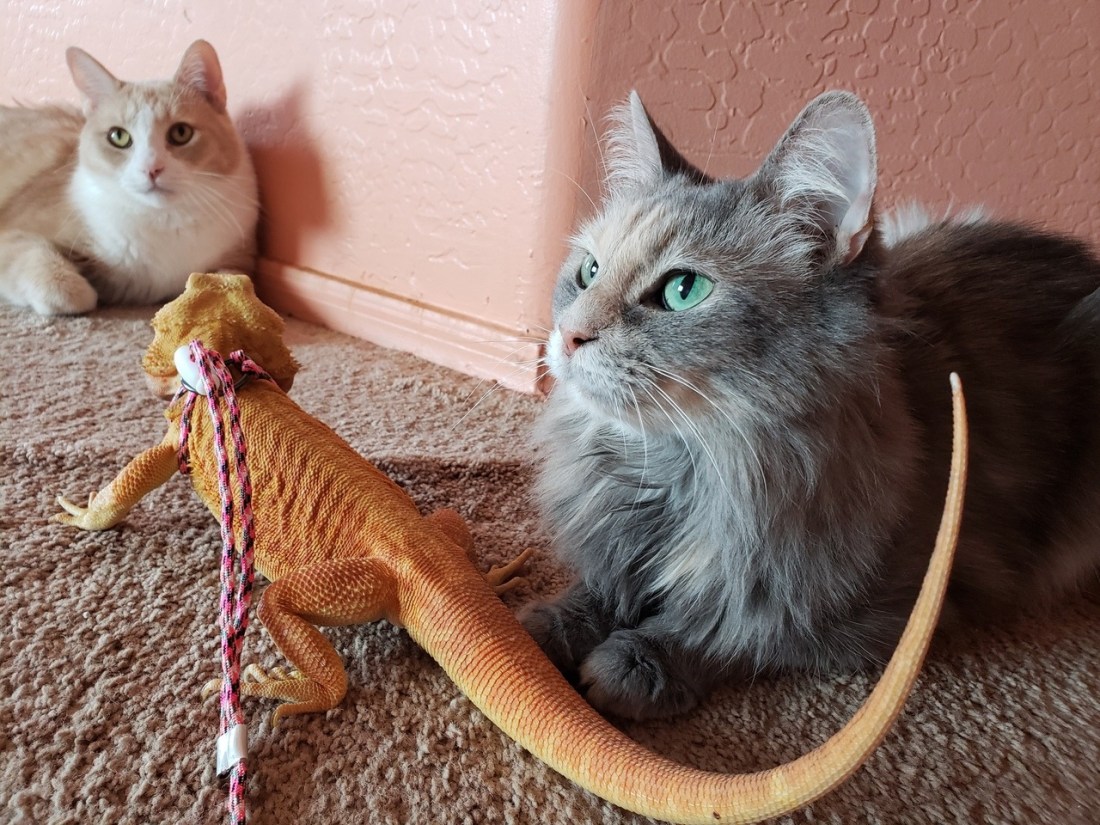
Hey! This is actually super dangerous for your beardie! Bearded dragons should never be within paw’s reach of a cat- even the friendliest, sweetest cat in the world can be deadly to them. The bacteria under their claws and in their mouths is often fatal to lizards, and so even an inquisitive pat can lead to astronomical vet bills! Cats are also extremely adept at killing reptiles; in the big kittycam study, reptiles were the number one prey of roaming felines. I’ve got a lot of information in my cats and reptiles tag if you’d like more information and in-depth sources.
putting this here because it’s really important. please do not let your cats and reptiles interact!
This is a horrendously obese animal that should not be kept indoors, nor should i be interacting with a house cat. That is a raccoon, they are not domesticated and they are very bad pets. That one is probably well on its way to dying an early death from being fed improperly.
terrifying your own child into submission makes you an abuser.
watching your child cry and screaming at them to stop and invalidating their pain and reasons for crying makes you an abuser.
staring at your child in disgust and contempt after they displease you makes you an abuser.
threatening to your child to take away their basic resources if they don’t give you exactly what you want makes you an abuser.
forcing your child to feel ashamed for not living up to your ideals makes you an abuser.
using slurs, hateful names and insults on your own child without any regard to what it does to their mental health makes you an abuser.
forcing your child to chase impossible expectations and making them feel like they’re worthless for not achieving them makes you an abuser.
acting like your child is a burden and a waste of space and blaming their illness/disability/depression on it makes you an abuser.
behaving like your child will never amount to anything and isn’t worth any resources and nurturing makes you an abuser.
making your child feel like they’re never good enough makes you an abuser.
if your child’s heart is hurting because they know no matter what they do and how hard they try they will always be a failure in your eyes, you are an abuser.
if your child can’t look at themselves without self hatred because they had to look at themselves from your perspective and all they saw is disgust and hatred, you’re an abuser.
If your child is struggling to believe they have the right to live and to be cared and loved, if they can’t stop hearing your hateful voice putting them down and using their every action to prove they’re worthless, you’re an abuser.
If you watched your child in pain and assured them they deserved it, you’re an abuser.
If your child can’t love themselves from how badly you hated them, you’re an abuser.
An interesting one from my own experience:
Convincing your child they will fail at anything they try, or that they’ll die young, because you used scare tactics like “do you want to end up a loser because you didn’t do (X)?” or “just wait until you get (disease) because you didn’t listen to me!” as a way to ‘motivate’ them makes you an abuser.
Using any form of negative reinforcement or feedback so recklessly and severely that your child internalizes all the negativity you throw at them makes you an abuser.
An inability to help or motivate your child into good behaviors without traumatizing threats, however indirect – and, likewise, a refusal to assess why your child may be engaging in bad behaviors – makes you an abuser.
Cats have bacteria in their saliva that can cause lethal sepsis from the tiniest of scratches, and that bacteria is often on their claws from when they groom themselves. If that cat nips or scratches the little furry thing, even in play, and breaks skin at all, that adorable fuzzball has a high chance of dying a slow death. Those playful swats could have done the job.
It’s freakin’ adorable, but you should not put predators and prey together, ever.
Squeaky toys have not fully matured into good playfellows yet.
Have… Any of you actually watched the video and seen the part where the dog almost grabs one of the kittens? If the dog decided to follow through that kitten would be a rag doll and dead or hurt in way too short a time to intervene. This is not ok.
That dog is far too large and excited to play with those kittens. Dog play is different from cat play, and there’s a huge size difference here. That husky could seriously hurt or kill one of the kittens by mistake, either by grabbing one or just by stepping on one. The video is cute, but not worth the risk of one of those kittens being crushed.
Nondisabled storytellers often seem to think of disability as an abusive roommate coming and imposing its will on a disabled person. When they think about wheelchair users, they don’t think about the mobility that’s made possible by assistive technology. They think about how they’d feel if someone chained them to a wheelchair and forcibly prevented them from walking.
This misconception is dangerous. When people see disability-related limitations as similar to violent restraint, they don’t know know to tell the difference between the innate limitations of someone’s body and limitations being forcibly imposed on them by others. When people don’t understand the difference between living with a disability and living with an abuser, they assume that abusive experiences are inevitable for people with disabilities.
In reality, there’s nothing inevitable about abuse. Coming up against the limitations of your body is fundamentally different from being forcibly restrained by someone else. Whether or not you are disabled, having physical limitations is part of having a body. Being disabled means that you have a different range of physical limitations than most other people do, but they don’t come color coded ‘normal’ and ‘disabled’. When you’re used to the way your body works, the disability-related limitations feel pretty similar to those that aren’t disability-related.
Using assistive technology is pretty similar to using technology for any other important reason. Everyone uses technology to do things that their bodies alone would be too limited to do. Most people use cars to go further than they could walk; some people also use wheelchairs to go further than they could walk. Some people type or use communication tablets to say more than they could with their bodies alone; some people use musical instruments; some people use both. People with disabilities have different limitations, and as a result, often benefit from technology that wouldn’t be particularly useful to nondisabled people.
When technology is associated with disability, people tend to have the dangerous misconception that using it is the same as being restrained. This can very easily become self-fulfilling. When people prevent disabled people from doing things, their inability to do it is often misattributed to their disability. For instance:
Wheelchairs as restraints:
Anthony lives in a nursing home.
Anthony speaks oddly, and most people interpret most of what he says as meaningless. They say ‘Anthony doesn’t communicate’.
Anthony can walk and wants to walk, but the nursing him staff don’t let him.
George, the supervisor, tells Sage, another staff member, ‘Anthony wanders. We need to keep him in his wheelchair to keep him safe. Just lock the seatbelt. After a few minutes, he stops resisting.’
Every morning, Sage puts Anthony in a wheelchair that he can’t move, and ties him down so he can’t escape.
Sage tells Marge, a new volunteer, ‘That’s Anthony. It’s so nice to have a volunteer – he’s been spending most of his time in the hallway lately. He doesn’t walk or talk, but he loves visiting the garden! Can you take him there?”
Marge and Sage don’t know what Anthony actually wants, and it doesn’t occur to them that it’s possible to ask.
Anthony actually hates the garden and hates being pushed by other people. He prefers to spend his time in the library or with children in the children’s wing.
Marge assumes that Sage is the expert on Anthony, and assumes that Anthony’s disability prevents him from walking and communicating.
Marge doesn’t know that Anthony has stopped talking because he’s constantly surrounded by people who refuse to listen to him.
Marge doesn’t know that Sage is tying Anthony to a wheelchair against his will to stop him from going where he wants to go.
Marge doesn’t know that she’s doing something to Anthony against his will.
When people see disability and restraint as the same thing, they fail to notice that people with disabilities are being violently restrained — and often unwittingly participate in physical abuse of disabled people.
The disability-as-restraint misconception also causes people to fail to understand that when they deny people access to assisstive technology, they’re preventing them from doing things, eg:
Mobility:
Beck is an eight year old who can’t walk.
Beck has a wheelchair, but he’s not allowed to bring it to school.
At school, he’s strapped into a stroller that others push around.
His classmate Sarah has *never* had a wheelchair that she can push herself.
At a staff meeting, Lee, their teacher, says “Because of their disabilities, Sarah and Beck can’t move around by themselves. Even though they stay in one place all day, they’re so fun to have in our class!”
Lee is missing the crucial fact that the reason Sarah and Beck are immobile is because they’re being denied access to assistive technology.
When people see disability and externally-imposed limitation as the same thing, they don’t notice limitations being imposed on disabled people.
Communication:
Rebecca types on her iPad to communicate.
Clay takes away Rebecca’s iPad.
Clay tells Sophie, ‘Rebecca is nonverbal. Her disability prevents her from communicating, but we’re working on improving her speech.’
Sophie sees that Rebecca can’t talk, and assumes that it’s her disability that’s preventing her from communicating.
Actually, it’s *Clay* who is preventing Rebecca from communicating.
When people see disability and abuse as the same thing, they don’t notice abuse of disabled people.
It’s important to be clear on the difference between disability and abuse. Disability is not an abusive roommate; people with disabilities are only abused if someone is abusing them. When people with disabilities are restrained against their will, this is not caused by their disabilities; it’s caused by the people who are restraining them. Restraint is an act of violence, not an innate fact about disability. When wheelchairs are used as restraints, the wheelchair isn’t the problem; the violence is the problem. When people are denied access to assistive technology, it’s not their disability that’s limiting them; it’s neglect. When we stop conflating disability and abuse, we’re far less likely to see abuse of people with disabilities as inevitable.
So many Pro-Spanking advocates talk about how they “Deserved” to be hit by their parents because they were “a bad kid.” And it makes me so sad.
You weren’t.
You weren’t a bad kid, and you didn’t deserve to be hit. Maybe you were a difficult kid, maybe you struggled with boundaries or rules or expectations. Maybe you had bad behavior much of the time. But you, yourself, were not and are not a BAD person for that, and you didn’t EARN violence. You didn’t have it coming. It shouldn’t have happened to you.
Someone’s kids are spoiled rotten little fucks who don’t know how to behave in public or at home. There have been many attempts to successfully pull spanking from parenting in recent years as the post modernist mentality hit that realm. But there is a reason is it a tried and true part of parenting because there is a balance to achieve between rewards and punishment. Some parents are too liberal with spankings and others won’t even hold it in reserve for the worst of behaviors. New age parenting is incomplete because it only looks at half of the nessisary puzzle to raise your child. If you look at studies previous to the 90s you find that spanking was beneficial, but when the post modernist echo chamber started impacting psychology this flipped to reject all classic knowledge as is a trend with post modernism as a whole.
And all of these are post 1990. Did you even read what I said, or simply get triggered by my statement so quick you just replied.
The first one explicitly says that its built off 50 years of collected meta data. Soooo.
And Also “This science is too recent” is an interesting methodology. Like…that…isn’t how sociology works.
also, the main reason nonviolent parenting styles haven’t worked isn’t because you need violence to parent, it’s because the various methods never actually address the problem.
we have this weird idea that consequences are the best deterrent to bad behavior, but that simply isn’t true. If consequences- be it spanking, a time out, losing your video games, going to jail, etc- are the ONLY THING keeping you from doing something bad, you’ll more than likely do it if you think you can get away with it. or, alternatively, you’ll be so afraid of consequences that you’ll be mentally incapacitated at the slightest hint that someone is upset with you, killing your social life and any chance to learn the skills you need to handle that situation.
what actually stops being from misbehaving is understanding WHY they shouldn’t do something. and “my house, my rules” doesn’t cut it as a reason; there needs to be an understandable reason. sometimes it’s an inherent consequence; you can’t put a cookie in the ps2 because then the ps2 breaks and you can’t play video games anymore. sometimes it’s a moral reason; you can’t hit your sister because it hurts her and makes her upset. sometimes it’s a social reason; grandma will think you’re rude if you drop a hard boiled egg in her water glass.
you need to actually talk to your kid and help them understand these things with whatever level of reasoning they have. and if they’re too young to be reasoned with, they’re too young to understand why you’re hurting them.
another issue is that many times, the child does understand why they need to be better, but they’re unable to. bad grades are a huge example of this. getting spanked for a bad grade never made me do better, it just made me cry so hard i choked every time i got anything below a C. it took until highschool, with no help from my parents or teachers, to realize that the reason i was failing was because i had memory problems, and it took another year to figure out how to remember better. if my dad had sat down and taught me some ways to remember better instead of putting me over his knee, i would have been doing much better.
and this may surprise you, but the reason we’re finally understanding that spanking DOESN’T benefit kids is because we’re finally looking at them as people, not pets or property. child psychology is about understanding that this is a human being with all the same capacity for feelings that you have, maybe even more, and not nearly enough resources to express them. children aren’t little monsters that need to be herded and corralled and trained. they’re very tiny, very confused people, and it’s our responsibility to teach them how life works.







 BettSplendens Tumblr Evac