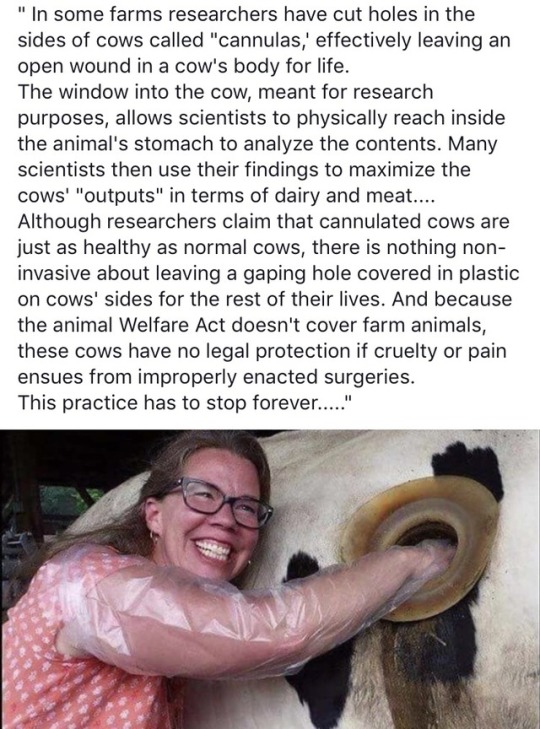
So there’s a really stupid page on FB called dairy farms exposed and they made this post not that long ago….
People. Cannulas do help with nutrition research. Because we kinda want to make sure cows’ food is easily digestible and nutritious for them. The absolute horror.
Also cannulas allow for ruminal fluid to be taken from the rumens of healthy cows and put into sick cows to replenish rumen bugs.
Cannulas don’t hurt cows!! They’re put in under anesthesia!! It’s just science!!
“Because we kinda want to make sure cows’ food is easily digestible and nutritious for them.”
Are you fucking serious?
If the food you’re giving them is so damn questionable for a grazing ruminant that you actually have to put a hole in a cow’s stomach to make sure they’re healthy, and if you can’t see the health of your animals by day-to-day physical inspection, then you’re a fucking idiot, or you have no experience with animals.
And then claiming it’s alright because “It’s just science!!”……….. No. Science is a method by which you study cause and effect, it’s not a justification for cruel research.
I don’t care if it doesn’t hurt or if they’re doped up and don’t feel it (more cheap justifications). This is wrong. You don’t put holes in animal stomachs. These aren’t machines to optimize, they’re living beings to be cared for and then milked or eaten.
I’m sorry, but how is it wrong to optimize your yield? Even if that yield is an animal product like milk or meat. I know cannulas look gross, but as long as they aren’t put there at the expense of the animals’ welfare, I really can’t see the problem. The goal of the procedure isn’t much different than the goal of genetic modification or selective breeding or testing new types of feed – it’s all about optimizing yield.
A cannula is nowhere near as invasive of a surgery as it looks. Ask any person who’s had an ostomy (different placement and cause, but both essentially involve an artificial opening in the body). During the operation, which only takes about 1½ hour, the cow has been locally anaesthetized and lightly sedated so she doesn’t feel a thing, and the first few days after, she receives painkillers. Ultimately, the cannula doesn’t seem to bother the cows and they’re able to run around like their non-cannulated sisters.
The cannula itself isn’t just there to optimize feed. I’m copying this from other sites, but here’s a bunch of the things we’ve gained from having cannulated cows:
“Reduced nitrogen emissions: Due largely to the fistula cows, a new system for protein evaluation for ruminants was introduced some years ago. This has led to significantly more environmentally friendly livestock farming through reducing nitrogen emissions.
Healthier milk fat: Based on research using fistula cows, researchers have arrived at a formula for cow feed that produces milk with healthier fat composition.
New knowledge on greenhouse gases: Through the agency of the fistula cows we are able to measure emissions of the greenhouse gas methane and thereby try to establish a feed that is as environmentally friendly as possible.”
“Being the quintessential symbiotic relationship — the cow supplies the bugs with nutrients and the bugs convert cellulose into usable energy for the cow — it also works the other way: when the cow gets sick, the bugs get sick, too. Then they die. And no gut bugs eventually means no cow.
Transfaunation — the act of taking microbes from one source and putting them in another — can be a literal lifesaver when it comes to a bovine bellyache. And how does one go about retrieving such a sample? By creating a one-stop shop for your sick cow’s gut flora needs. Designated donor cows with a surgically installed port allow access to the rumen from the outside.
Rumen flora from a fistulated cow helps not only sick cows, but also sheep and goats because they share similar digestive systems. “Our vet school always has a fistulated cow,” Aldridge says. “The bovine GI surgery patients routinely get a transfaunation because it’s been shown that the recovery rate and return to appetite and milk production is much greater if you reestablish the gut flora.”
Sick farm animals and surgical patients aside, fistulated cows are also a staple in bovine nutrition research, since having a fistula makes it easy to sample rumen contents in order to study how different nutrients affect a cow’s digestive system. The cost of surgically installing a rumen fistula is about $300 and doesn’t affect the longevity or health of the cow, says Dr. Susan Fubini, professor of large animal surgery at Cornell University’s College of Veterinary Medicine. “The plastic cannulas themselves last forever,” she says. As for the fistulated cows, “They are without a doubt the happiest animals in our hospital.””
On top of this, cannulas can be used to treat bloat, which is very painful and always fatal if left untreated.
How does one deem something which doesn’t cause an animal any pain or discomfort “wrong”? If they don’t care, neither should you.
Plus, I’d imagine looking at what happens to food as it’s digested is a very good way to figure out exactly what food is best for the animal in question.
And the hole isn’t left open. There’s a lid to cover it when it’s not in use. It’s not an open wound any more than a piercing is.
the howlies were an unconventional unit. we moved faster than most other groups, and we were willing and able to take bigger, harder targets than most our size could. we also had the advantage of all being experts in our respective fields, and combined with steve’s conniving artist brain being in charge, we came at problems in unexpected ways.
all those things meant that we ran a lot of what phillips misleadingly called ‘precision ops,’ where our small team would covertly reach and then take out a target beyond our own lines, then exfiltrate back to safety. generally whatever our target was wound up as a massive heap of ash and rubble, because the howlies had a really unnecessary number of guys who wanted to demolitions. uh. ill admit to being guilty of that one myself.
cows are so wild like here I am walking through a field surrounded by 30, 1200 pound animals who are Fully Convinced I am capable of killing them with my bare hands so they are dutifully cautious of me
but then sometimes they suddenly think “hey wait…maybe WE could kill HER” and they start getting uppity so I have to pick up a stick and walk toward them as if I could do anything about it and they think
“oh hm wait….she has a branch now……… … We wouldn’t stand a chance……”
You could not milk the cow if you just?? Let it’s baby cow feed like it’s supposed to.
If you take away the bby then obviously you have to milk it but if you aren’t needlessly removing the bby I don’t see the problem.
Plus milk is way too many calories and makes you fat. It’s not meant for humans.
expect you can’t just “not milk” a cow. It literally needs to be milked. Cows that aren’t milk can suffer infections (mastitis), pain and discomfort.
And there’s many reasons for removing a calf from it’s mother.
And milk has only 42 calories per 100 grams. So no it doesn’t have “too many calories” or does it “make you fat” and being fat ≠ unhealthy.
You shouldn’t comment on things you obvious have no idea about. You’re spreading ignorant misinformation and it makes you look like an idiot to boot.
Me again, I’m sorry for reblogging again, my responses are just too long for the repy button.
Dairy cows produce too much milk for calves, so regardless of calves suckling we would have to milk the cows or they would get engorged, and after a day if being engorged the baby would actually not even be able to suckle due to the swelling of the udder.
Calves are actually not taken away at birth, they are allowed to nurse and live with their mom for the first few days. Then they are seperated into calf hutches/rooms where they live with the other calves. They get fed formula every day and most farmers/farm hands are nice and give them pets so it’s not like they’re starved for affection. They can just look across the partition and chat with other calves.
Calves are also very rough. As someone who has scars on her hand from calves just a few weeks old trying to suckle on them, let me tell you how rough they are. Calves headbutt, chew, tear, and rip the cow’s udders very frequently. Udders are not as strong as most mammals teats after years of domestication, so they are fragile. Calves only have bottom teeth, as the top is just hard gums, but those teeth are razor sharp. My hand was in a calves mouth for 20 seconds before I was bleeding, because he wanted his formula right now. You can tell when a calf has been left with a cow by looking at the udder, which will be scarred and knotted. Sometimes the nipples will be so scarred that no milk can come out, leaving problems for infection and engorgement the next cycle. When the cows get sick of being hurt, they kick the baby in the head to make it stop, which is dangerous to the poor calf.
Leave the baby with mom sounds good in theory, but dairy cattle have been specialized and raised this way for a very long time. That means that natural methods can sometimes hurt them, and it is our job to protect them. Nature is harsh and lots of animals die and suffer. Our goal is to keep animals safe and alive even if it’s for the purpose of consuming them and their by products later.

 BettSplendens Tumblr Evac