birdsbugsandbones:

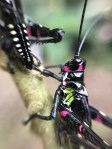
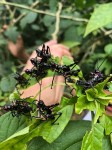
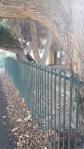
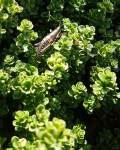
Lovely large ladies on the alpine mintbush! Both these insects are big, for bugs, and both are flightless, flashy coloured, and female.

On the right is the spotted mountain grasshopper (Monistria concinna), who’s delightful spots are an aposematic colouration warning of her toxicity. She’s grazing voraciously on the mintbush to build up weight before winter, where she won’t die like other alpine insects but rather, she will freeze solid, awaiting the thaw of spring to live and eat another year!

On the left, the flagship species of my lab, the mountain katydid (Acripeza reticulata), doing her deimatic display. She has lifted her wing cases to reveal her colourful, curled abdomen covered in foul tasting secretions, as well as inflating her orange throat patches. She too is eating the mintbush, possibly to sequester the toxins in its leaves for her defense, like the grasshopper does.

These gorgeous girls are but a small part of the fantastic array of Australian alpine invertebrates that make fieldwork a real treat.
cool-critters:

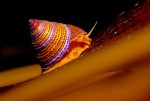
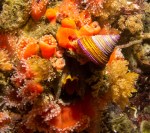
Purple-ring topsnail (Calliostoma annulatum)

The purple-ring topsnail is a medium-sized sea snail with gills and an operculum.This is a sublittoral marine gastropod mollusk in the family Calliostomatidae. This snail lives off of the Pacific coast of North America.his species is fairly omnivorous, feeding seasonally on kelp, sessile fauna like bryozoans, and detritus.

photo credits:

Peter Liu PhotographyEd Bierman

bunjywunjy:

congenitaldisease:

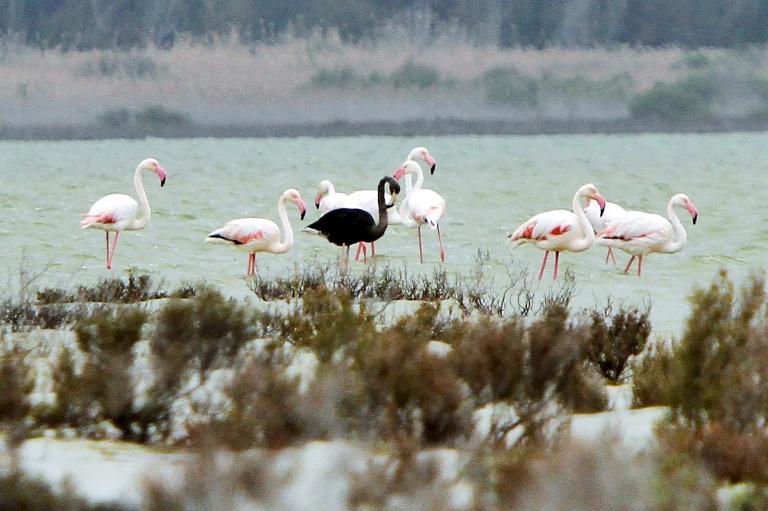
This black flamingo was spotted in Cyprus. It is just the second black flamingo ever seen. The first one was seen in Israel in 2014 but experts believe they may be the same bird, meaning that only one black flamingo has ever been seen. The black flamingo is affected with melanism, which is a condition caused by an overproduction of melanin, darkening the skin. An animal with melanism is a very rare sight.

goth spotted

justnoodlefishthings:

thecolorsofwater:

ask-ickle-mod:

rasec-wizzlbang:

revereche:

rotifers:

becausebirds:

A conversation between a Raven and a Snowy Owl.

more stuff on becausebirds.com

It looks like the raven really wants the owl to leave and is trying to intimidate it, but the owl doesn’t care because it knows the raven is all bark and no bite. Or all squawk and no peck. Erm…

Actually, it looks more like the raven is curious about the funny bird and wants to sit next to it, and the owl doesn’t wanna be friends :[ The raven’s body language isn’t aggressive at all — it’s backing down appropriately when the owl displays aggression. Notice the way it’s careful to draw back every time it gets too close to the owl. This is an animal that’s trying to establish it isn’t a threat.

Keep in mind there’s a huge intellect disparity here — ravens exhibit novel tool use and complex communication, whereas owls aren’t even as smart as ducks. We’re sort of trained to view crows and ravens as villainous, but really they’re very playful animals.

“HI YOU’RE PRETTY WANNA BE FRIENDS??”

“HISSS”

This is so cute ‘cause I can imagine the crow being the talkative, friendly one and he’s just like “hi gosh wow you’re pretty I’ve never seen a white crow before! How’d ya get your feathers so white? Do you eat a lot of marshmallows? I eat a lot of marshmallows! This human lady feeds me marshmallows–” and on and on and the owl’s probably just like “What no go away”

This is adorable

My whole childhood just got ruined by that “owls aren’t even as smart as ducks”

typhlonectes:

Termites are just cockroaches with a fancy social life

Reordering demotes one infamous insect group to being a mere branch of an equally infamous one

BY SUSAN MILIUS

Termites are the new cockroach… Literally. 

The Entomological Society of America is updating its master list of insect names to reflect decades of genetic and other evidence that termites belong in the cockroach order, called Blattodea.

As of February 15, “it’s official that termites no longer have their own order,” says Mike Merchant of Texas A&M University in College Station, chair of the organization’s common names committee. Now all termites on the list are being recategorized.

The demotion brings to mind Pluto getting kicked off the roster of planets, says termite biologist Paul Eggleton of the Natural History Museum in London. He does not, however, expect a galactic outpouring of heartbreak and protest over the termite downgrade. Among specialists, discussions of termites as a form of roaches go back at least to 1934, when researchers reported that several groups of microbes that digest wood in termite guts live in some wood-eating cockroaches too.

Once biologists figured out how to use DNA to work out genealogical relationships, evidence began to grow that termites had evolved as a branch on the many-limbed family tree of cockroaches…

Read more: Science News

drferox:

Hi Dr Ferox! I saw this guy today and thought you might be interested – he’s got 3 legs! I didn’t see it til he flew away, but you can see it in the zoomed in photo!

It’s still hard for me to see, but it doesn’t seem to have slowed the fellow down at all.

That is really cool! You don’t often see a perfectly functioning animal with an abnormal number of limbs in the wild. He looks healthy.