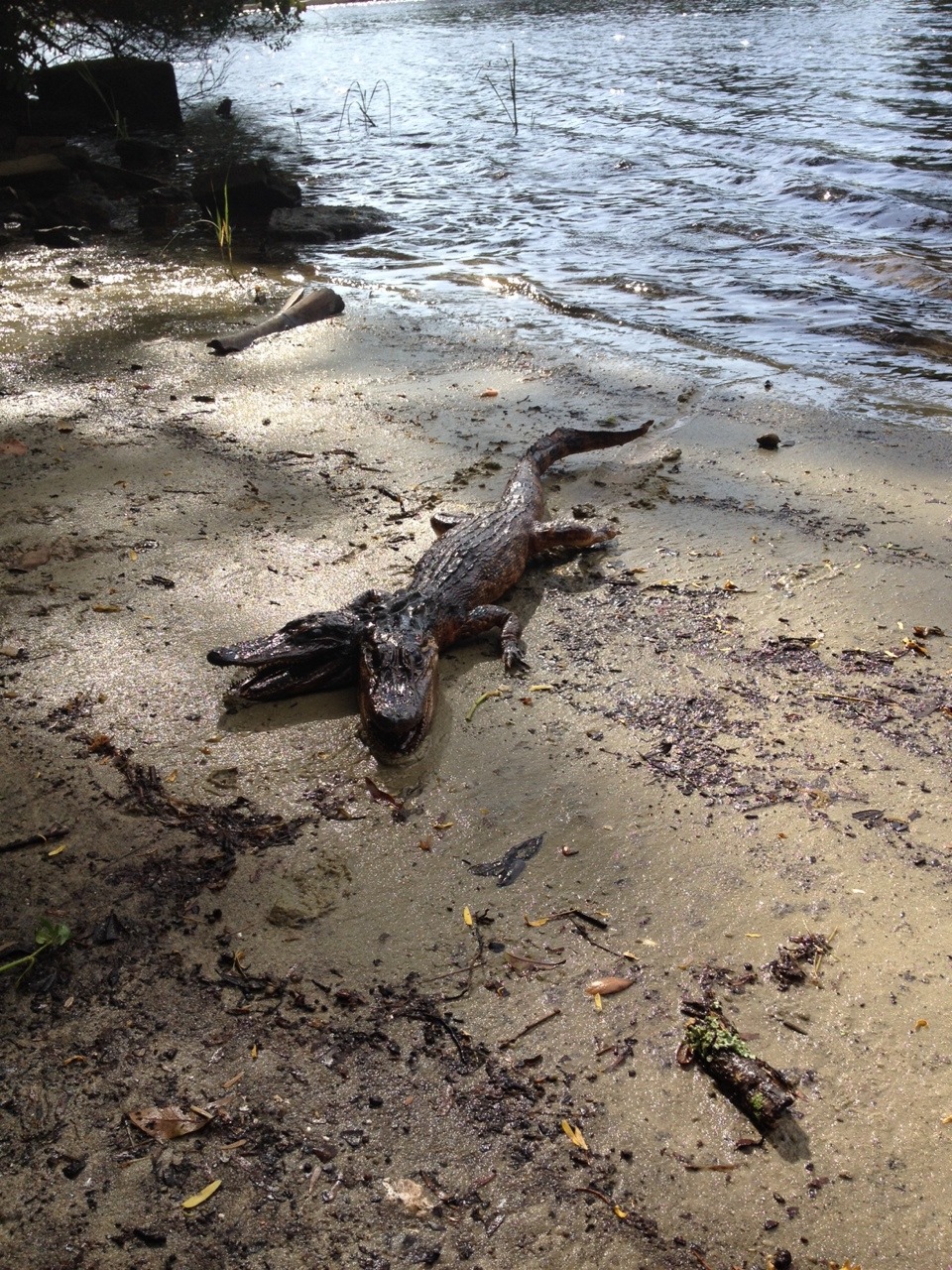
Two-headed alligator spotted in Tampa, Florida along the Hillsborough River in the Seminole Heights neighborhood. According to Florida Fish and Wildlife, this alligator has been reported by several people. They explained that failed separation of monozygotic twins is common in reptiles and amphibians but they rarely reach this juvenile state.
I checked this out online…no sign of photoshop! This is honestly the first time I’ve seen a dicephalic, non-infant animal in the wild!
It’s hard to tell, but it still does look pretty young! That’s super cool.
It looks relatively healthy, too, not emaciated or anything. I’d be in favor of scooping it up to put it in a zoo and keep it alive longer, but it seems to be doing OK for now. Might have more difficulty when it has to sneak up on larger prey as it grows. That can’t be very hydrodynamic, either.
The Phantom Nudibranch (Melibe colemani) is an incredibly cool see-through nudibranch. It seems to be only made up of strings, which are actually its digestive glands. This allows it to blend in almost perfectly with its surroundings, making it incredibly hard to spot in the wild. Because of this, it was only discovered as a species in 2012! Being in the Melibe genus, the Phantom Nudibranch has an expandable oral hood to catch prey. It lives off the coast of Malaysia and Indonesia. Want to see it in action? Check out this video!
HOLY SH*T. THEY FOUND NITROGEN-FIXING CORN BRED BY INDIGENOUS PEOPLE IN MEXICO. @botanyshitposts
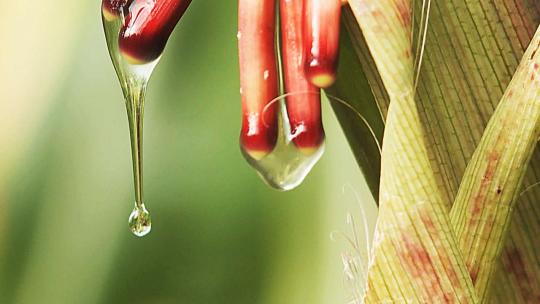
“The study found the Sierra Mixe corn obtains 28 to 82 percent of its nitrogen from the atmosphere. To do this, the corn grows a series of aerial roots. Unlike conventional corn, which has one or two groups of aerial roots near its base, the nitrogen-fixing corn develops eight to ten thick aerial roots that never touch the ground.
During certain times of the year, these roots secrete a gel-like substance, or mucilage. The mucilage provides the low-oxygen and sugar-rich environment required to attract bacteria that can transform nitrogen from the air into a form the corn can use.
“Our research has demonstrated that the mucilage found in this Sierra Mixe corn forms a key component of its nitrogen fixation,“ said co-author Jean-Michel Ané, professor of agronomy and bacteriology in the College of Agricultural and Life Sciences at UW–Madison. “We have shown this through growth of the plant both in Mexico and Wisconsin.”
…
“
Researchers are a long way from developing a similar nitrogen-fixing trait for commercial corn, but this is a first step to guide further research on that application. The discovery could lead to a reduction of fertilizer use for corn, one of the world’s major cereal crops. It takes 1 to 2 percent of the total global energy supply to produce fertilizer. The energy-intensive process is also responsible for 1 to 2 percent of global greenhouse gas emissions.
“
I’ve written about this before, this is one of those ‘saving the planet’ levels of discovery. No joke.
According to a new genetic analysis, his dad was a
rough-toothed dolphin and his mum was a melon-headed whale – the first
ever known hybrid of its kind.
This is an albino gray tree frog (Hyla versicolor) which is normally – you guessed it – gray in color. The lack of melanin gives it this pink hue… which to me makes it look like it’s made out of BUBBLE GUM!



 BettSplendens Tumblr Evac