BONNETHEAD IS AN OMNIVORE SHARK, RESEARCHERS FOUND
What an animal consumes and what an animal digests and assimilates for energetic demands are not always synonymous. Sharks, accepted as carnivores, have guts that are presumed to be well suited for a high-protein diet. However, the bonnethead shark (Sphyrna tiburo), an abundant shark commonly found in seagrass habitats, has been previously shown to consume copious amounts of seagrass, flowering marine plant that forms subsea meadows in some coastal waters in the Gulf of Mexico, as in other parts of the world. And now, is considered the first known plant-eating shark. The finding were published in the journal Proceedings of the Royal Society.
The bonnethead shark is an abundant shark species in shallow waters of the Eastern Pacific, the Western Atlantic, and the Gulf of Mexico, where they feed on seagrass and small crustaceans, snails and other fishes, and according to researchers, in natural conditions, up to 62.1% of gut content mass is seagrass. Because a large percentage of the diet is seagrass, conserving seagrass beds is vital to the hammerhead shark family and other marine life.
Photo: bonnethead shark in Bahia State, Brazil, by José Amorim Reis-Filho.
The Horse Heaven Hills, near Prosser Washington, get lots of fog. It’s been a week or more since the sun was last seen (assuming it’s still out there) and the ice from the fog is really building up.
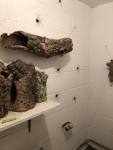
From (The Spider Shop) an entire small bathroom as a whipspider habitat is such an amazing aesthetic concept and I’m sure they love it when the lights are out and there’s no humans bothering them, HOWEVER I’d be so worried about them getting hurt or lost when the door is opened and it looks like the toilet is still used by people?!
I don’t know how they’re clinging to those tile walls either, my one can’t climb anything smoother than bare rough brick.
Oh yeah you might notice how they’re arranged really evenly on that wall, too – that’s actually how they live in the wild!
They inhabit caves, hollow trees or sheer rock walls in the tropics, and will spend most of their time just sitting in one spot, slowly slowly waving their ultra-long “whips” (legs modified into feelers) all around themselves in a circle to search for any passing prey.
If they feel the whip of a fellow spider they will move just out of their way, so they all end up exactly at “arm’s length” from one another in a sort of loose grid or checkerboard of little hunting spots.
It’s almost like a perfect video game setup. If you’re an insect lost in a whipspider cave, you’ve got to navigate this minefield of nearly blind predators whose huge long skinny arms are just constantly, silently circling in search of YOU!
Not a lot of things they eat are really smart enough to last very long that way.
Actually even if they were smart this is still the setup they’re dealing with:
WAIT ANOTHER THING I FORGOT
So they live in total darkness, and most of their prey, like cockroaches, rely entirely on touch to navigate that environment.
So, the prey feels something brushing it in the dark, something little and light, just the tip of something, no big deal….and has an instinct to just move AWAY from that thing, right? Problem solved?! But since the arms reach around so far, it often means a situation like this:
….And if the prey doesn’t just blindly march straight into its mouth from there, the whipspider will do this:
It doesn’t need to pounce or chase. The prey doesn’t have a direction to go where it won’t bump into one of the arms, turn around, and try to go a different way, like a roomba, as the arms slowly close in and shrink that corral more and more towards the predator’s jaws!
do you ever see paleolithic art and go “oh fuck that’s good” like they hadn’t developed agriculture or the wheel but god damn could they paint horses real good
look at this pretty accurate horse art. this is from chauvet cave and is between
31,000 to 28,000 years old.
We actually know a lot about paleolithic-period animals specifically because of this art! It includes all these details like fur and sometimes patterns, things that aren’t around to look at now.
[If you found my blog because you’re curious about Greek people mixing up prehistoric bears and demigods, this post is for you. I studied archaeology with a focus on other things, and the research on this topic goes back decades, but imo the best book on how dinosaur bones influenced mythology is Adrienne Mayor’s The First Fossil Hunters. I strongly suggest you support this amazing historian and buy her stuff – she’s a great writer and she specializes in folklore and geomythology, it doesn’t get much cooler than that – but if you can’t and you’re interested in the subject – well, I believe scientific knowledge should be shared and accessible to everyone, so here are a few highlights. Part one of six.]
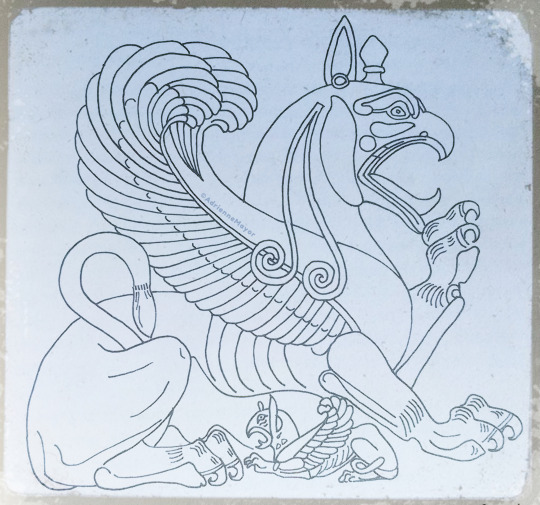
Griffins: a very mysterious mystery
“A race of four-footed birds, almost as large as wolves and with legs and claws like lions.”
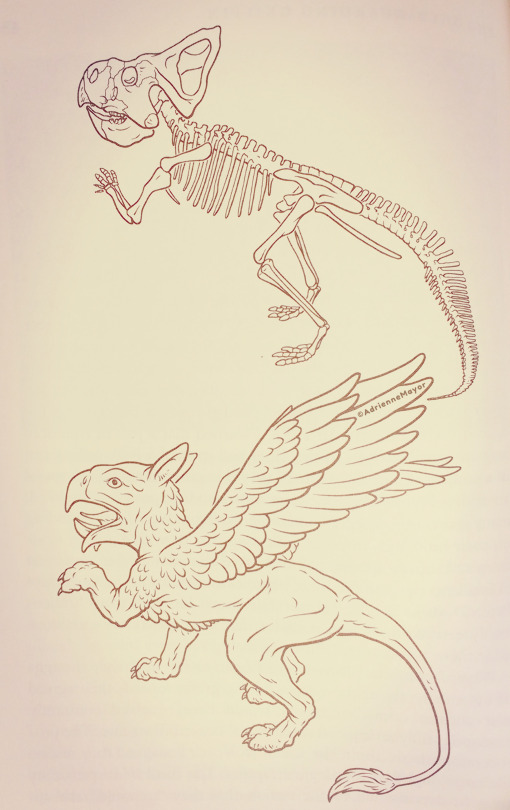
The one thing you need to know about griffins is that they don’t really fit in anywhere. They have no powers, they don’t help heroes, they’re not defeating gods or anything like that. Technically speaking, they’re not even monsters – people thought griffins were legit – real animals who lived in Central Asia and sat on golden eggs and mostly killed anyone who went near them. And okay, someone might say, ‘Frog, what’s fishy about that? People used to be dumb as rocks and there’s plenty of bizarro animals out there, anyway’ and yeah, that’s a very good point – except for one thing. See, what’s creepy about griffins is that we’ve got drawings and descriptions of them spanning ten centuries and thousands of miles, and yet they always. look. the. freaking. same.
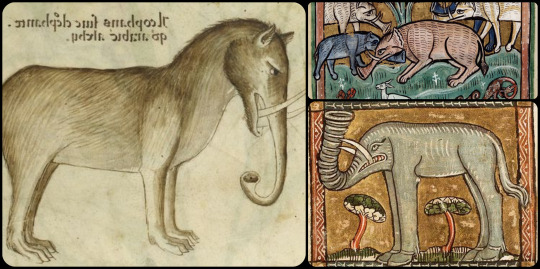
Like, here’s how people imagined elephants.
This is insanely funny and probably why God sent the Black Death to kill everyone, but also pretty common tbh, because a) people want to feel involved, b) people are liars who lie and c) it’s hard to imagine stuff you’ve never seen. So the more a story is passed around, the more it’s going to gain and lose details here and there, until you get from dog-footed hairy monkey of doom to plunger-nosed horror on stilts. But griffins – art or books, they’re consistently described as wolves-sized mammals with a beaked face. So that’s what made Adrienne Mayor go, Uh.
And what she did next is she started digging around in Central Asia, because that’s the other thing everyone agreed on: that griffins definitely lived there and definitely came from there. And this is where things get really interesting, because as it turns out, on one side of the Urals you’ve got Greeks going, ‘Mate, the Scythians, you know – they’ve got these huge-ass lion birds, I’m not even shitting you rn’ while on the other side of the Urals – wow and amaze – you’ve got Siberian tribes singing songs about the ‘bird-monsters’ and how their ancestors slaughtered them all because they were Valiant and Good.
(This according to a guy studying Siberian traditions in the early 1800s, anyway, because you know who writes stuff down? Not nomads, bless them: dragging around a shitload of books on fucking horseback is not a kind of life anyone deserve to live.)
And anyway, do you know what else those Mighty Ancestors did? They mined gold sand, and they kept tripping over dinosaur bones because that entire area is full of both things and some places are lucky like that. And in fact, the more excavations were carried out in ancient Scythian settlements, the more we started to realize that those guys were even more obsessed with griffins than the Greek were. Hell, some warriors even had griffins tattooed on their bodies?
And it’s probably all they ever talked about, because that’s when griffins suddenly appear in the Mediterreanean landscape: when Greek people start trading (and talking) with the Scythians.
(Another important note here, not that I’m not bitter or anything: something else those excavations are showing is that Herodotus was fucking right about fucking everything, SO THERE. Father of lies my ass, he was the only sensible guy in that whole bean-avoiding, monster-fucking, psychopathic and self-important Greek ‘intelligentsia’ and they can all fuck off and die and we don’t care about temples Pausy you dumb bitch we want to hear about the tree people and the Amazons and the fucking griffins goddammit. Uuugh. /rant)
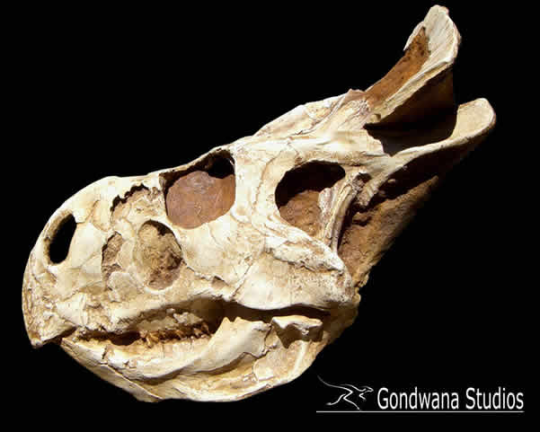
So anyway, Scythian nomads had been hunting for gold in places with exciting names like ‘the field of the white bones’ and basically dying of exposure because mountains, so Herodotus (and others) got this right as well: that successful campaigns could take a long-ass time, and very often people just disappeared, never to be heard from again. What everybody got less right: the nomads and adventurers and gold miners weren’t killed by griffins, because by the time they started traveling into those mountains, ‘griffins’ had been dead for hundreds of thousands of years. What they did see, and what was sure to spook the fuck out of them, were fossils – and, more precisely, protoceratops skulls, which can be found on all the major caravan routes from China all the way to Uzbekistan and are so ubiquitous paleontologists call them ‘a damn nuisance’.
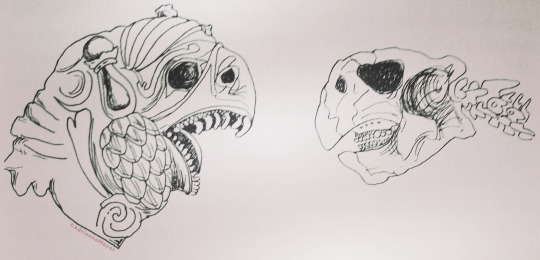
And guess what they look like.
Just fucking guess.
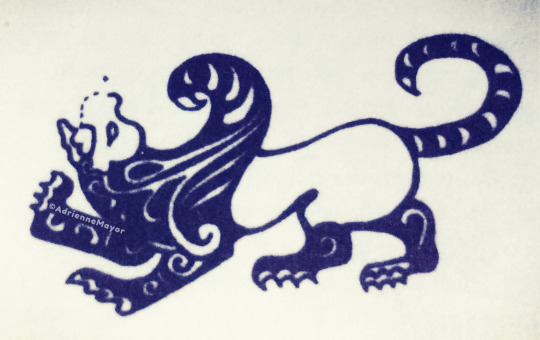
[Left: a golden griffin, Saka-Scyhtian culture; right: psittacosaurus skull, commonly found in Uzbekistan and the western Gobi.]
Also, fun detail if you’re into gory and painful ways of dying: many of the dino skeletons are found standing up, because the animals would be caught in sand storms and drop dead. So basically you’d be riding your horse and minding your own gold-related business when all of a sudden you see the empty sockets of a beaked something staring at you and yeah – as a reminder, the idea of evolution was not a thing until Darwin, so any Scythian or Siberian tribesman seeing something like that would assume there was a fairly good fucking chance of a live whatever-the-hell-this-is waiting for him behind the next hill. And that’s what he’d say to Greek traders over a bowl of fermented mare’s milk: to stay the fuck away from those mountains, because griffins, man, they’re fucking real and there’s hundreds of them and anyway, maybe write that down if writing’s something you’re into, never saw the point myself but eh, to each his own, right, and cheers, good health, peace and joy to the ancestors.
Man, don’t you just love mythology?
(How fossils influenced mythology: part two, Cyclops, will be up soon.)








 BettSplendens Tumblr Evac