ahh i actually havent ! at first i thought you were actually talking about a CATERPILLAR that looks like a snake, and said cocoon on accident (specifically the caterpillar of the hemeroplanes triptolemus, or snake-mimic hawk moth)
but it TURNS OUT theres a species of butterfly that takes it way further, to the point where all the other caterpillars are like “is this really fuckin necessary”
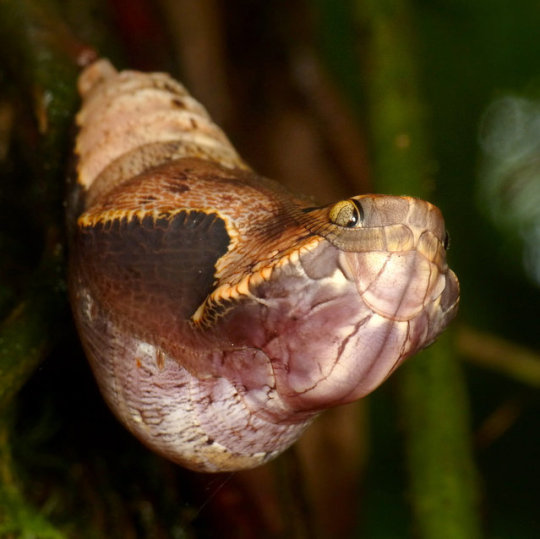
its the chrysalis of the daring-owl butterfly ! a species thats found in trinidad and spends a good portion of its young adult life trying to convince other things that its not actually completely helpless
LOOK at the detail thats gone into this though- i cant even imagine the journey this look mustve taken, with lightly less-snakelike chrysalises being eaten over time again and again until youve got something with definable eyes and scales
apparently if disturbed theyll also rock violently back and forth, furthering the idea that this is a very dangerous pitviper with the tiniest body imaginable
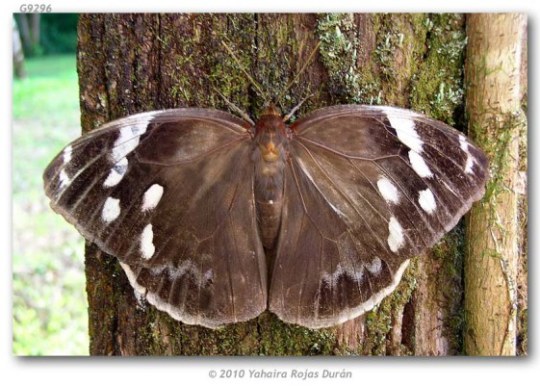
the adult butterflies are much less exciting but honestly they dont need to be with a history like that a+ bug
The following is a rare half male and half female butterfly. The butterfly was determined to be a Lexias pardalis, and its condition is called bilateral gynandromorphy. Gynandromorphism is most frequently noticed in bird and butterfly species where the two sexes have very different coloration. (Source)
Gynandromorphs are chimeras, i.e. two different sets of genetics in one animal. They usually happen when a set of non-identical twins, or members of a larger litter, fuse in the womb. It happens in egg-born animals when two fertilized egg cells end up encased in the same egg and fuse due to the lack of space. They’re probably more common than we think, but chimeras are impossible to detect without testing every inch of a creature’s body for DNA, inside and out. Gynandromorphs like this one are often more obvious, but, in animals (say, fish) with minimal sexual dimorphism, often go unnoticed. Chicken gynandromorphs are particularly neat to see, they have the fluffy rooster hackles on just one side, and a thick leg and spur on that side.
Tyree Callahan has recycled (or upcycled, perhaps) a classic 1937 Underwood typewriter by replacing letters with sponges soaked across the spectrum with bright yellows, reds, blues and combinations thereof.
@zooophagous this is “Marshmallow.” At first I thought she was freshly molted but it’s been several weeks and she’s still white with dark brown markings (they’ve gotten darker but her white is still bold). Can dubia roaches be leucistic?
Any given animal can be leucistic, and she absolutely looks like she is. I can see some transparent areas of exoskeleton.
VERY cool! I’d say set her aside in another container with a male and plenty of food, see if any babies have the same pattern. That’s a very pretty roach.
A fun timelapse video of the preparation of a massive 4” wide lower molar of an adult Titanothere from the Chadron Formation of South Dakota. I found this on a trip this summer with
. The molar is a little weathered as it was exposed and sticking out of a cliff face when we found it. It’s actually prepped out really well though and has all its complete root system. Titanotheres or Brontotheriidae (also known as “Thunder Beasts”) were the massive horned herbivorous giants of North America during the Oligocene.
This GIF shows how the toucan releases heat using its beak to cool itself off.
The toucan beak isn’t just beautiful, it’s also an adjustable thermal radiator that the bird uses to warm and cool itself. When the bird is hot, the blood vessels in their beak open up to allow more circulation to enable heat to escape. Birds can’t sweat so evolution has come up with some life hacks to get the job done. [video]
You fool they’re charging their laser cannon
You can actually kinda see the start of the heat bleeding out of their body!








 https://embedr.flickr.com/assets/client-code.js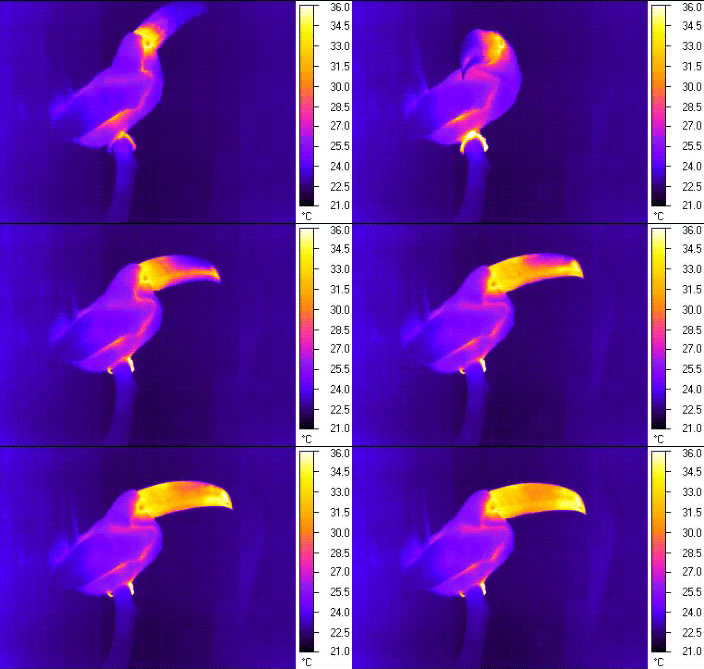
 BettSplendens Tumblr Evac