Lacking a tongue, bamboo sharks (Chiloscyllium plagiosum) swallow with their shoulder bones. Other tongue-less sharks and fish species likely use a similar method of swallowing. The finding comes from the lab of Ariel Camp, a postdoctoral researcher at Brown University’s Department of Ecology and Evolutionary Biology. Using state of the art X-ray imaging technology, Camp and her team filmed the internal going-ons of bamboo sharks having lunch. These tongueless critters, it seems, rely on their shoulder-blades to create suction when it’s time to swallow.
palaeoartTime for another time lapse video of the preparation of a Phacops species of Trilobite from Ofaten, Morocco. This trilobite is from the Middle Devonian – 365 million years ago! The matrix was incredibly tough so took a while to work out. Sorry for twisting and turning the rock so many times. Hope you don’t get motion-sickness watching it!!!palaeoartTime for another time lapse video of the preparation of a Phacops species of Trilobite from Ofaten, Morocco. This trilobite is from the Middle Devonian – 365 million years ago! The matrix was incredibly tough so took a while to work out. Sorry for twisting and turning the rock so many times. Hope you don’t get motion-sickness watching it!!!
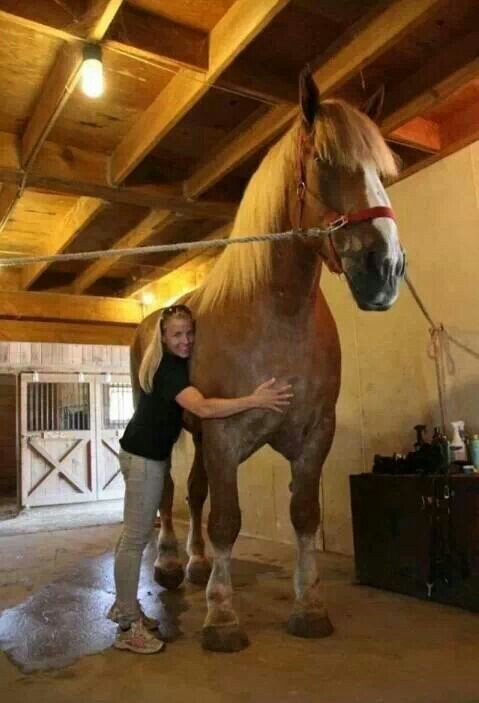
I never made a post about draft horses. :T They are the gentle giants of the horse world, sometimes growing as large as 20 hands and over 2000 lbs. The tallest horse in the world is an American-type Belgian horse named Big Jake (I think???).
A very big (but good) boy!
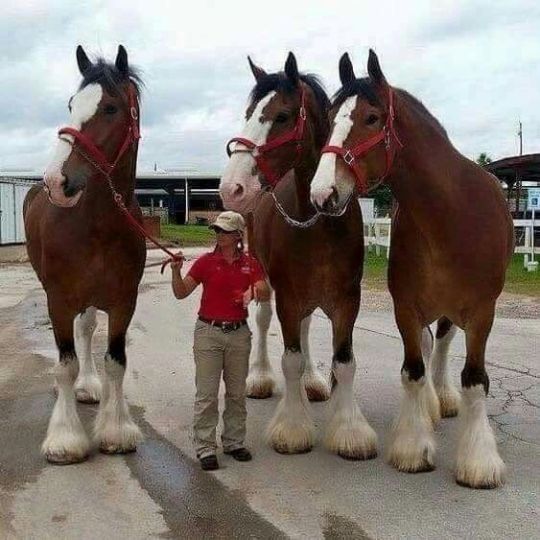
Despite their size, draft horses are known for their quiet, even temperaments, which make them good work horses. They were originally bred to pull wagons and plows, and they still do that. The most famous draft horses are probably the Budweiser Clydesdales, i.e. the horses in those Superbowl commercials that make us cry every goddamn year.
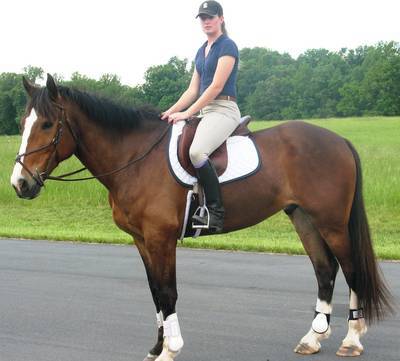
Draft horses can be ridden, and they are often crossed with lighter breeds, such as Thoroughbreds and Quarter Horses, to create tall, sturdy-boned, quiet sport horses.
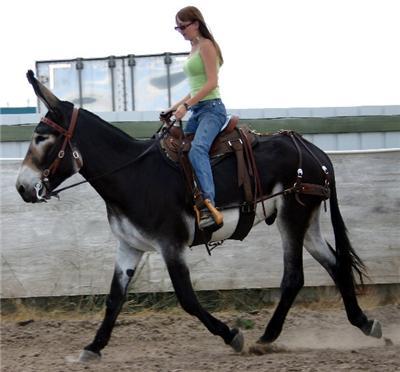
Such horses were a common sight during foxhunts, as “hotter” breeds, like Arabians and Thoroughbreds, tend to lose their minds a bit in the chaos of the hunt. Draft horses can also be crossed with Mammoth Jack donkeys to create draft mules, which are also used to pull plows for the Amish.
Mammoth Jack donkey:
Draft Mule:
There are a lot of draft breeds, some more common than others. Many of the common ones are easy to tell apart from the others, but they’re all large-boned and tall, except for the draft ponies, such as Halflingers and Norwegian Fjord horses.
The Belgian
There are two Belgian horses, one that’s popular in Europe and another that’s very common in the US.
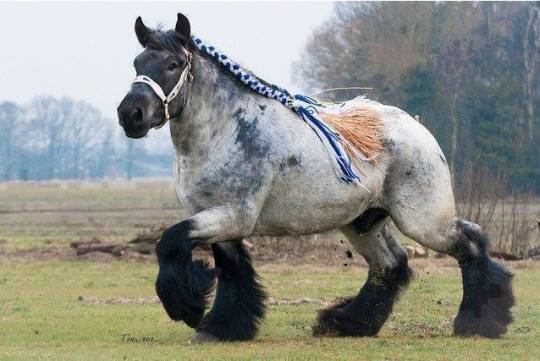
This is the European-type “Brabant” Belgian, which tends to be very thick boned and roan in color.
This is the American-type Belgian, which is lighter-boned and always sorrel/palomino in color:
Here is a Brabant Belgian mare pulling some shit:
A lot of draft horses really do enjoy pulling stuff, as much as a horse CAN enjoy doing anything that’s not eating grass and farting. Horse pulls are a common sight in Middle America, often done using Belgian horses. Here’s one of a team pulling 9200 lbs. They pull for a very short period of time, often only a few seconds.
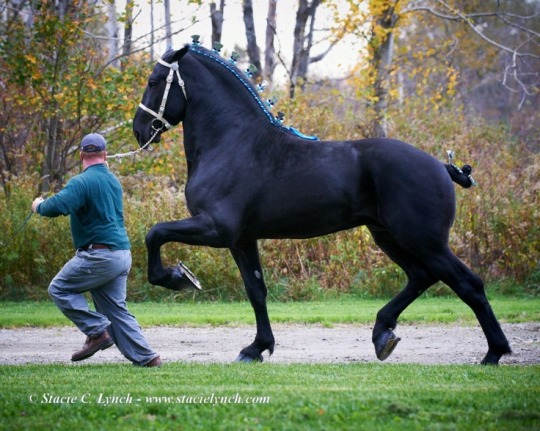
Next up is the Percheron, which has a similar body type to the Belgians but are always black or dapple. They can be slightly more spirited than Belgian horses, with some demonstrating high stepping action.
They are not to be confused with Friesians, who have much more “feathered” legs and feet (long hair around the lower legs) and are lighter-boned. Friesians also don’t come in dapple colors, like the horse at the top of this post.
Clydesdales
Clydesdales are recognizable because they are a) always bay colored and b) almost always have four white socks and a blaze on their faces. They also have much more feathering on their legs than Percherons or Belgians. Clydesdales are more common in parades and the like because they tend to be slightly lighter than Percheron and Belgians, and because of this, they’re more agile and “showy”. You probably would not want to plow with a Clydesdale. You could, but their feathering means their feet get dirty much easier than a Belgians might.
Shire Horse
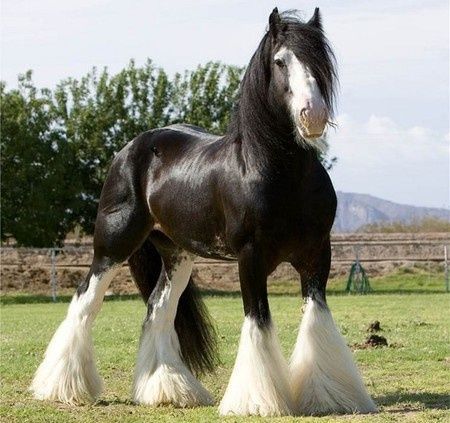
Shires come in a variety of colors, usually black or bay, and they are probably the most “feathered” horses of the popular breeds. They’ve got lots of fur on their feet.
Gypsy Vanner Horses
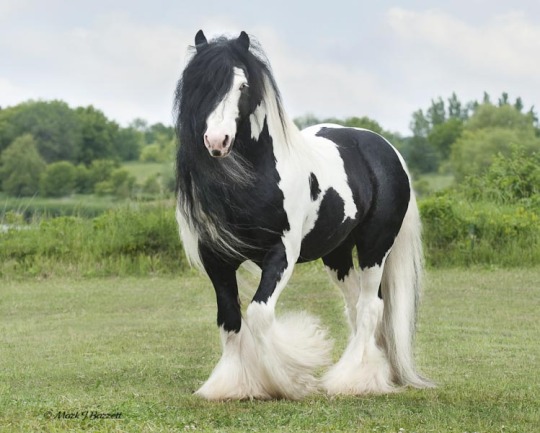
Gypsy Vanner horses got their start pulling Roma wagons, but now they’re mostly used in fantasy photoshoots, and you can see why. They are beautiful horses, definitely not the type you’d want toiling in the muck. They are almost always paint colored, which distinguishes them from Shire horses.
These are the main, most popular and commonly seen full-sized draft breeds, at least in the US. However, there are also draft ponies, the most popular of which is the Halflinger, which resembles a shrunken Belgian horse. They are ALWAYS sorrel/palomino colored, but their frame can vary. Some Halflingers are lighter-boned and more suitable for riding. Others are thicker-boned and better for pulling.
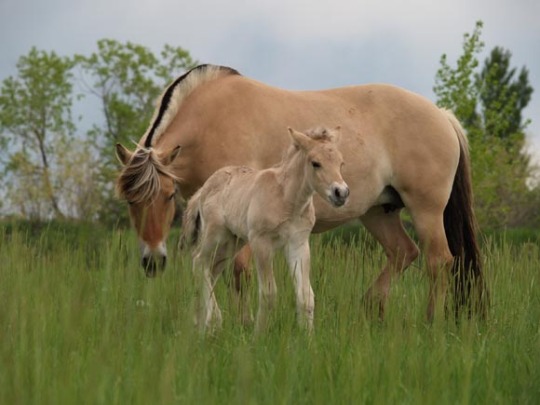
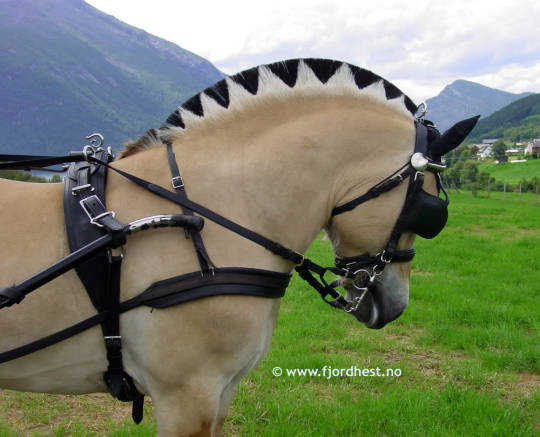
The other unmistakable draft pony is the Norwegian Fjord, easily recognized by the black stripe in the center of its mane, like a reverse ice cream sandwich.
This can lead to some creative hair cuts
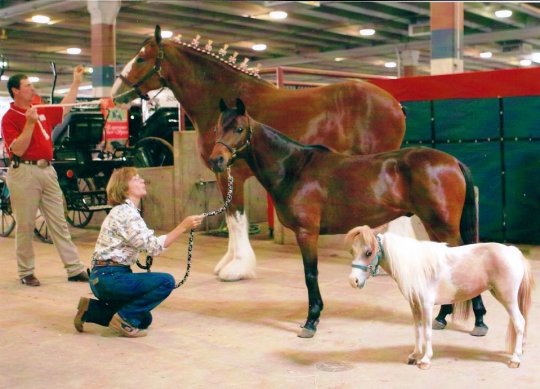
So there you go. That’s a somewhat comprehensive review of draft horse breeds. Here is a size comparison for funsies, with the average riding horse in the middle.
@mothbug I believe this may pertain to your interests
There’s also the Finn horse (or Finnish Universal) which can be used in basically ANY horse related thing; farming, forestry, harness racing, horseriding and vaulting.
Finally caught a chicken in one of the nesting boxes! I took the picture of Mrs. Bucket and went inside to wait, expecting to go back and get a picture of her egg before collecting it, but apparently Mrs. Bucket wasn’t the only busy hen this morning (view from inside and then outside the nesting box). I’m pretty sure the darker blue egg is hers, because it was the warmest. The lighter one must be from Lady Elaine, and I haven’t a clue who laid the pinkish-brown one.
Polycephaly is the condition of having more than one head.
Two-headed animals (called bicephalic or dicephalic) and three-headed (tricephalic) animals are the only type of multi-headed creatures seen in the real world, and form by the same process as conjoined twins from monozygotic twin embryos.
While two headed snakes are rare, they do occur in both the wild and in captivity at a rate of about 1 in 10,000 births.
Most wild polycephalic snakes do not live long, but some captive individuals do. A two-headed black rat snake with separate throats and stomachs survived for 20 years.
Why does this seem to happen to snakes so often compared to other animals? I mean, you don’t see this happen to dogs or cats very often but snake embryos seem almost eager to mix it up every once in a while and pull a two-for-one deal in the head department.
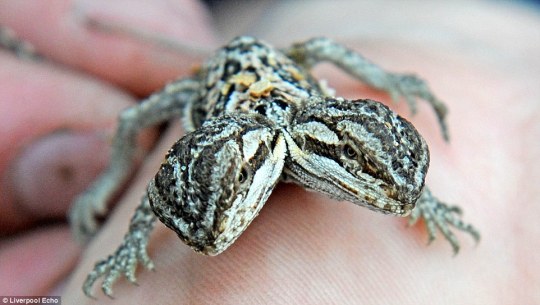
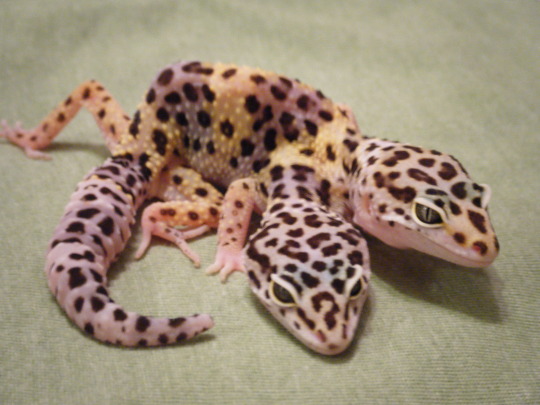
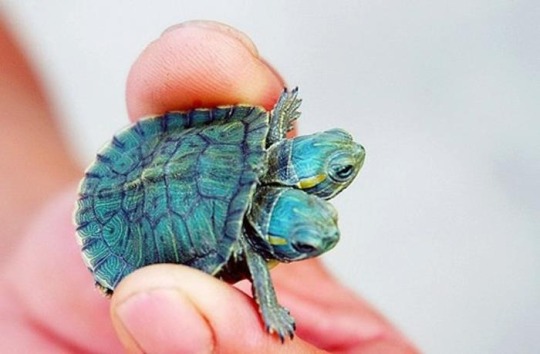
The consensus seems to be that polycephaly occurs more often in reptiles than other animals, but the why of it, as far as I could find out, is relatively unknown. Polycephalic animals appear so infrequently and they survive for such a short time that scientists just have not been able to study them sufficiently. If anyone can find more information about why it happens more often in reptiles, feel free to chime in. In the meantime, enjoy these two-headed lizards and turtles:
Can you imagine the arguments!
One thought real quick: two-headed dinosaurs
oh my god i will lose my fuckin mind the day that fossil is found
@magicturtle two headed dinosaurs seems like something you’d be down for.
Rawr YEAH!
I think I misunderstood the assignment.
Um not to put a dampener on the idea of two headed dinos but aren’t dinosaurs closer to birds and birds most likely don’t have two heads.
Birds are reptiles! That sounds insane, but let me explain.
Biologists use a system to classify animals called the phylogenetic system, which means animals are grouped together based on their ancestry. In this way, birds are reptiles because they’re more closely related to reptiles than anything else, crocodiles in particular. In fact, crocodiles are more closely related to birds than they are to lizards.
The first groups of reptiles evolved about 300 million years ago. About 40 million years later, a group of reptiles called therapsids branched off, which eventually became modern mammals. Other groups of reptiles split off over the next 120 million years, one branch being the dinosaurs. These dinosaurs were only distantly related to modern snakes, lizards, and turtles, groups that had split off at different times. But 65 million years ago there was a massive extinction event, and all dinosaurs were killed except for a single group of feathered dinosaurs. These evolved over the next 65 million years into modern birds.
So birds are dinosaurs, and dinosaurs were reptiles, and thus birds are reptiles.
A point I forgot to mention in my birds-are-reptiles ramblings…two-headed birds are definitely a (rare) thing. This bird with two heads and three beaks was found in Massachusetts. (x)
so i learned yesterday that theres a tiny plot at the corn research/breeding nursery i work at thats full of what the breeders call “zoo corn”??? its like. corn that got mutated by accident when they were breeding and they just kept the lines as separate varieties bc its interesting to see and might come in handy some day (it doesn’t get bred into other stuff or developed, just kept in the zoo plot for display). zoo corn includes:
-”bloody butcher corn”: corn that has red streaks all over the ears
-”rainbow corn”: corn plants that are covered in red streaks
-”glass corn”: the breeders say this exists but they dont have it at our facilities??? its corn thats normal corn but the yellow pigment in the kernels got mutated, so the kernels are literally just translucent
-”lazy corn”: corn plants with the protein that helps keep them upright mutated so they grow straight and then when they reach adulthood, they bend all the way over in graceful arcs. like they’re perfectly fine they’re just having a good time on the ground
-”hosta corn”: its corn but its short and bushy and has square stems instead of round stems
i love my mutated corn babs they are beautiful and good
okay so a lot of people have been asking me for pics of the beautiful mutated corn children!!
first of all, hosta corn:
its about 2 feet tall, idk if you can tell from that pic. its also hard to articulate how square the stems are but i did my best:
then, some rainbow corn. turns out that its more than red streaks (before hunting out the plot itself for these pics i had only heard verbal descriptions of these plants!!!)
i have no idea what this is but he got pretty yellow streaks???
finally, lazy corn. turns out these are not the graceful creatures i was imagining and are actually hilarious
thats. thats what a row of lazy corn looks like??? like they’re actually not dying (except the one on the far left that flopped into the alley and got walked on a little)????? they’re just??? perfectly happy plants just having a great time on the ground???????????????????????????? guys i cant do this









 BettSplendens Tumblr Evac