Sometimes I wonder if animals ever conceive of monsters. What menaces my dog in her nightmares? Is it only real creatures that she’s familiar with, or does she ever dream about stranger beasts – bigger, meaner dogs with barks like fireworks? Things that come out of the bathtub drains? Humans that only look like her humans, but smell horribly, impossibly wrong?
my rabbits have never, as far as i know, and i got them young, met any actual predators, save for one kitten smaller than them, and nonthreatening dogs they liked, but they still have that instinctual fear for predators. lots of rabbit owners will say theirs do the same – if theres something new in their area and its dark, theyll start thumping and acting panicked, running at any movement or noise they perceive, because they think the new shadow is some looming, unknown predator. my one rabbit, when she was still a baby, would sometimes thump and dart from nothing at all, while the other was unfazed (or simply startled from the others panic). i wonder what she thought was there
I’m very curious about the extent of different animals’ imaginations. The human imagination is incredibly rich and overactive and probably oranges to crabapples in comparison to most non-human animals’, but I wouldn’t be surprised even rabbits’ brains supply them with some form of imagined danger beyond pure instinctual reactions.
Crows seem to be able to form mental images of tools they want to make. Certain other birds, when exposed first to a snake and then to snakelike things, will give the “snake” alarm call more easily than if they just see the snakelike thing, suggesting they have a mental image of what a snake is and are more alert for one if they’ve gotten the idea.
Trees, like animals, can also experience albinism, though it is extremely rare.
the reason it’s rare is because without chlorophyll, the plant can’t get energy, and dies shortly after sprouting unless it has some other source of food. so if you see a plant as big as the one in the picture that doesn’t have any green in its leaves, it’s getting its nutrition from the roots of a neighboring plant of the same species, feeding on the sugars created by the other plant’s photosynthesis.
albino plants are basically vampires.
thats metal af
That or the neighbouring plants are helping to keep it alive.
There has been research saying plants can share resources with one another, such as carbon and nitrogen, when one is deficient, so this plant likely has an abundance of mycorrhizal fungi on its root system that isn’t so much parasitizing from its neighbours as it is borrowing.
It’s not a vampire. It’s a disabled plant being supported by a community of healthy individuals who have more than enough nutrients to share.
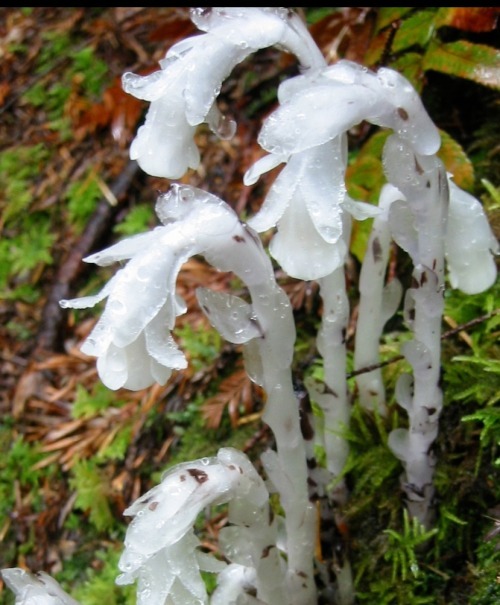
The real vampire plant is actually Indian Pipe, which lacks chlorophyll and sucks out nutrients from photosynthetic trees, meaning they can grow in dark places without much trouble. They look badass as well.
this is the coolest thing, because every plant is connected to every other plant by underground fungi! scientists now hypothesize that fungi actually evolved long before plants, so plant root systems evolved with fungi that were already in the soil. fungi aren’t just useful for the survival of plants, they are essential for the survival of most vascular plants! (vascular plants = those with root structures)
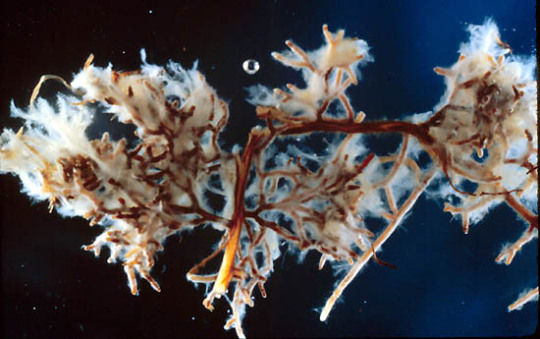
networks of fungi under the ground can cover miles and miles, and each fungus sends out very long branches, called hyphae. these hyphae can surround the root tips of a plant (these are called ectomycorrhizae, because ecto = outside, myco = fungus, rrhizae = root), which looks something like this:
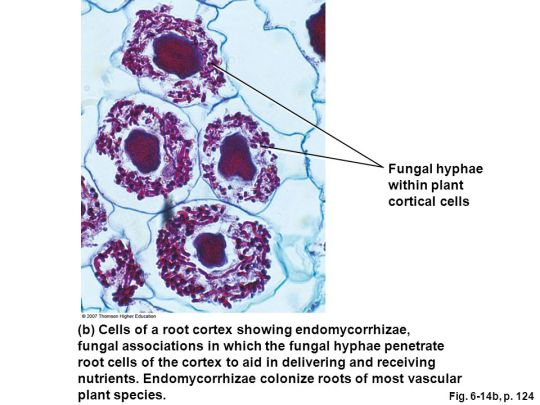
(picture source) alternatively, plant roots can be colonized by endomycorrhizae (endo = inside), which are WILD, because they essentially just bust through the plant cell walls and, like, chill directly inside of the root cells? like HI here we are we’re moving in now! that looks like this, on a cellular level:
(picture source) despite the occasional door-busting, this is a good, codependent relationship for both parties, because plants provide the fungi with sugars and energy, while fungal networks can grow even farther than plant root networks, so they transport essential nutrients to the plants as well as helping the roots to gather enough water. fungi are also the world’s greatest decomposers, and break down rotting organic material in the soil to increase the amount of carbon surrounding the root networks!
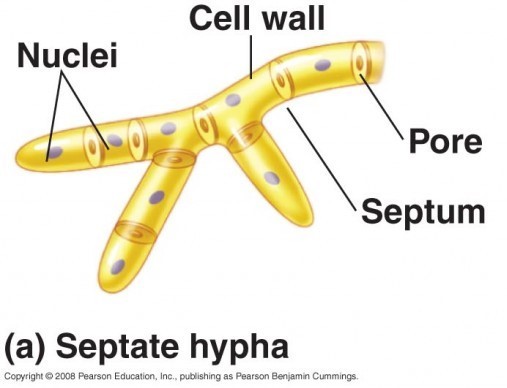
fungi are uniquely disposed to transport materials and to communicate over long distances because they have a supercool cellular structure! so fungal hyphae are only sort of composed of individual cells, but they’re cells with serious boundary issues. most species of fungi have septate hyphae (septum means boundary or partition), where individual cells have dividers between them, but these dividers have, like, GIGANTIC ass holes in them. the concept is kinda like this:
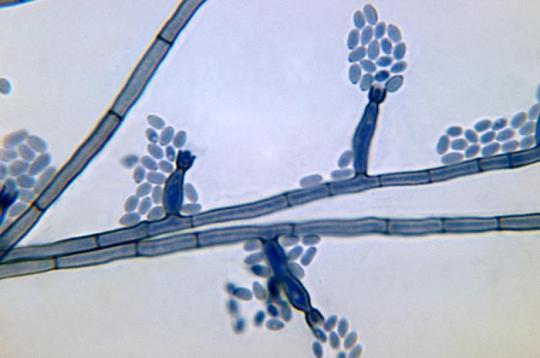
(picture source) these pores are so ENORMOUS that they can fit entire organelles through them! so one cell can just pass its entire nucleus or mitochondria through a pore to its neighbor, which is WILD! you can literally see these septa when you look at fungi under a microscope, like look at this beautiful bullshit!
(picture source) something like 90% of vascular land plants are colonized by mycorrhizae, so when you are standing outside, know that literally every plant around you, every blade of grass beneath you, is connected to every other plant by a vast network of fungal friends, roommates, and helpers! sometimes a SINGLE fungus will be connecting all of these plants to one another! ALL THE PLANTS ARE HOLDING HANDS.
there are these incredibly intimate, cooperative relationships going on beneath your feet that allow plants to help each other and communicate with one another (or compete with one another), and there is NO WAY that we would have enormous trees like we do without fungi to help them expand their reach and weather different soil conditions! the plants are talking to one another, y’all, and we’re the only ones who can’t hear them.
(okay so this explanation is gonna have a lot of pics so im gonna put it under a cut even though i super dont want to because this is so cool like im gonna die) EDIT: i’ve been told that the read more sucks so im removing it
yes, those are fangs. they don’t function like actual fangs- keep in mind that nepenthes pitchers are inert, and don’t close or move like sundews or venus fly traps do. in this case, the fangs profusely secrete nectar (other functional uses of them are debated, but include warding off monkeys that might try to drink from them and creating loose footing for insects):
this is pretty much the main appeal of bicals to growers and hobbyists, but scientifically, they’re an amazing case of mutualism! the pictures we’ve seen so far are what we call the lower pitchers of the plant. nepenthes have upper and lower pitchers that grow on those respective portions of the vine; these pitchers sometimes have physiological differences. what we’re gonna focus on here is the upper pitchers, which look like this:
its a built-in house for a very specific species of carpenter ants, Camponotus schmitzi, which live almost exclusively in wild bicals and are heavily dependent on them in their native habitat of Borneo.
both of these species are so specifically evolved to each other that its ridiculous. the ants:
-get to eat all the nectar they want because they’re specially evolved to be able to crawl all over it
-get to eat flies, mites, fungus, other ants, other insects, and anything else that might fall into the pitcher, or just attack them so they can’t escape.
-can walk on and be submerged in the fluid inside the pitcher without getting eaten alive by acid because they’re evolved to
-get a free house with every upper pitcher the plant makes. the plant doesnt have special lower pitchers for them because they sometimes get flooded when it rains (closer to the ground) and the plant doesnt want to hurt its ant friends
-basically sit right under the lip of the pitcher and wait to ambush things that fall in
-the ants have this behavior where they drag big prey they want up from the fluid up the pitcher to eat it under the pitcher lip. this is just how they eat. what do u expect like they’re not gonna eat right in the pitcher fluid like animals even if dragging food up two inches can take them up to twelve hours at a time depending on the size like were u raised in a barn?????????
the plant:
-gets free protection from mites and fungus and stuff
-doesnt need many digestive fluids of its own because the ants just eat whatever falls in and then poop it into the pitcher, which is way easier to digest
-gets its pitchers kept clean and the fluid free from clutter that might cause rot
-sometimes gets to eat dead ants that happen to fall into the pitcher
-research also tells us that the ants tend to prefer attacking large prey and stuff that tries harder to escape, increasing the amount the plant gets to eat.
in general, bicals can survive without the ants and do fine in captivity, but the ants cannot survive without the plants- they nest in their upper pitchers exclusively and get a ton, if not all, of their food from them. in general, this relationship is suuuuuper complex and is actually still being studied!
some more sweet plant and ant friend pics from this research paper on their friendship:
here’s a video showing the ants going about some of their daily business!


 BettSplendens Tumblr Evac