1. Ocellated Turkey. I mean you have gorgeously iridescent feathers on the rest of the bird, but blue skin and orange and pink caruncles AND a magnificent drooping snood? It’s almost too much. Sadly this photo doesn’t show the snood to its greatest glory since it’s on the other side of the beak but the rest of the display makes up for it.
2. Kokako. I mean a wattlebird has to feature somewhere, and personally, while I appreciate how outrageous the ocellated turkey is, sometimes you want elegantly understated, and the kokako has you covered there. Sleek grey feathers and deep blue wattles under the bill make a heck of a statement.
3. Southern Cassowary. The undisputed winner of “most intimidating wattles” as far as I’m concerned. I don’t want to meet these wattles in a dark alley. Or dark forest. Or anywhere without a fence between me and the wattles, to be quite honest.
4. Andean Condor. Check out the wingspan on these wattles. And unlike the cassowary, I feel like I’d love to chill in the presence of a condor. Also, I like the muted tones. It sends off much less of a “don’t fuck with me” vibe without reducing any of the magnificence.
5. Temminck’s Tragopan. I mean. Just look at it. It’s almost eyeburning in its magnificence. All the tragopans deserve recognition for their amazing achievements in fleshy face decorations, but Temminck’s just has a little extra something.
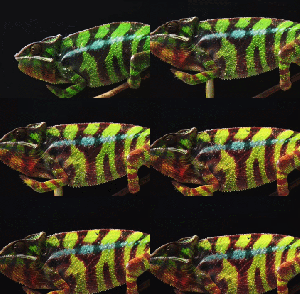
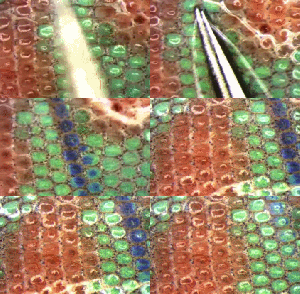
Many chameleons, and panther chameleons in particular, have the remarkable ability to exhibit complex and rapid colour changes during social interactions such as male contests or courtship. It is generally interpreted that these changes are due to dispersion/aggregation of pigment-containing organelles within dermal chromatophores.
But, combining microscopy, photometric videography and photonic band-gap modelling, we show that chameleons shift colour through active tuning of a lattice of guanine nanocrystals within a superficial thick layer of dermal iridophores. In addition, we show that a deeper population of iridophores with larger crystals reflects a substantial proportion of sunlight especially in the near-infrared range.
The organization of iridophores into two superposed layers constitutes an evolutionary novelty for chameleons, which allows some species to combine efficient camouflage with spectacular display, while potentially providing passive thermal protection. –src
Shimmering Close-Up Shots Of Peacock Feathers Reveal Amazing Detail
Waldo Nell, a Canadian software engineer and photographer, captured the feathers of a peacock magnified over 500 times. Not least are they beautiful photographs, they also reveal some of the science behind the iridescent glow of a peacock’s plumes.
From green to golden to blue and indigo, the photographs reveal the mix of colors that give peacocks their distinctive appearance. But the actual pigmentation of the feathers only plays a part in peacocks’ coloring. Much of it comes from small nanostructures on their feathers’ barbules, which give them an iridescent shimmer.
As the direction of light changes, these different facing barbules reflect the light at different angles, resulting in the feathers appearing to change color and shimmer as they move. You can also see this effect on butterfly wings, beetle shells and other birds such as hummingbirds. (Source)
All images credit: Waldo Nell




 BettSplendens Tumblr Evac