How “Chameleons” change color
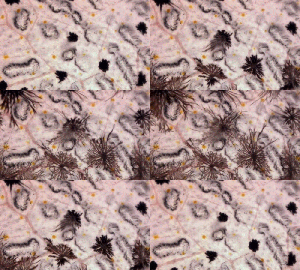
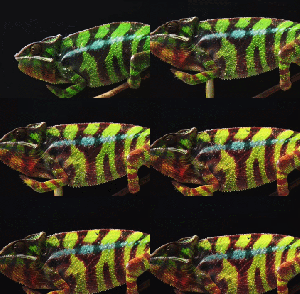
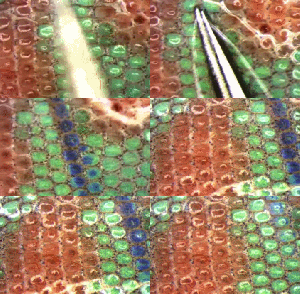
Many chameleons, and panther chameleons in particular, have the remarkable ability to exhibit complex and rapid colour changes during social interactions such as male contests or courtship. It is generally interpreted that these changes are due to dispersion/aggregation of pigment-containing organelles within dermal chromatophores.
But, combining microscopy, photometric videography and photonic band-gap modelling, we show that chameleons shift colour through active tuning of a lattice of guanine nanocrystals within a superficial thick layer of dermal iridophores. In addition, we show that a deeper population of iridophores with larger crystals reflects a substantial proportion of sunlight especially in the near-infrared range.
The organization of iridophores into two superposed layers constitutes an evolutionary novelty for chameleons, which allows some species to combine efficient camouflage with spectacular display, while potentially providing passive thermal protection. –src
Giffed by: rudescience From: This video
Tag: chameleon
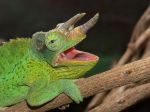
Jackson´s chameleon (Trioceros jacksonii)
Jackson’s chameleon is a species of chameleon native to East Africa, but also introduced to Hawaii, Florida, and California. Jackson’s chameleons are native to woodlands and forests at altitudes of 1,600 to 2,440 m in south-central Kenya and northern Tanzania. Jackson’s chameleons live primarily on a diet of small insects. They also prey on centipedes, isopods, millipedes, spiders, lizards, small birds, and snails in their native habitat.Most chameleons are oviparous,
but Jackson’s chameleon gives birth to live offspring; eight to thirty
live young are born after a five- to six-month gestation.photo credits:
Movingsaletoday, Benjamint444, Patrick Gijsbers
Look at that neat tail coil in the first pic!
Mount d´Ambre leaf chameleon (Brookesia tuberculata)
The Mount d’Ambre leaf chameleon is a diminutive chameleon from far northern Madagascar. This species inhabits rainforest and during the day it is active in the leaf litter or on small branches a few centimetres above the ground. At
night it can be found roosting on branches approximately 5 – 15 cm above
the ground. It is considered ’Vulnerable’ by the IUCN red list.photo credits: ovguide