Incapable of traditional flight, Western Meadowlarks maneuver through the world by leaping with powerful legs. Capable of jumping three times their body’s length completely vertically, these springy Sturnella are hardly hampered by the lack of flying ability; many casual observers have been fooled into believing they take wing due to the speed and precision of their numerous jumps. Above, a pair of meadowlarks judge the leaping form of a third.
is there a reason people on tumblr have a need to make up bullshit all the time?
Hello friend! Thank you for your valuable contribution to Bird Discourse (or as it is known in Prosumer Ornithographical circles: Bourse).
While ordinarily we here at The Academy of Bird Sciences welcome any and all corrections in the name of scientific cooperation and education, in this specific instance it appears you are in error: the photo you have attached is an Eastern Meadowlark, sister species to the Western Meadowlark described above. Do not be dismayed, this sort of mistake happens all of the time! They look quite similar but can be differentiated by the fact that Eastern Meadowlarks are incapable of terrestrial locomotion, as you can see in the above photograph. While ordinarily this would be a minor impairment to other birds, these skyborne Sturnella are quite able to hunt and eat enough aerial insect life to sustain their unceasing flapping.
Thank you again for your Bourse and have a nice day!
Sacramento Zoo Welcomes 5 Baby Flamingos After Chick Drought
SACRAMENTO (AP) — “Five baby flamingos have hatched at the Sacramento Zoo after an 18-year drought of the spindly-legged creatures.
The eggs hatched between June 28 and July 18. Zoo spokeswoman Tonja Candelaria said the birds are finicky and that a number of factors may have resulted in the baby gap and sudden laying of eggs this season.
The chicks need daily walks to strengthen their legs. Eventually, they will join the others at the zoo lake, which is already home to 36 adult American flamingos.
American flamingos have been at the zoo since 1966.
The American flamingo is native to South America and the Caribbean. Adult flamingos are pink, but the chicks are downy white. Pigments in their aquatic food give the birds their pink coloration.”
Hummingbirds are incredible acrobatic fliers, capable of hovering for more than 30 seconds at a time, even in windy conditions. Their feeding habits are equally impressive. Many species of hummingbirds have a forked tongue, each half of which curls over like a partial straw. As the bird extends its tongue, its beak compresses the space inside the tongue’s curls. Once in the nectar, both halves of the tongue re-expand, pulling liquid in along the full length of the tongue. For the birds, this is a much faster technique than simply sucking the nectar up like a straw. Hummingbirds can lick nectar more than ten times a second this way. For more gorgeous imagery of hummingbirds, be sure to check out National Geographic’s full feature. (Image credit: A. Varma, source; via Aarthi S.)
Cute little animals are under the misinformed impression that looking cuter and fluffier will make you want to touch them less.
[Image Description: A cartoon of a person’s hand reaching toward a small parrot who is puffed up with mantled wings. The parrot’s speech bubble says, “Don’t touch me! I’m big!”
Like this
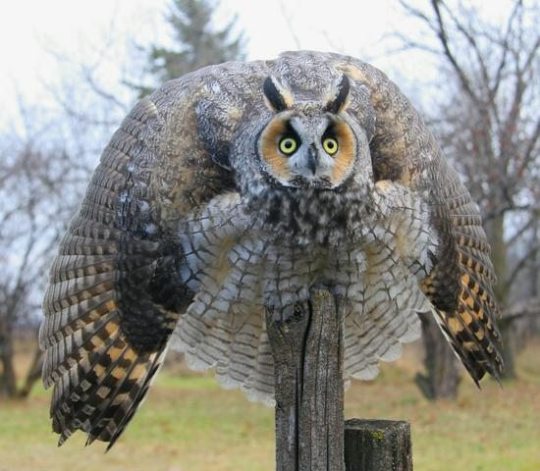
[Image: a large grey owl, perched on top of a post. It has mantled its wings and flared its tail in such a way that it appears to be a large sphere of feathers with a small owl head. It is attempting to look intimidating, but has only managed to look silly.]


 BettSplendens Tumblr Evac