The big one on the right (in both pics) is ‘Miss Pecky’. She’s a bit special. Looking at her comb and wattles, she matured three months or so after her sisters for unknown reasons. I’m not sure if we ever had a single egg from her – she is now 10 months old. She is waaaay bigger than the others, and I don’t think she’s fatter.
… a bit maybe, but also much taller.
If anyone has ANY clue what’s up with her, please let me know!! 😆
I suspect she might have something different about her thyroid, or whatever passes for it in chickens. Just a general hormone difference. Maybe her hormones think she’s supposed to be a rooster.
You know that “Lemme smash” video with the two birds and the blue and yellow and stuff?
yeah that one.
The girl bird in that video is a juvenile male of the same species. And the adult male is reportedly practicing his courtship on the younger male. (or that’s what the documentary says and it’s Attenborough so I trust him)
The video is literally 2 dude bro birds where the older one is hitting on the hot teen boy.
The video is two dudes.
Why isn’t THAT EXTREMELY IMPORTANT DETAIL going as viral as the video itself???
…some of you probably already knew that because some of you know more about birds than I do, but it’s super important to me ok???
(actual clip from Documentary below to show my sources)
I’m seeing some confusion about this one in the reblogs, and it is for my money one of the most interesting things to know about birds, so:
The big guy in this picture is the cuckoo – a young cuckoo. The little one is the momma bird, who is feeding the baby, even though the baby is now like five times as big as she is. That’s because the cuckoo is a brood parasite.
Cuckoos lay their eggs in the nests of other birds. If the hosts notice the cuckoo egg, they will try to get rid of it – if they don’t, though, and the cuckoo chick hatches, they will raise it as their own, even though the first thing it does when it hatches is to murder all of their other children.
The question with this is always: why, at that point, do the host birds raise the cuckoo chick? It’s way too hungry, it’s way too aggressive, it hangs around way longer than a normal chick would, and it’s huge, for god’s sake. It’s obviously not theirs. There are a couple of theories. One is that the begging call a baby cuckoo makes sounds like an entire nest of normal chicks, and the parents are programmed to feed whatever makes that noise. I got some doubts about behavior models that are that deterministic, though. I like to think it’s some avian variation on the sunk cost fallacy – the parents put all these resources into making this nest and laying this clutch, and by god they’re going to get a baby out of it, even if it’s a giant monster baby.
There is absolutely zero science behind this but my impression has always been that the parasitized parents, upon raising a gargantuan monster child, are basically just thrilled to pieces, like, “fuck yeah my huge Gundam kid can beat up your honor student” and “gaze upon my feathered monster truck pride and joy and despair”.
There are plenty of parent birds who end up booting the brood parasite when they see something is ‘off’ with their offspringl. Then again, there are plenty of parent birds who boot their own brood as well so take that with a grain of salt as to whether it recognizes the impostor or not.
To my understanding raising the impostor can be a mix of strong hormonal parenting urges (which helps parents of any species ‘adopt’ another even if they aren’t their biological progeny) and a sunk cost fallacy. Some birds are just super good parents and have the right urge and instinct to parent and raise chicks regardless of how they turn out. (Others are terrible parents who may not end up passing their genes to a new generation because they keep killing the beebs for a variety of reasons).
Though the worst part about brood parasites isn’t so much that they take more resources away from the other chicks but they often push out any remaining eggs or chicks from the nest until they are the only one for the parents to focus on.
Back to the Gouldian post from awhile back, some theorize that their shiny little mouth orbs serve not only to help the parents find their mouths in the dark nests, but also because brood parasites had been a problem as the species developed and the shiny orbs help the parents only feed their own.
Either way this is a fascinating topic to look into.
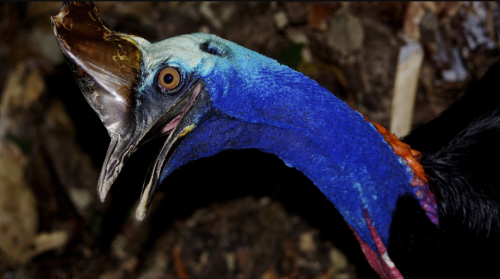
there are basically 2 kinds of birds: the one that decided it’s time to move on and the other that was like ‘nope i’m still a dino you fuckers’
exhibit a:
exhibit b:
When I was in Cairns, I saw a sign warning about cassowary attacks. The instructions were particularly ominous. I didn’t take a photo of the sign, but it read something like:
DO NOT RUN.
DO NOT MAKE EYE CONTACT.
DO NOT RAISE YOUR ARMS ABOVE YOUR HEAD, AS THIS WILL EXPOSE YOUR VULNERABLE CORE.


 BettSplendens Tumblr Evac