cool-critters:

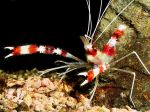
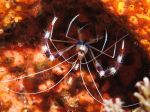
Stenopus hispidus

Stenopus hispidus is a shrimp-like decapod crustacean belonging to the infraorder Stenopodidea. It has a pan-tropical distribution, extending into some temperate areas. It is found in the western Atlantic Ocean from Canada to Brazil, including the Gulf of Mexico. In Australia, it is found as far south as Sydney and it also occurs around New Zealand. It is a cleaner shrimp, and advertises to passing fish by slowly waving its long, white antennae.S. hispidus uses its three pairs of claws to remove parasites, fungi and damaged tissue from the fish.

photo credits: Doutornemo, wiki, easterncapescubydiving

It should be noted that these guys, though fairly popular in reef aquariums, are not to be trusted with small fish. Fish kept with them should be larger than the body of the shrimp by a decent bit, as these are opportunistic omnivores, and can grow fairly large for reef shrimp. They’re often territorial towards other shrimp, as well, and will sometimes kill them.

There’s another kind which is much smaller and has more blue and gold on it, and that’s safer around small fish simply because it isn’t as large. 

They’re great shrimp, don’t get me wrong, they’re just not tiny-fish-safe. Also, if you want cleaning behavior, you want what’s called a “scarlet skunk cleaner shrimp”. Small shrimp with six white antennae, red back with a single white stripe, yellow flanks and belly. Aggressive towards other cleaner shrimp, but generally safe with most other things. Small enough to clean most reef fish. The ones above will clean only large fish. 

And neither of those species will cure ich! They can only pick off some of the surface parasites, which means the below-the-skin ones are still harming the fish. At best they’ll slow the reproduction of the parasite. They should be kept for appearance and for the interesting behavior of cleaning fish and your fingers (you can train them to eat from your fingers and clean under your nails very easily), not for any practical purpose.

fishamiright:

I’ve had this fish for like over a month now and this is only the second time he’s been out and about. Meet Steak (we brought him to a steak and shake on the way home from getting him) the newest saltsquad member, he’s a beautiful Court Jester Goby that does a great job keeping the sandbed clean.

Court Jesters are lovely fish! They’re really shy, though. Also, they need a lot of sand to pick through for food, they don’t do well in small tanks despite their small size. Anyone looking to get one should keep that in mind. The Hector’s goby is a similar looking fish with very similar behavior (lots of hovering and picking at things) that can stand having less sand around, and eats hair algae as a bonus, so they’re good for tanks that haven’t been up long enough to have that really active sandbed. The two shouldn’t be kept together as they’ll probably fight. Hector’s gobies need at least a 20 gallon aquarium or a 10g with a refugium, Court Jesters generally need at least a 30g to get enough food.

Congrats on your pointy cutie coming out of hiding! There’s a decent chance he’ll come out more and more as nothing threatens him, though he’s always gonna be shy.

@why-animals-do-the-thing

What do you think is going on here? I thought at first that the white goby was just trying to burrow in a bad spot, but it does seem to be intentionally throwing sand on the jawfish. Both of those are fairly intelligent fish species who are very good at moving sand, so I don’t think that much targeted movement of sand into the tunnel is accidental. 

My only guess is maybe the jawfish (blue) stole the goby’s tunnel, and the goby is trying to drive it out. 

The clownfish, I’m guessing, is hanging around in hopes that the digging unearths tasty snacks. That, or it’s trying to intimidate the others. 

hongsloi:

elemental-kiss:

aquatictimes:

smokee78:

aquatictimes:

diseased-bodies:

Pseudomugil furcatus

I hate to do this, but these guys in the original post are actually P. gertrudae, the Spotted Blue-Eye Rainbowfish (lovely friends). P. furcatus (Forktail Blue-Eye Rainbows) are these critters:

BUT ALSO, this is the PERFECT opportunity to talk about one of my favourite genuses (plural?), SO HAVE SOME MORE SPARKLY FEEEEEESH!!! 

P. gertrudae:

P. pelucidus:

P. luminatus:

P. paskai: (some confusion surrounds the identification of these guys, as they are exceptionally similar to P. luminatus. It is now understood that fish circulated as P. paskai in the hobby are actually P. luminatus, as paskais have not become established commercially, and both genetic and physical differences exist between the two. Source)

P. cyanodorsalis: (these guys are euryhaline, meaning that they are capable of occupying pure freshwater, but also a vast range of salinities – including fully marine conditions and even waters reaching a specific gravity of 1.030(!!!!); considerably higher than sea water. However, mild to moderate brackish conditions are preferred)

P. reticulatus:

P. signifer: (also euryhaline – found in freshwater to marine conditions. Mildly brackish conditions probably best)

P. ivantsoffi:

Pseudomugil novaeguineae:

P. mellis:

P. connieae:

P. tenellus:

Also, have another rainbow – Rhadinocentrus ornatus:

These three pictures are all of the same species! The only species within its genus, their extreme colour differences are a matter of geographical range.

ANYWAY

As far as I’m concerned, Blue Eye Rainbows and Rhads are dramatically underrated.

I LIVE FOR THEM ALL

Obviously I’d do more research before buying them, but what kind of tank set up do these guys prefer? Theyre so pretty, and I’d like to know whether I’d be able to afford a setup for them 🙂

These guys are generally pretty easy keep, and setup doesn’t need to be pricey at all! The smallest suggested tank is a 10g, but while they are very small and not the most active fish, more space is obviously better. Water chemistry varies according to species, but largely leans towards the neutral/moderately hard bracket and the majority are tropical (though P. luminatus is an exception to this: they edge more towards temperate climates). Flow, again, varies, but many species seem to enjoy a moderate amount of it. They are generally very peaceful (again, there are exceptions, such as P. ivantsoffi, which would do better in a harem) and very sociable (min group of 8), but they are shy, so shouldn’t be considered for the ‘general’ community unless the tank mates are similarly peaceful, not too boisterous and uncompetitive when feeding. They’ll do best in a well planted/decorated aquarium with lots of cover and floating plants – and they do jump. Definitely need a lid. 

Unfortunately, many Pseudomugil species are difficult to get hold of – and some are endangered and entirely unavailable to the hobby – but there are a few species that pop up more regularly. Ideal choices would be P. gertrudae (easier to find than most of the others, adaptable and beautiful), P. luminatus, and P. furcatus. P. signifer can also be found fairly regularly, if wanting a brackish setup. (However, with signifers I’d suggest caution when sourcing them: you’ll normally see the Southern form, which is a good thing, but it’s best to double-check their origin because the Northern strain is larger and considerably more aggressive.).

The pro with any pseudomugil, though, are the MEGA beautiful displays the males perform. The colours and the fins…just…wow.

I’m in love with P. pelucidus x.x

Thank you for posting these!!

fishcommunity:

bluecheeseisnotahappycheese:

letsgetsalty:

Yoshi’s starting to stand up for himself!

I love Yasha gobies so much!!

I just love seeing Mollies in marine tanks 🙂

For anyone concerned: mollies are actually brackish water fish, and they can be acclimated to either freshwater or saltwater. They’re great in marine tanks because they’re one of the few readily available fish that will eat algae without eating your corals, plus they’re small and not terribly aggressive.