terrifying your own child into submission makes you an abuser.
watching your child cry and screaming at them to stop and invalidating their pain and reasons for crying makes you an abuser.
staring at your child in disgust and contempt after they displease you makes you an abuser.
threatening to your child to take away their basic resources if they don’t give you exactly what you want makes you an abuser.
forcing your child to feel ashamed for not living up to your ideals makes you an abuser.
using slurs, hateful names and insults on your own child without any regard to what it does to their mental health makes you an abuser.
forcing your child to chase impossible expectations and making them feel like they’re worthless for not achieving them makes you an abuser.
acting like your child is a burden and a waste of space and blaming their illness/disability/depression on it makes you an abuser.
behaving like your child will never amount to anything and isn’t worth any resources and nurturing makes you an abuser.
making your child feel like they’re never good enough makes you an abuser.
if your child’s heart is hurting because they know no matter what they do and how hard they try they will always be a failure in your eyes, you are an abuser.
if your child can’t look at themselves without self hatred because they had to look at themselves from your perspective and all they saw is disgust and hatred, you’re an abuser.
If your child is struggling to believe they have the right to live and to be cared and loved, if they can’t stop hearing your hateful voice putting them down and using their every action to prove they’re worthless, you’re an abuser.
If you watched your child in pain and assured them they deserved it, you’re an abuser.
If your child can’t love themselves from how badly you hated them, you’re an abuser.
An interesting one from my own experience:
Convincing your child they will fail at anything they try, or that they’ll die young, because you used scare tactics like “do you want to end up a loser because you didn’t do (X)?” or “just wait until you get (disease) because you didn’t listen to me!” as a way to ‘motivate’ them makes you an abuser.
Using any form of negative reinforcement or feedback so recklessly and severely that your child internalizes all the negativity you throw at them makes you an abuser.
An inability to help or motivate your child into good behaviors without traumatizing threats, however indirect – and, likewise, a refusal to assess why your child may be engaging in bad behaviors – makes you an abuser.
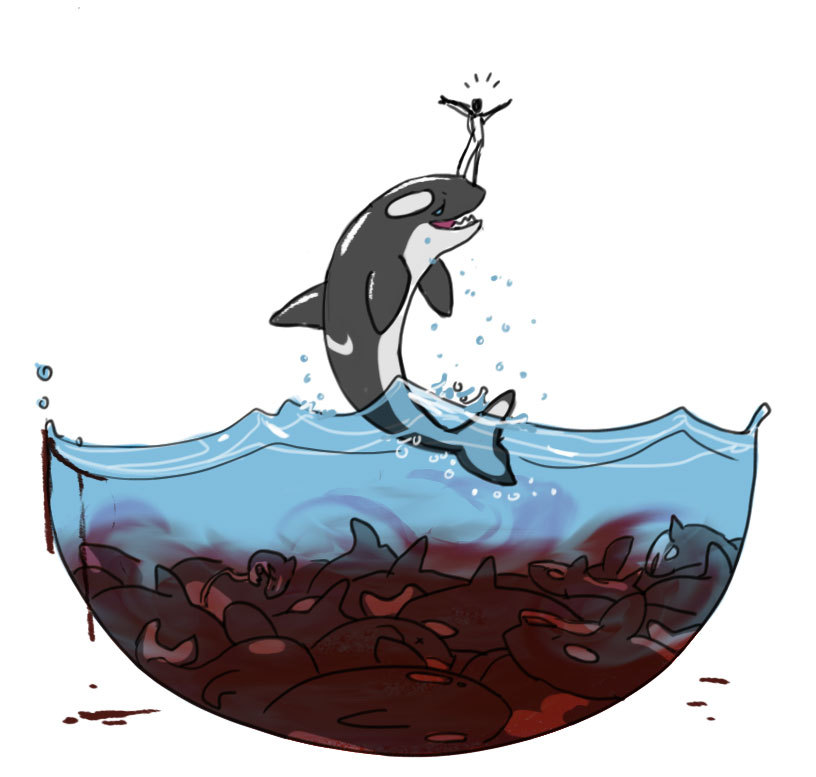
I did the sketch for this a few days ago and was going to make a more finished version for today, but my week was a little interesting.
So have the quick-colored and cleaned-up sketch.
Happy 50th Sea World. I’m bringing out the reality of that celebration. 50 years of piling up dead Shamus for human amusement.
Such an occasion, right?
You’re an ignorant fool if you believe this picture.
Orcas in the wild average a lifespan of 60 to 70 years. They can and have been recorded living to 100.
All captive orcas have died under the age of 32. The average death is below the age of 10. (often below even 3)
As of December 2013 159 orcas have died in captivity since orcas started being captured in th 1960s. The oldest of which was 32, her name was Nootka 5. (note that these do not include stillborn calves, misscarriages, or other unsuccessful pregnancies. Which are rampant, and many of the listed Orcas died due to pregnancy complications.)
13 of these deaths are Seaworld Japan. 16 are Seaworld of California. 12 are Seaworld of Florida. 10 are Seaworld of Texas.
That means of the 159 Orca deaths in marine parks worldwide, a total 51 are in Seaworld parks. Not including Seaworld affiliate parks, or parks where Seaworld sent calves/adults.
There are currently 53 living captive Orcas, 19 of them wild captured, 34 captive born. The majority of them being owned by the Seaworld parks, with 55% being in the U.S. ( 2 in Seaworld Japan, 10 at Seaworld California, 7 at Seaworld Florida, 6 at Seaworld Texas.)
I won’t go into the deplorable living conditions, but if you want hard statistics without opinion, here you go. Of the 212 killer whales in captivity since the 1960s, 159 are dead. All of them below the age of 32, all due to illness, injury, or complications. The majority of which at Seaworld parks. This does not include other marine mammal species, such as dolphins, other whales, etc.
If handed any other animal with this statistic would you continue fighting for the practice for the sake of public entertainment?
I urge anyone to do their own research on the subject. Don’t be swayed by just what I have posted, but also do not be swayed b ywhat is being fed to you by the very organizations who use these animals for profit. As we all know, when presented with criticism any company will do their best to downplay it.
This is the effect of dehumanizing and xenophobic rhetoric. They turn human beings and children into animals in the eyes of people who believe it. This is dangerous and fascist behavior
Um excuse me, America, what the fuck
Hey not to be aggressive but can all these assholes get their own fingers smashed in and noses broken,,, thanks,,,
hey anon… these are also people who say “we’re not all bad, look at the good side too!” I would hope you don’t want to be like them.
and just because I’ve been slamming this pretty hard (I mean, understandably), let me also add this. unlike many people on this hellsite, I am positive that everyone can learn and change. I do hope that you learn more and change your views, anon. it’s a strength, not a weakness, to say “I was wrong, but I know better now.”
You ever read some shit so evil it kinda pumps the brakes on the rest of your day?
Are you fucking ready for this knowledge? To my exasperated followers, give me a break, I haven’t given a good historical rant about her in a few months. Also who the hell uses the word ‘vegetable’ anymore? Yeah, I’m taking over this post. Here we go:
Rosemary Kennedy was JFK’s sister. Joseph Kennedy manipulated his children for years, always wanting them to be the picturesque family to help gain political traction. “Oh, they’re so pretty, oh, they’re so well-behaved, oh, they’re the definition of family ideals” that stuff.
For the most part, the rest of the Kennedy children obliged.
Rosemary?
Rosemary left her boarding school to go on dates.
…Yeah. Yeah, that was it. Rosemary left the boarding school and went on dates. That was her “rebellious nature”. She was a tad bit clumsy, she might have actually had borderline Asperger’s due to her inability to pick up on social cues, and she left her boarding school to go on dates with boys. That last one pissed off Joseph so that, by the time Rosemary was twenty-three (the above cruce post makes it seem like she was a teenager but no, she was twenty-three, I’m not saying this to diminish anything, I’m saying that she was a fully-grown adult and still under her father’s manipulations), he took her to Walter Jackson Freeman without consulting his wife. If you haven’t been privy to any of my rants, Walter Jackson Freeman was a man who used icepicks and knives to cut into people’s heads, chopping off pieces of their brain, a process known as the frontal lobotomy. Icepicks. The things you used to chip ice. Icepicks. Although I’m pretty sure he used a kitchen knife on Rosemary because, you know, that’s so much better. Anywho, not only was she forced into the operation, not only was she forced to sing God Bless America, but she was forced to say The Lord’s Prayer. The. Lord’s. Prayer. Until. She. Couldn’t. Because. They. Paralyzed. Her.
Joseph was so disgusted by her new state (you know, because she was paralyzed) that he sent her to a far-off asylum where she remained for decades. When JFK ran for his presidency and was asked about the whereabouts of his sister, he said that she was away, teaching and/or studying.
Nobody visited Rosemary for decades.
Nobody visited Rosemary for decades.
When her mother finally visited, Rosemary lunged at her in anger and had to be sedated. Her mother’s response? You ready for this? I mean, seriously, are you ready? Like I know what you’re thinking: “Mate, you just went into a rant by memory (yeah, I’m typing this all by memory) about a woman whose brain was hacked up using a butter knife so that she wouldn’t embarrass her family during their political campaign, only for that woman to become paralyzed and institutionalized without visitors for decades, what the fuck can be worse than that?” Seriously though, brace yourselves.
When Rose Kennedy saw her daughter for the first time in decades (after Rosemary was institutionalized as a result of Joseph’s severe medical abuse), when Rose saw her…her first concern…was that she was fat.
Like I said, I wrote this all from memory, but have a bundle of sources confirming everything:
Lobotomies to “correct” misbehaving children weren’t isolated to this family. This was considered a parent’s right. This family isn’t specially cursed, this was fucking “normal” at one point.
Even now, there’s disabled kids who have to fight their parents about invasive and detrimental surgeries and “medical treatments” like this.
It’s part the abuse culture that surrounds parenting – that parents can do what they want to their kids and nobody can tell them otherwise – and part more standard bigotry. The lines between sexism, racism, and ableism tend to blur when it comes to parental abuse culture.
And shit like this is happening in everyday homes,
Nondisabled storytellers often seem to think of disability as an abusive roommate coming and imposing its will on a disabled person. When they think about wheelchair users, they don’t think about the mobility that’s made possible by assistive technology. They think about how they’d feel if someone chained them to a wheelchair and forcibly prevented them from walking.
This misconception is dangerous. When people see disability-related limitations as similar to violent restraint, they don’t know know to tell the difference between the innate limitations of someone’s body and limitations being forcibly imposed on them by others. When people don’t understand the difference between living with a disability and living with an abuser, they assume that abusive experiences are inevitable for people with disabilities.
In reality, there’s nothing inevitable about abuse. Coming up against the limitations of your body is fundamentally different from being forcibly restrained by someone else. Whether or not you are disabled, having physical limitations is part of having a body. Being disabled means that you have a different range of physical limitations than most other people do, but they don’t come color coded ‘normal’ and ‘disabled’. When you’re used to the way your body works, the disability-related limitations feel pretty similar to those that aren’t disability-related.
Using assistive technology is pretty similar to using technology for any other important reason. Everyone uses technology to do things that their bodies alone would be too limited to do. Most people use cars to go further than they could walk; some people also use wheelchairs to go further than they could walk. Some people type or use communication tablets to say more than they could with their bodies alone; some people use musical instruments; some people use both. People with disabilities have different limitations, and as a result, often benefit from technology that wouldn’t be particularly useful to nondisabled people.
When technology is associated with disability, people tend to have the dangerous misconception that using it is the same as being restrained. This can very easily become self-fulfilling. When people prevent disabled people from doing things, their inability to do it is often misattributed to their disability. For instance:
Wheelchairs as restraints:
Anthony lives in a nursing home.
Anthony speaks oddly, and most people interpret most of what he says as meaningless. They say ‘Anthony doesn’t communicate’.
Anthony can walk and wants to walk, but the nursing him staff don’t let him.
George, the supervisor, tells Sage, another staff member, ‘Anthony wanders. We need to keep him in his wheelchair to keep him safe. Just lock the seatbelt. After a few minutes, he stops resisting.’
Every morning, Sage puts Anthony in a wheelchair that he can’t move, and ties him down so he can’t escape.
Sage tells Marge, a new volunteer, ‘That’s Anthony. It’s so nice to have a volunteer – he’s been spending most of his time in the hallway lately. He doesn’t walk or talk, but he loves visiting the garden! Can you take him there?”
Marge and Sage don’t know what Anthony actually wants, and it doesn’t occur to them that it’s possible to ask.
Anthony actually hates the garden and hates being pushed by other people. He prefers to spend his time in the library or with children in the children’s wing.
Marge assumes that Sage is the expert on Anthony, and assumes that Anthony’s disability prevents him from walking and communicating.
Marge doesn’t know that Anthony has stopped talking because he’s constantly surrounded by people who refuse to listen to him.
Marge doesn’t know that Sage is tying Anthony to a wheelchair against his will to stop him from going where he wants to go.
Marge doesn’t know that she’s doing something to Anthony against his will.
When people see disability and restraint as the same thing, they fail to notice that people with disabilities are being violently restrained — and often unwittingly participate in physical abuse of disabled people.
The disability-as-restraint misconception also causes people to fail to understand that when they deny people access to assisstive technology, they’re preventing them from doing things, eg:
Mobility:
Beck is an eight year old who can’t walk.
Beck has a wheelchair, but he’s not allowed to bring it to school.
At school, he’s strapped into a stroller that others push around.
His classmate Sarah has *never* had a wheelchair that she can push herself.
At a staff meeting, Lee, their teacher, says “Because of their disabilities, Sarah and Beck can’t move around by themselves. Even though they stay in one place all day, they’re so fun to have in our class!”
Lee is missing the crucial fact that the reason Sarah and Beck are immobile is because they’re being denied access to assistive technology.
When people see disability and externally-imposed limitation as the same thing, they don’t notice limitations being imposed on disabled people.
Communication:
Rebecca types on her iPad to communicate.
Clay takes away Rebecca’s iPad.
Clay tells Sophie, ‘Rebecca is nonverbal. Her disability prevents her from communicating, but we’re working on improving her speech.’
Sophie sees that Rebecca can’t talk, and assumes that it’s her disability that’s preventing her from communicating.
Actually, it’s *Clay* who is preventing Rebecca from communicating.
When people see disability and abuse as the same thing, they don’t notice abuse of disabled people.
It’s important to be clear on the difference between disability and abuse. Disability is not an abusive roommate; people with disabilities are only abused if someone is abusing them. When people with disabilities are restrained against their will, this is not caused by their disabilities; it’s caused by the people who are restraining them. Restraint is an act of violence, not an innate fact about disability. When wheelchairs are used as restraints, the wheelchair isn’t the problem; the violence is the problem. When people are denied access to assistive technology, it’s not their disability that’s limiting them; it’s neglect. When we stop conflating disability and abuse, we’re far less likely to see abuse of people with disabilities as inevitable.
I WANT TO KNOW THE STORY BEHIND THIS. I HONESTLY THOUGHT THEY WERE LOVERS.
Okay, okay, so short version:
Joker seduced Harley while he was in Arkham and she was his psychologist. He did so by manipulating sessions to make him seem pitiable.
Harley broke Joker out. Joker was originally going to kill her then, but fans had latched onto Harley Quinn’s new look and she was a fan favorite (mind you as I recall, she was originally introduced in BTAS, and then transferred to the comics later). So she ended up surviving his first murder attempt.
He decided that although annoying she could still be useful (since she’s actually brilliant, and at this point somewhat codependent). This leads to a string of horrific abuses and murder attempts. Including (in the TV show alone) throwing her through a window that is at *least* three stories up, choking her, beating her with a hammer, threatening her with one of his gag guns (which, depending on the gun, may or may not kill her in various ways), and attempting to get hyenas to eat her.
In the comics, it includes starving her, chaining her to a wall in a sewer on top of corpses of “failed Harleys,” poisoning her, leaving her in burning buildings, pushing her into the line of police fire, gaslighting her basically every time he fails to kill her, and the list goes on. When she becomes pregnant with her and Joker’s kid, she leaves for nine months, to her sister’s place, and gives birth there. She doesn’t tell Joker about the kid (and goes out of her way to prevent Joker from finding out). She tells Canary that it’s because Mr. J would be too busy for a kid, but if you pay attention to Harley’s behavior throughout the comic, the clear subtext is “My kid would end up dead or worse if Joker knew about her.”
Additionally, post break up, she notes he was abusive, says it wasn’t love, it was manipulation, and frequently describes it as the worst part of her life.
I’m no expert but I remember one more thing… she said he never noticed she was gone for those 9 months.
THANK YOU FOR CLEARING THIS UP.
This is why couples are creepy as fuck for dressing up as Harley and the joker and why people are especially fucked up for thinking the relationship they had in suicide squad was “goals”
hello there, howdy, my name is diz, and i’ve been wanting to make this post for a while. before i jump into it, let me start by giving you my credentials: i am a “women’s advocate” at a domestic violence shelter (i don’t particularly like that title, because i feel it minimalizes the experiences of men/non-binary survivors, but i aslo cannot argue the fact that our clientele is overwhelmingly female, and domestic violence is, in a lot of way, a result of a society based in patriarchal values, but that’s its own post)
that said, i don’t claim to be an expert. my bachelor’s degree is in english with a focus in creative writing, for fuck’s sake. therefore, what i’m going to say in this post is based off of information i’ve gathered from trainings, conferences, and what i’ve seen firsthand working daily at a DV shelter.
let’s dig in, shall we?
terminology: what the frick-frack do these words mean?
domestic violence, aka intimate partner violence: abbreviated as DV and IPV, these terms often carry the connotation of physical violence, but DV/IPV encompasses all types of aggressive behavior, be it mental, physical, verbal, sexual, financial, etc etc. now, the argument can be made that domestic violence transcends partners/spouses, and can include familial violence as well. familial violence is not to be minimized, but for purposes of discussion, what i will be referring to in this post will be solely IPV
domestic violence advocate: i’m sure this varies, but the particulars of my position are that i take crisis calls from people who are currently experiencing domestic violence, and i help manage our communal shelter by getting things for the residents, listening to them talk, and just in general spending time with them. every advocate’s experience is going to be different, tho, and i can only speak to my own
domestic violence shelter: every shelter provides services differently, but it generally amounts to providing a safe place for survivors while they are trying to escape their DV situations. when i talk about shelters, i can only speak to shelters in the usa, although there are domestic violence programs internationally. visit nnedv.org for more information about shelters near you
abuse/abusers: we’re going to be diving into the specifics of abuse real hard in this post, so i’ll keep this brief, but what i will say is that “abuse” is a hard word to swallow for some. when taking crisis calls, we usually refrain from calling it abuse unless the person on the other line calls it that. “abuse” carries baggage that not everyone is ready to take on. if this pertains to you, i ask you to look past the word, and focus on the bullet points. semantics are not what’s important here
trauma: there are so many types of trauma that it could be a post of its own, but in it’s most bare-bones definition, trauma is an experience that is distressing/disturbing, and often times has lasting effects
victim vs survivor: i have a tendency to use the term “survivor” over “victim,” because to me it’s more empowering, and gives agency to the affected person. you may hear victim, as it’s still common practice to use it, but here i will almost always use survivor
the power and control wheel
i could go on a nerd rant about the history of this wheel, but this post is already a novel and is only going to get worse, so i’ll spare you. what this wheel is, however, is a visual representation of different tactics abusers will use to maintain control over their partner
okay, are you ever going to get to the part about whether or not i’m in an abusive situation?
yes. right now.
what follows will be subsections of abuse, and the qualities of each. read through each bullet, and see if they pertain to your current situation
abuse
physical abuse:
my partner shoves, pushes, punches, slaps me, or in general puts their hands on me with the intention of causing harm
my partner has thrown objects at me
my partner has threatened me with weapons/has appropriated tools or objects around the house and used them as weapons
my partner has prevented me from getting medical care
my partner has initiated fights with me when they were/i was driving that were serious enough to put us at risk of an accident
my partner punches walls, breaks property, uses violence in my surroundings without actually putting his hands on me
my partner has made me fear for my life
verbal abuse:
my partner calls me names, often derogatory in nature
my partner yells or screams at me when we argue
my partner verbally puts me down by targeting my physical appearance, my intelligence, my self-worth, or anything that will make me feel lesser as a person
my partner makes accusations about my actions, such as saying that i am cheating on them, or that i am lying when i’m not
my partner sends me harassing or threatening messages via text or social media
my partner verbally threatens violence
emotional abuse:
my partner makes me feel worthless or ugly
my partner “gaslights” me, or makes me doubt myself or makes me feel like i’m crazy
my partner encourages or forces me to stop seeing friends or family so that i feel isolated and without a support system
my partner has told lies about me to other people to make me look bad and make them not want to associate with me; this includes family and friends
my partner makes me feel guilty for my emotions, especially if it involves me being unhappy with their actions
my partner blames me for everything, including their negative behavior
my partner uses my children/family/loved ones as leverage in order to keep me from leaving
my partner denies having done negative actions, or refuses to take responsibility for them
my partner makes me feel that if i leave them i will not be able to make it on my own
my partner threatens to take their own life if i leave them
my partner stalks me, checks up on me as though making sure i am where i say i am, or will show up at my work/events/activities without notice
my partner gets angry if i stay out too long, or if i do anything that doesn’t involve them
my partner says that they should be enough for me, and that i don’t need anyone or anything else
my partner makes me feel subservient to them
sexual abuse:
my partner forces me to have sex when i have said no
my partner puts me in sexual situations where i feel like i don’t have the right or ability to say no, even though i don’t want to participate
my partner makes me participate in sexual acts that i am uncomfortable with
my partner touches, gropes, or fondles me when i tell them not to
my partner makes me feel guilty for not participating in sexual acts with them
my partner dismisses my sexual discomforts, such as excessive porn watching, or fetishes i find demeaning
my partner has coerced me into having unprotected sex when i wasn’t okay with it
my partner has made me feel guilty for wanting to have protected sex
my partner has engaged in sexual acts with me while keeping STDs/STIs a secret from me
my partner has intentionally given me an STD/STI or has intentionally gotten me pregnant
financial abuse
my partner won’t let me work; makes me financially rely on them
my partner makes me rely on them financially, but will not provide me with enough money to meet my needs
my partner refuses to get a job and relies on me financially
my partner controls the money i make/expects me to pay for all of their wants and needs
my partner doesn’t allow me to have my own bank account, debit card, or credit card
my partner takes money out of our joint account/savings without consulting me
my partner puts loans/credit cards/debts in my name without my consent/through coercion
my partner has negatively affected my credit score against my will
risk assessment
while everything on these lists are valid and serious forms of abuse, we as advocates also look for a few specific traits or behaviors that may increase the lethality of a relationship. if any of the following pertains to you, your life may be in immediate danger:
my partner has choked me, strangled me, or suffocated me
my partner is violent and owns a gun/multiple guns
my partner has threatened me with said gun
my partner has a previous history of domestic abuse/has been arrested for domestic assault
my partner has hurt or killed an animal or pet i care about
my partner has made ominous sounding comments such as, “if i can’t have you, no one can,” or “until death do us part [in an uncomfortable context]”
my partner has verbally threatened my life
my partner has threatened the lives of my children/family/or people i love
my partner has made me believe they will truly end my life
okay, well i only relate to a few of these. that doesn’t make my relationship abusive, does it?
let’s put it this way: every bullet on this list, on its own, is a toxic behavior that should not be present in a relationship, and is enough reason to leave someone. and something to consider is that abuse rarely starts out with everything at once. abuse escalates. nobody goes to the first date saying, “btw, i intend to abuse you down the line, you chill with that?” abuse is a lot like the frog in the pot. you start off with low heat, and the frog doesn’t realize until it’s too late that it’s boiling to death. consider everything on this list as a red flag. a healthy relationship should not have red flags
but i can’t leave because…
i don’t have anywhere to go
have you exhausted all your family/friend resources? go through them all, and if that’s still a no-go, check out your local domestic violence shelters. they can help you figure out housing, can provide you with food, clothing, and hygiene while you try to get back on your feet, and will provide you with the resources you need to become independent. go to nnedv.org to look for shelters near you
i’m afraid the abuse will escalate if i leave
safety planning is something domestic violence advocates are trained in. if you work with a professional, they should help you figure out how to get you safe, even if your partner has a history of stalking, tracking, or violent behavior. and if you stay, the abuse may, and probably will, escalate anyway
they will take my kids/i will lose my kids/i don’t want my kids to go through that
kids are one of the most difficult factors in IPV situations, and your concerns are valid, but there are options. protection orders often can let you add your children on them, so that if it is granted, you can get temporary custody while you figure out the long-term solution. schools and daycares will usually work with you if you’re worried your partner may attempt to take them without your consent. many cities have legal aide resources for low-income individuals, and custody is a common thing they deal with. as for not wanting to put them through all those changes, something you should consider is “what kind of trauma are my children experiencing in the situation they are already in?”
they said they will change and i want to give them the chance
that is 100% your right, and i can’t make the decision for you. all i can do is speak from my experience, and from my experience, i have never seen an abuser change their behavior. exactly zero times. that information is there for you to make of it what you will, and i won’t judge you, however it is you take it, but know that that is what i’ve seen firsthand
i want to try couple’s therapy first
again, you do what you feel you need to do, but it is a statistical fact that abusers will often use couple’s therapy as a means of gaining more control over their partner, and therefore, it usually causes more harm than good
i feel stupid for being in this situation to begin with
one of my favorite quotes is, “when you look at someone through rose colored glasses, all the red flags just look like flags.” we all end up in situations we wish we hadn’t, and we all make choices we’re not fond of, but that doesn’t make us stupid. and someone treating you badly is not a reflection on you, it’s a reflection on them. abuse is never the survivor’s fault
i have left before, and then went back, and i’m too embarrassed to leave again
there are currently, right this minute, at least four repeat clients at my shelter that only houses 8 women at a time. the average amount of times it takes for someone to leave an abusive partner is 7. let me repeat that. it takes upwards of about 7 times before a person leaves their abuser for good. never feel bad for going back, and never feel like you’re not able to make changes. “past performance is not a predictor of future events.” maybe this time will be the time
i love them
hey, that’s entirely okay. women come to me all the time and say that they feel guilty because even though they know what was done to them wasn’t right, they still love their abusers, and what i always tell them is this: you don’t fall out of love overnight. an abuser never introduces themselves as an abuser, and you did not fall in love with the person who is violent towards you. it’s okay to have mixed feelings.
but what you should do is stop and consider, what are the parts of them you love? is it the person they pretended to be at the beginning, or the person who they showed themselves to be? are all the sweet nothings, promises to change, or nice gestures enough to make up for the abuse? is what you’re feeling love, or a fear of being alone? and, most importantly do you realize that you deserve to be treated well?
now? i guess now it’s up to you decide what you want to do. my inbox is always open if you have questions, and there are always people who want to help. the first steps are yours, and you get to decide what direction you’re going to go.
good luck, and be safe. you have me in your corner




 BettSplendens Tumblr Evac