every fall teenage girls are like.. “oh , im gonna enter a place of business and order a product which is offered by that place of business because i like the flavor of it” and honestly? how dare they. that’s so annoying. why can’t they buy the beverage that i, a smart man, would prefer to drink
szechuan sauce frappe bc the cartoon science man like it
I’m WHEEZING
I wanna be clear, especially to anon: I’m not meaning to go “IF U LET UR CAT OUTDOORS U R EVIL”. I know it’s the norm in a lot of places, and I know a lot of people consider it cruel to keep a cat indoors- mostly because indoor cats not properly entertained do get incredibly bored!
I’m just saying “if you have a cat or have say with someone who does, maybe consider these things here”. It’s not intended to be a challenge, accusation, or suchlike.
Again, I have a fever right now, and I’m not good with tone even when my brain isn’t mushy. So apologies if this comes off as some variety of rude, it’s meant to just be “here are the facts as I see them”.
Yep, that’s nature. Coyotes and raccoons are both a lot more ferocious than people realize.
My mom once took an indoor/outdoor cat to the vet for deep puncture wounds, wondering what had fought him, and was told by the vet that it was probably another cat rather than the local raccoon. Why?
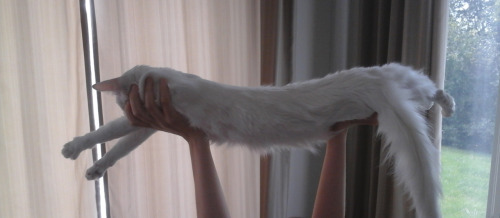
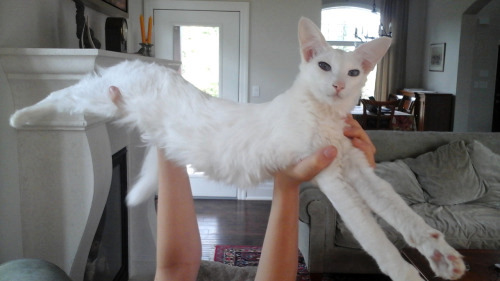
I love every single picture of Pangur being manhandled because she always seems pretty blasé about it. Like, “Yeah, okay, I’m not sure why we do this but I trust you completely.”
(first off, I apologize if this comes off as rude or argumentative. It’s not meant to, but I have a bit of a fever, so my brain is a tad mushy. The intended tone here is just “here is what I think and here are the reasons why I and a bunch of other people think that”.)
Definitely more of an American thing, but one that needs to spread. That post and many others explain why. Outdoor cats are much more likely to get sick or die violent deaths, and they don’t live as long.
Plus, they have massive environmental impacts. They kill rodents, yes, but also birds and reptiles. Any small prey animal nicked by a cat’s claws or teeth that manages to escape is at a serious risk of dying a slow, agonizing death of bacteria-induced sepsis from the bacteria in the cat’s saliva. They’re also responsible for the decline of numerous bird species, and have entirely wiped out several native marsupials in Australia.
Basically, it all boils down to this. The only benefits to letting your cat outdoors (aside from rodent control, which has other options) are that they’re less likely to get bored or overweight. Those things can also be accomplished indoors with proper care and toys, with zero risk of infection and no violent deaths of small animals. The downsides include serious risk to your cat and to wildlife that encounter your cat.
If you can’t make the indoors enriching and fulfilling for them, then don’t get a cat.
Peace. ✌🏻
Cats are natural hunters. Bred from wild felines. They are outside animals.
Yes, dangers exist.
If you live in the middle of a busy city with crazy roads, obviously keep them in. If you live in a quiet suburban area, collar track them if you must, but…
…Rae, this is one thing we disagree about. I completely respect your opinion; frankly, after Mika, mine is changing, but…
I do think it depends on the environment. Suburbs, city, country…
Cats are outside animals to me. Inside-outside. They can rest in my bed, cuddle with me, and still go out.
Just be careful. Every cat is different, as is every neighbourhood. My boy recently died from anti-freeze poisoning, in autumn. No need for anti-freeze in cars yet. This was after ten years.
Just be safe. Keep your babies safe. You are their caregiver, after all.
There’s nothing “natural” about domestic cats, they’re domesticated pets.
They are not outside animals just because they can survive outdoors when forced to. And if you let your cat outdoors, you should contain it appropriately.
What other domestic pet do you allow to run wild?
Dangers to cats exist outside of big cities; wildlife will kill cats. Diseases. Injuries. Other human beings. Weather. Poisonous plant life. There is no need to expose your cat to that many risks.
I am that most despised of creatures (on tumblr). One who has had free roaming cats, outdoor cats, indoor cats, and an indoor cat who was ejected into the great outdoors.
Oh, and I worked for a vet who adopted three very friendly barn cats.
Chickens are a livestock species, they were not domesticated for companionship and therefore were not housed inside. You don’t house your food inside. And, I don’t know about you, but I don’t let my chickens freeroam without supervision because I know they can get injured or killed if I am not watching them and I prefer to keep my animals alive.
I don’t see how your vet adopting three barn cats has anything to do with outdoor cats? I had outdoor cats for most of my life. Out of the three I had, two disappeared, never to be seen again and one disappeared for 18 months before coming back. She has been an indoor cat since even though she was born and raised an outdoor cat.
YOUR cats might have lived outside for a long period of time, but mine didn’t. They died. Dead. I will never see them again. Why does your experience mean more than mine?
There are hundreds of people that claim that cats are, in fact, wild animals and that they belong in the wild. This is false. The domestication of cats began around 10,000 years ago in the Fertile Crescent, from F. s. lybica, a subspecies of the Wildcat known as the African Wildcat or the Near Eastern Wildcat. We have since selectively F. s. lybica and turned the old species into our modern day housecats. We have directly changed their genetic level and changed their biological tendencies. Through selective breeding and domestication, we have impacted the temperament of the domestic cat and made them marginally better at utilizing plant-based proteins. Cats are domesticated and no longer have a natural role to play in the ecosystem.
Cats have a huge environmental impact that most people don’t realize. Since they are domesticated animals, they are considered an invasive species. Not only are these animals features on the Global Invasive Species Database, but they are considered one of the top 100 worst invasive species in the world. It is estimated that free-ranging domestic cats kill 1.3–4.0 billion birds and 6.3–22.3 billion mammals per year. Free-ranging cats have been introduced all around the world and have even been known to cause extinctions on islands. Free-ranging cats on islands have caused or contributed to 33 (14%) of the modern bird, mammal and reptile extinctions recorded by the International Union for Conservation of Nature (IUCN) Red List. It’s not limited to the United States, either. ln under a year British cats killed between 85 – 100 million animals, according to one study, and is considered to be of sufficient magnitude to affect populations of preyed upon species. European songbirds are too afraid of cats to breed, for example, and in Italy they threaten bat populations. It is also well documented that European free-roaming cat owners are disconnected from the realities of their cats’ impact on the well being of European environment and conservation efforts, even reducing the effectiveness of protected parks.
When humans domesticated cats, we took on the responsibility for their health and welfare. This includes protecting them from all possible dangers. When outside, cats are exposed to diseases, cars, and deadly wildlife. They also have the chance to maim or kill OTHER cats that are also outside.
Feline Immunodeficiency Virus or FIV is just one deadly disease that cats can get if they are allowed outdoors unsupervised. FIV retrovirus in the same family as the human AIDS virus, with a few significant differences. It is estimated that in the United States, 2% of cats are infected with the FIV virus. This is not the only disease that outdoor cats can catch; they are also at risk for FIP (Feline Infectious Peritonitis), Panleukopenia (Feline Distemper) and Zoonotic Diseases. Not to mention that mice your cat may eat or bring home can also cause a host of other dangerous diseases that not only threaten cats, but the humans they live with as well.
Cats kept indoors are safe from predators such as coyotes, dog packs and other stays. The average lifespan of an indoor cat is 12 – 15 years; the average lifespan of an outdoor pet cat is 2 – 3 years less. Outdoor cats are below wildlife predators in the food chain, and they are sitting ducks for owls, raptors, coyotes, and native big cats. Dogs running in packs will consider a cat fair game; even one large dog can easily overpower and kill a cat. Even dogs that are owned by people can cause a cat harm. Many dogs carry a high prey drive and cannot be blamed when they see a cat run and their instincts take over.
Indoor cats do not get hit by cars. Period. Cars kill about 5.4 million cats per year which is a million more than are killed in shelters. Most of these cats are hit at night because the beams of cars can confuse and disorient them and they don’t have enough time to move.
There are more reasons not to let cats outside. Such as monitoring cat’s urinary tract and bowel health, not going in neighbor’s yards, getting abscesses from fighting, human abuse, getting lost, getting stolen, or freezing in the winter.
Some argue that their cat is depressed or bored when they are forced inside. Cats will sleep an average of 15 hours per day, and older cats may sleep as many as 20 hours without it being abnormal. Cats are naturally crepuscular, meaning they’re activity peaks at dawn and dusk. It is important to distinguish lethargy, an actual a symptom of depression, or merely your cat doing a normal cat thing. A cat that is kept inside will never be bored if they are being provided enough enrichment. Enrichment is the most important part when bringing cats inside. If a cat is not provided enough enrichment, then that is on its owner and not the cat. Going outside should not be a cat’s only enrichment. If the cat’s owner can not provide the enrichment a cat needs, then the owner should not have a cat. If a cat absolutely needs to be outside, then they can be outside in a secure and supervised environment or on a harness. A catio, which is a patio specifically made for cats and fenced in, can be built.
Cats are the only domesticated animal that is let outside unsupervised. People do not let their dogs, ferrets, gerbils, chinchillas and rabbits free-roam because of the dangers toward them and the impact they create. Even though dogs, also natural born hunters and predators, are not allowed to roam free. Why? To protect them and the environment. Cats should not be the exception. This needs to stop to improve the environment, protect the animals that live there and promote the safety of our own pets. Humans should not be advocating against the protection of their own pets and education efforts to warn of the dangers of outside cats should be more prevalent. Leaving cats outside and unsupervised is irresponsible and needs to change. It is irresponsible and damaging to the ecosystem and frankly, there is not a single good reason to keep them outside.
Guarantee you there’s a trooper out there named Shark, not because he has any particular affinity or connection to the aquatic apex predator, but because he’s always putting weird shit that isn’t food into his mouth
One of which is probably a small animal that is poisonous to humans



 BettSplendens Tumblr Evac