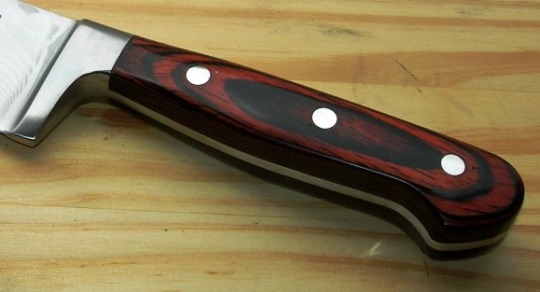
I don’t wanna like Kill The Joke but this brings up a really cool fact about swords in ~14th-16th century Germany! The only people who were allowed to own Real Swords were the royalty and nobility BUT! Everyone else was allowed to own knives. The definition of a knife, however, was based on not length but handle construction, and to some extent how it was sharpened. The handle had to be constructed Like So with 2 pieces of wood sandwiching the metal tang.
Only one edge was allowed to be sharpened, but oftentimes a small part (a couple inches) of the short edge (e.g. the edge that wasn’t sharp) would be sharpened, and weapon design often allowed for this
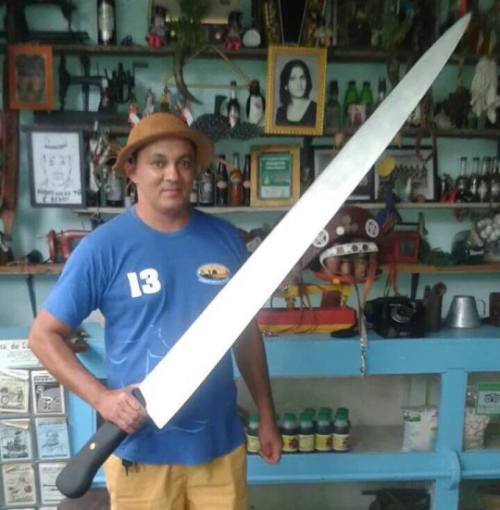
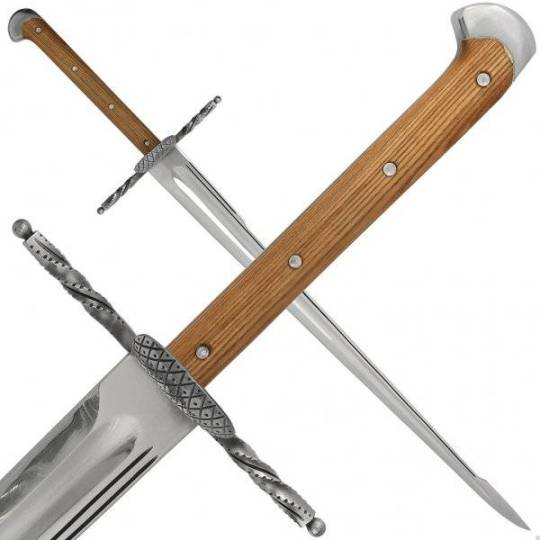
In this way, something that looked like This, a messer of just over a meter in length…
…would be legally considered a knife, and therefore allowable for non-nobility to possess. (you can also see the bit on the back of the tip that would be sharpened)
So @swordmutual, there’s a not definitive but certainly interesting historical perspective on your question
In legal terms (at least in 14th-16th century Germany), the above object is a knife. In practical terms, it’s a sword. A really heavy sword.
The dress I’ve been wanting since 2011 but only bought last week arrived and I love it. I take my fashion inspiration from beetles that spray you with horrifically stinky defense chemicals when you impulsively pluck them from the ground during the eclipse.
Hey, Ship? Are you much taller than I thought or are you just standing in a short room and doorway
Short room and doorway. I live in a renovated attic.
That’s a fiery caterpillar hunter! They run around really fast, have beautiful rainbow bellies, and are hard to keep in captivity because they only eat live prey.
If you force an introvert into a social gathering they don’t feel comfortable with/don’t want to go to you are responsible for their good time.
You have to include them in conversations or go sit with them when they have no one to talk to.
Because if you can’t do that, don’t make them come. Don’t force them in a situation where they feel alone and helpless and leave them floundering.
“But it’s good for them to get out.” You’re not making me adapt. You’re not making me more social. You’re reinforcing every negative opinion I have on these gatherings and giving me the resolve to say ‘Fuck off’ the next time you try this.
I would also like to add to this rule. Do not trap them there. Make sure they have a way to get home without you or you are willing to take them home if they feel uncomfortable. Even if you do spend time with them and make sure they have a good time let them leave if they want. Social interaction even with people they know and like can be tiring and they can’t always keep up with extroverts.
Journal Entry 7: “I came across the ruins of a castle that’d been decimated by a war not too long ago. I squeezed in through a gap in the toppled entry gate, wanting a look around for any trinkets, but instead I came across someone sitting alone in the disheveled mead-hall. I gently approached him and found out he had been a guard here at the castle, now currently cursed to roam as a Death Knight. He hasn’t seen another soul since his death, not one as ‘handsome’ as I, he told me. I asked him if he still felt love’s warmth in his bones… he said he wasn’t sure. I asked him if perhaps we could spend the evening together and find out. He agreed.”
Just gonna reblog this out of gratitude because I actually did forget…
Fffffffff let me get right on that.
and then reblog for the next forgetful son of a bitch
I’m so great full for everyone that is reblogging this. I totally forgot to take mine
I think that there is some sort of unspoken fairy godparent thing where you see this, realize that you forgot your meds, and rebagel it because if you forgot someone else must have. And in our turn we all take care of each other, even if we don’t know it.
what
kinds of body decoration do your rtts aliens do? like, are there alien
versions of/analogues to tattoos, hair dye, nail polish, pierced
jewelry, face paint, etc.?
OH BOY do I have a lot of stuff for this topic! For reference the main posts for centaurs, avians, and bug ferrets are here. Scud body decoration not included in this post because they are my most recent Runaway to the Stars race and I don’t have as many juicy cultural details for them.
More info under the cut.
Bug ferrets (or just ferrets) are from an iceball planet where most lifeforms live underground in the tropical band of the otherwise glacial planet. After millions of years of subterranean life, the tropics are now riddled with vast networks of biologically formed tunnels, caves, and seas. Ferrets rose from a strain of endothermic and highly social omnivores. They have both an endoskeleton (mostly for muscle support) and an exoskeleton covered by a thick layer of subcutaneous fat, skin, and dense, highly sensitive hairs and whiskers. Ferrets wear minimal clothing, if any, because it irritates their delicate hairs. Their central nervous system goes down the length of their body, and they are wicked fast at picking up sensory signals and reacting to them.
Ferrets also have an incredible propensity for language, and pick up other ferret languages and alien languages with ease. Generally, all ferret cultures have at least one vocal language, one visual sign language, and one tactile sign language. Tactile sign is unique to ferrets, and is spoken by touching the arms, chin, and chest of the conversational partner. Humans have described it as “like the most intense and complicated game of pattycake you could imagine.”
Ferrets are hermaphroditic and usually live in family units of 15-45 individuals. A given family will usually all be in single profession, operating almost like an individual– for instance, in public offices, a family will be nominated rather than an individual ferret. Having ferret ambassadors over on other planets is a nightmare, because you can’t just invite one ferret, or two, or eight, you have to have the entire family of 30 or so ambassadors (and their kids, and their picnic baskets and etc). It’s for good reason, as ferrets are so socially co-dependent that leaving one alone with no company will severely stress them. Spending over a day alone without social contact is enough to put them into a state of shock.
They are a spacefaring race, and have been for the longest of any of the races. The first aliens the ferret race met were the avians, then later the humans and centaurs.
They are from an oceanic planet, where endothermic, feathered flyers are one of the most successful land-based lifeforms. Since land is limited to a scattering of small islands, the feathered flyers can travel the distances between dry land more easily than flightless or exothermic creatures.
The evolutionary ancestors of the sapient genus of avians are tree climbing critters with grasping hands on both their fore and back limbs. In the sapients, the hindlimbs are specialized to a point where they are used almost entirely for grasping, tool manipulation, and launching into flight. The dramatic speciation of the sapient avians was caused by hundreds of thousands of years of separation by ocean, and fostered by a lack of traumatic events like Earth’s ice age or K-Pg asteroid impact to wipe any of them out. Besides the five major species, there are many subspecies that can successfully breed with one or more of the major species.
The avians are a technologically advanced genus. After the industrial revolution, aggressive colonization by the skimmer species, and the globalization of information, the avian genus achieved interstellar flight. The first aliens they made contact with were the ferrets, then later humans (after the ferrets found us.)
Note: Despite the fact I drew all of them naked, avians have very strict decency standards (well, the skimmers do, but they have forced their cultural standards upon the others) and they wear quite a lot of clothing; usually covering as much as they can without restricting flight. They are like little space Victorians.
Centaurs come from a planet fairly similar to Earth, and their biology is convergent with Earth’s in many ways. Their evolutionary ancestors were savanna pack predators who used ambush and speed to hunt prey. Modern centaurs emerged when they started to use tools like spears to help with hunting. Centaurs are obligate carnivores but they supplement their diet with grain, starchy tubers, and small amounts of roughage and vegetation. Much like humans, they have a two-sex reproductive system where the individuals with the larger gametes give birth to live young.
They are very vocally talented. With their trunk they can produce a wide range of pitches and consonants, while with the muscular tissue near their breathing outtake they can make subsonic booming noises. The booming is mostly inaudible to humans and avians, but ferrets can detect the low-frequency vibrations through their numerous whiskers. There are a variety of simple subsonic languages collectively called ‘boom-speak’ that are traditionally used as contact calls over long distances.
Most centaur cultures are matriarchal, with family groups of about 20-30 living together in a small village of interconnected houses. These clans are run by the oldest females of the family, and younger females are often expected to stay in the same clan their whole life. Males are often expected to marry outside of the clan, and although they will usually join a new group for one or more specific mates within it, the ‘marriage’ for most cultures is between the new member and the entire family. Despite this, many individuals may never mate to reproduce, and instead help care for their family members’ children.
The centaurs were discovered by a ferret planetary exploration vessel, but they weren’t a spacefaring race when they were found– they were barely starting to use electricity and radio. The Interspecies Summit (a council including humans, avians, and ferrets) met on the matter and it was agreed that the centaurs should be left alone until they were capable of space flight. Unfortunately, this policy proved impossible to enforce, and human and avian ships began visiting the centaur homeworld to trade technology and resources for centaur laborers. Today, most centaurs in space work as manual labor under human and avian companies, or they run pirate vessels.
 BettSplendens Tumblr Evac