the woods are haunted, but not in the way youve been lead to believe by so many horror stories and whispered folk tales. the creatures within the trees just want to survive and see their home thrive, the trees are ancient and tired. they yearn for the gentle love of both the sun and the inhabitants of the world, outstretching their leaves to the sky in hope. when you stumble over roots and hidden paths with tears in your eyes, the ones from inside the woods are not following you to hunt you. they are not here to hurt you or kill you, instead they ache for you. they love you even from just a single glance and they know your pain. flowers spring up close to where you finally collapse, no matter what season it is. the woods is haunted, but not out to get you. it wants to heal with you.
shortly after william the conquerer came to power he initiated something known as ‘the doomsday book’- he sent envoys to survey his new lands to record the properties he now controlled so they could pay accurate taxes. every acre of field, every mill, livestock, buildings and their relative size- all would be recorded to determine the wealth of each settlement so a percentage could be expected as rent. for an example of what this book meant; the previous king was aware of and collected taxes from about 20 grain mills in england, william’s audit shot that number above 200. you dont know the meaning of ‘pedantic’ untill you start reading about medieval grain mills, theres a church that paved its floor with confiscated ‘illegal’ millstones to ensure that the town had to get its flour from the church’s official mill and one war simply about stealing the same millstone back and fourth for quite a few decades
of course word of these envoys traveled faster then they did, virtually every town they came to had time to claim they had far less taxable wealth then they actually did have by the time the audit arrived. in one of the more over the top cases an entire village pretended to have caught insanity- when the taxmen arrived they saw screaming laughing idiots with underwear on their heads so they left as fast as they could considering at the time insanity was thought to be literally contagious. it would be over five years before anyone tried to audit that town again. its safe to assume a large number of other villages also had sudden cases of strange diseases, mysteriously disappearing cows, or very large shrubberies and haybales shaped like buildings and you dont need to look over that hill either. thats not even touching how many small communities just plain didnt technically exist because they were too small, somewhere weird, or in legal limbo of who owned it
of course when the feudal part of feudalism started moving its gears you found that the local lord of that village was unlikely to divulge the exact amount of rents they could collect to THEIR lord either, knowing that the more they admitted to receiving the more they were expected to hand over. this was not exclusive to england either, the more you learn about feudalism the more you have to ask how all these minor lords out in the boonies kept having the money and soldiers to do all the political intrigue bullshit, the answer is also tax evasion. each village kept claiming it had fewer people living in shittier houses with less land and fewer livestock then they actually had, and each local lord kept claiming they were receiving less rents then they actually took so were also adverse to an accurate audit.
their knowledge of tax loopholes also extended to finding out that clergymen were either exempt from tax or received a far lower rate of tax, so proving you qualified as a clergyman was an endeavor that paid dividends. specifically to prove you were clergy you proved that you could read and write enough Latin to satisfy an official, so you could spend some money to hire someone to tutor you enough Latin to fake it. its estimated that due to this fully ten percent of medieval english households wrote ‘clergy’ on their tax forms.
another and even more extreme example was the peasants revolt of 1381, london was swarmed by the unwashed masses from all sides instigated by an official trying to collect (a lot of) unpaid poll taxes, an angry mob driving a teenaged king Richard II to retreat to a boat in the river, and culminating with 1500 peasants being executed by an emergency militia. this doesn’t sound like a huge success untill you dig into some of the details- peasants from a large number of villages all arrived at london at the same time, leaving dedicated forces specifically to stop ships from acessing london to break the siege, the peasants executed a select number of court officials and started burning paperwork- but systematically only burning the ones detailing who owned plots of land, debt records, and a few criminal records. the peasants who besieged london and scared the king into the river had successfully purged a whole lot of debts and reclaimed a lot of land in one very ballsy and highly coordinated move that relied on them being seen as illiterate dirt farmers with no ulterior motives besides pitchfork mob riot and trying to kiss the queen mother while they touch everything in the tower of london with their grimy hands
found it. this is… this is amazing. I did a BA in Medieval British History and we never, ever, once considered this. Not once. At a major Canadian university.
today i found out that when monarch butterflies migrate south for the winter, all the ones that go across the middle of lake superior suddenly stop going south and go west for five miles and then continue south. which really freaked scientists out cos like What is in the Middle of Lake Superior what do Butterflies know that We Dont Is This The End Times etc. anyway turns out about a hundred million years ago there was a mountain there and the butterflies still think they gotta fly around it. classic butterflies
combine this with the fact that caterpillars literally turn into bug soup in their crystallis, meaning there is no central nervous system to carry over any information, but they seem to retain memories from caterpillar life regardless…
and it brings up a lot of questions about what kind of information can even be stored in genes, like… does genetic memory really exist? what does this mean for humankind? could a race of people develop an instinctual memory of the land like this? are there people whose bones tell the stories of ancient mountains? what about my people? is the diaspora something that can be felt among every one of us? are we all the living cumulation of hundreds of thousands of ghosts?
i am simultaneously fascinated and frightened by this. classic butterflies indeed
Isn’t this why we’re instinctually afraid of spiders? We’re not taught, we just know.
It’s thought that some people have genetic memories that carry over a fear of things. My friend and her mother are deathly afraid of snakes, and my friend’s grandfather on that side nearly died from a snake bite when he was a little boy.
That may also explain why certain things, like spiders and snakes, tend to frighten people. Something about the movement, in particular, seems to be what bothers people. Enough bad experiences stack up.
It’s not everyone, though. I don’t mind snakes at all, they aren’t creepy to me, and I know people who feel the same about spiders. When I was a little kid, I liked spiders ‘till someone yelled at me for handling one, and now I’m arachnophobic. (don’t yell at little kids about how spiders are “deadly dangerous”.)
Some of it may also be accidentally taught. Most representations of spiders and snakes in media are extremely uncomplimentary.
Also, rodents. Mice and rats. People seem to be afraid of mice pretty frequently, but those aren’t dangerous at all.
On a related subject, there’s a theory about that phase kids go through where they insist there are monsters in the dark. Part of it is probably because tiny child brains don’t like the darkness (can’t see what’s in it, things look weird) and they decide “there’s monsters” to explain the fear, but it’s thought to partly be an ancestral memory of when there were monsters. For a long time in human history, the area outside the firelight, outside the cave or the house, did have monsters, in the shape of predators.
friendly reminder that, if you take proper care of your eels and keep them in a big tank with lots of hiding places, they will never feel the need to hide in the sand
instead, they’ll either sit at the front of the tank and wait for you to walk in the room, or they’ll all noodle out of the woodwork they were napping in when they find out you’re there
eels will only bury in the sand if they’re scared or threatened and have nowhere else to hide. thanks for coming to my ted talk
This goes for all sneaky fish prone to hiding. All fish will hide sometimes, but every fish in the world will be much more confident if they have enough cover. The more cover they have, the safer they feel, and the more you see them.
Moray eels very frequently sit in their holes, that’s just what they do, but even they will stick more of their bodies out and come out more when they feel safe.
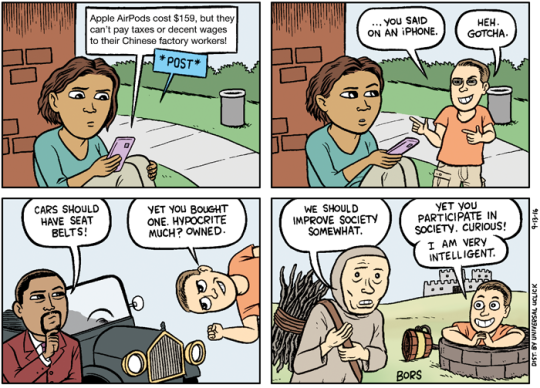
See also: how staying home from the polls and refusing to run for office doesn’t get rid of the system, it just gives assholes free rein to take away the resources we might otherwise use to dismantle it.
Wait, in this narrative, who’s making the profit??
It’s a tactic where you underprice competitors in order to drive them out of business. You lose money right up until you steal their whole client base and they’re forced to shut down. Once you’ve eliminated the competition, you’re free to hike up prices obscenely high. This is how Amazon destroyed traditional bookstores.
Pretty sure Standard Oil did the same thing too
Walmart does this in small towns
Yes this is a capitalist tactic used by many companies, including Amazon, Standard Oil, and Walmart.
THE SHARING ECONOMY IS BULLSHIT.
I mean so is capitalism but the sharing economy is a special kind of bullshit because it pretends it’s fighting the bad guys when in reality it’s just the grandkids of the bad guys in slightly cooler suits.
Plenty, but this made me think instantly of last summer when I met @vampireapologist for the first time in TN for the eclipse. We’d gone barefoot hiking within twenty minutes of her arrival, and a large, green beetle scuttled across our path. She bent to pick it up as I whipped out my phone to photograph it. It was beautifully iridescent and colorful, and neither of us had seen one like it in either Indiana or Ohio.
If we had, we wouldn’t have picked it up. The fiery searcher caterpillar, a native of Tennessee, releases a powerful stench when distressed. Smelly Anne had stinky fingers for hours despite washing her hands multiple times.
These also live in Texas, and they have beautifully rainbow-colored bellies, but they do Not like being handled.




 BettSplendens Tumblr Evac