ramihackme:

dellvanity:

madeinchernobyl:

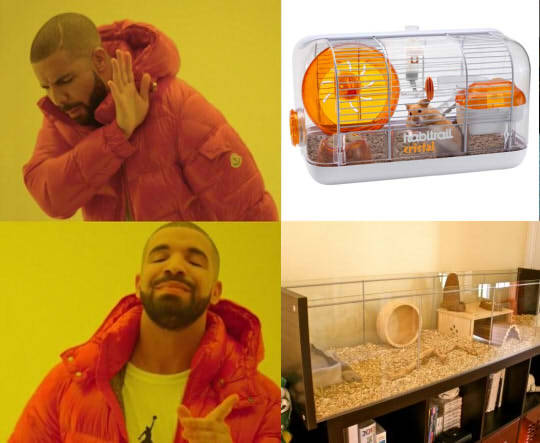
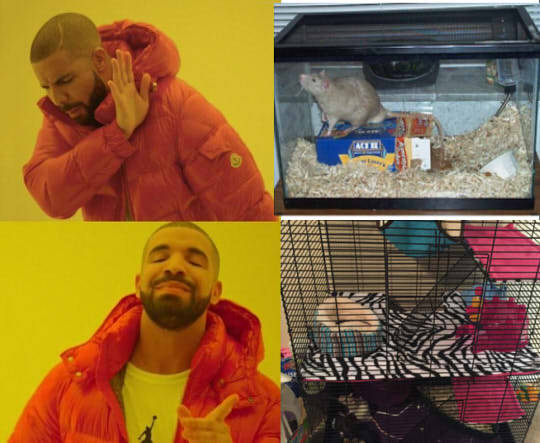
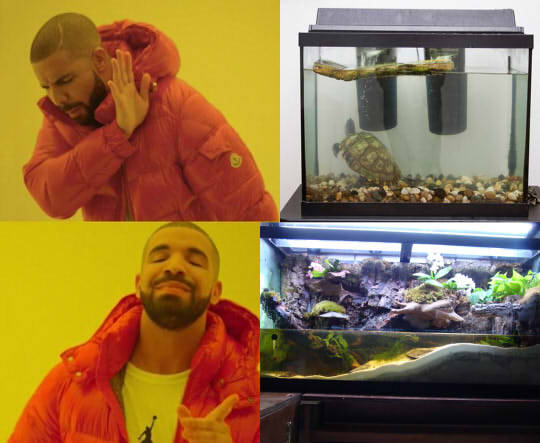
I’m adding to this because y’all gonna learn some shit about housing your pets.

Someone make more I love this new meme.

I know that huge homes are great for pets but also did it fucking occur to you that some people don’t have the room or money for those?

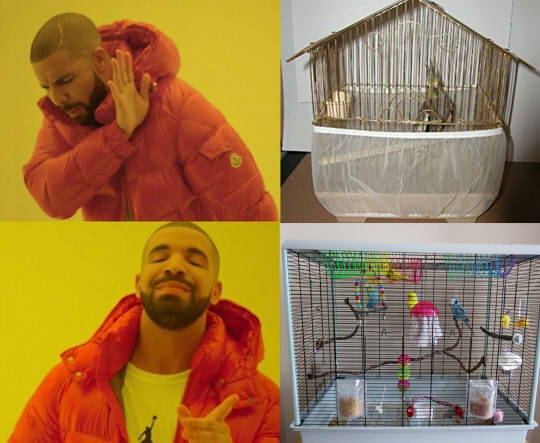
hey, guess what. those are all minimum requirements. actually, the person who added onto my post even made the bird cage still TOO small for those birds.

and if you dont have the money or the space for those pets, don’t fucking get the pet.

That turtle tank is too small for most freshwater turtles, too. The most commonly kept species, redear sliders, get dinner-plate-sized and need a small pond to live in. 

Pets are not a human right. However, enough space and enrichment to be healthy is a basic right of all living things. If you cannot properly house a living thing, do not get that living thing. If you already have the living thing and cannot properly house it, give it to someone who can. 

//www.instagram.com/embed.js

lillivati:

tinysaurus-rex:

tinysaurus-rex:

Yummy!

I’m gonna die. Y’all out there just like “that’s wrong!” “cannibalism!” “awful!”

Eggs are not chicken. They’re not children. They’re a nutritious container that has the ability to grow a baby, but not until it’s been incubated for several days. Until then it’s just food. Eggs are full of protein and a very rewarding snack, cooked or raw. Very healthy for these babes, especially during winter when there aren’t any bugs to feed them which is what Momma Pepsi would be giving them. As you can see in the video, she’s perfectly content with this substitute!

The hens outside get really excited when we collect eggs because if there happens to be a dirty one then we just crack and give it to them right there. I’ve never met a chicken that didn’t love eating eggs!

Some frogs ans fish literally produce extra eggs to feed their young. It is a part of their reproductive strategy.

It’s not always the best plan to give chickens an egg right out of the coop, some might start breaking all the eggs to eat them, but egg certainly isn’t going to hurt your chickens. Nor is it creepy to give them an egg. 

the-wolfbats:

dispatchrabbi:

copperbadge:

revyspite:

queendread:

Right now, I’m sifting through 50+ applications for a new entry-level position. Here’s some advice from the person who will actually be looking at your CV/resume and cover letter:

  • ‘You must include a cover letter’ does not mean ‘write a single line about why you want this position’. If you can’t be bothered to write at least one actual paragraphs about why you want this job, I can’t be bothered to read your CV.
  • Don’t bother including a list of your interests if all you can think of is ‘socialising with friends’ and ‘listening to music’. Everyone likes those things. Unless you can explain why the stuff you do enriches you as a person and a candidate (e.g. playing an instrument or a sport shows dedication and discipline) then I honestly don’t care how you spend your time. I won’t be looking at your CV thinking ‘huh, they haven’t included their interests, they must have none’, I’m just looking for what you have included.
  • Even if you apply online, I can see the filename you used for your CV. Filenames that don’t include YOUR name are annoying. Filenames like ‘CV – media’ tell me that you’ve got several CVs you send off depending on the kind of job advertised and that you probably didn’t tailor it for this position. ‘[Full name] CV’ is best.
  • USE. A. PDF. All the meta information, including how long you worked on it, when you created it, times, etc, is right there in a Word doc. PDFs are far more professional looking and clean and mean that I can’t make any (unconscious or not) decisions about you based on information about the file.
  • I don’t care what the duties in your previous unrelated jobs were unless you can tell me why they’re useful to this job. If you worked in a shop, and you’re applying for an office job which involves talking to lots of people, don’t give me a list of stuff you did, write a sentence about how much you enjoyed working in a team to help everyone you interacted with and did your best to make them leave the shop with a smile. I want to know what makes you happy in a job, because I want you to be happy within the job I’m advertising.
  • Does the application pack say who you’ll be reporting to? Can you find their name on the company website? Address your application to them. It’s super easy and shows that you give enough of a shit to google something. 95% of people don’t do this.
  • Tell me who you are. Tell me what makes you want to get up in the morning and go to work and feel fulfilled. Tell me what you’re looking for, not just what you think I’m looking for.
  • I will skim your CV. If you have a bunch of bullet points, make every one of them count. Make the first one the best one. If it’s not interesting to you, it’s probably not interesting to me. I’m overworked and tired. Make my job easy.
  • “I work well in a team or individually” okay cool, you and everyone else. If the job means you’ll be part of a big team, talk about how much you love teamwork and how collaborating with people is the best way to solve problems. If the job requires lots of independence, talk about how you are great at taking direction and running with it, and how you have the confidence to follow your own ideas and seek out the insight of others when necessary. I am profoundly uninterested in cookie-cutter statements. I want to know how you actually work, not how a teacher once told you you should work.
  • For an entry-level role, tell me how you’re looking forward to growing and developing and learning as much as you can. I will hire genuine enthusiasm and drive over cherry-picked skills any day. You can teach someone to use Excel, but you can’t teach someone to give a shit. It makes a real difference.

This is my advice for small, independent orgs like charities, etc. We usually don’t go through agencies, and the person reading through the applications is usually the person who will manage you, so it helps if you can give them a real sense of who you are and how you’ll grab hold of that entry level position and give it all you’ve got. This stuff might not apply to big companies with actual HR departments – it’s up to you to figure out the culture and what they’re looking for and mirror it. Do they use buzzwords? Use the same buzzwords! Do they write in a friendly, informal way? Do the same! And remember, 95% of job hunting (beyond who you know and flat-out nepotism, ugh) is luck. If you keep getting rejected, it’s not because you suck. You might just need a different approach, or it might just take the right pair of eyes landing on your CV.

And if you get rejected, it’s worthwhile asking why. You’ve already been rejected, the worst has already happened, there’s really nothing bad that can come out of you asking them for some constructive feedback (politely, informally, “if it isn’t too much trouble”). Pretty much all of us have been hopeless jobseekers at one point or another. We know it’s shitty and hard and soul-crushing. Friendliness goes a long way. Even if it’s just one line like “your cover letter wasn’t inspiring" at least you know where to start.

And seriously, if you have any friends that do any kind of hiring or have any involvement with that side of things, ask them to look at your CV with a big red pen and brutal honesty. I do this all the time, and the most important thing I do is making it so their CV doesn’t read exactly like that of every other person who took the same ‘how-to-get-a-job’ class in school. If your CV has a paragraph that starts with something like ‘I am a highly motivated and punctual individual who–’ then oh my god I AM ALREADY ASLEEP.

Very good post thanks for this.

Excellent advice for building and submitting job application documents.

This is the first good resume advice post I’ve seen on this site. Much better advice than the “lists of active verbs to use” and “here are resume templates”. Follow this advice.

Sound advice. the hoops americans have to jump through for less than a living wage. I love it.

A Smorgasbord of History Fun Facts

lookninjas:

seldnei:

sensiblydeluded:

Here’s another from the History Secret
Santa Archive! For today, rather than sort of getting into a longer,
more in depth description of some historical event or person, I
thought it would be fun to mix things up a bit, and just give you a
bunch of amusing little snippets. I hope you all like them!

The emperor Domitian, the last of the
Flavian dynasty in the Roman Empire, was a) not a very well-liked
ruler and b) very paranoid about assassination. After executing
random senators, sexual debauchery, and indulging in weird
psychological torture involving a meal of all black food in a totally
black room, a freedman named Stephenus finally got Domitian alone and
stabbed him to death with the ruse of saying, seriously, something
along the lines of, “Emperor, I need to speak with you in private!
I have just learned of a conspiracy to assassinate you!”

Mithridates VI of Pontus, also called
Mithridates the Great, is most notable for waging an almost
successful war against Rome (no mean feat), and also being terrified
of being poisoned. Like some sort of Dread Pirate Robert’s times
1,000, this king spent most of his young adulthood eating small doses
of various poisons and building up his immunity to almost every known
toxin. In addition, he invented a supposedly universal antidote that
is still called mithridae
(one recipe includes
frankincese, myrhh, and
cinnamon!) Unfortunately, after Pompey defeated Mithridates in
battle, the Pontian king tried to commit suicide by poison, but found
he couldn’t turn off his immunity. He ended up dying by sword,
instead.

The
month February takes
its name from the februa,
or a cord of goat hide that specially selected men would use in a
religious festival to essentially smack fertility into women (or at
least, that’s how the Romans saw it). In the Lupercalia, the young
men chosen dressed in the
skins of recently slaughtered goats, and most sort of arranged these
skins into loincloths as best they could, so they could run around
the city whipping various women without flashing the entire city.
Marc Antony, however, did not care about modesty, basically at all,
and he participated in this festival, and, to make a long story
short, we have historical verification that at least one member of
the Second Triumvirate was VERY well endowed.

Laksmibai,
Queen of Jhansi, and instrumental figure in the Indian Rebellion of
1857, was awesome in many ways, but she was a particularly skilled at
horsemanship. She could apparently ride a horse no-handed, clutching
the bridle in her teeth to steer, and would often go into battle as
described, but swinging a sword in each hand.

Romulus,
the mythical founder of Rome, was probably named after the city, and
not vice-versa as the legend suggests. Many possible meaning for the
name exist, including the idea that the name may originate from
rumina, a descriptor
for what the hill of the original city may have reminded people of.
Rumina means “breast”
in early Latin.

The
16th
President of the United States, Abraham Lincoln, apparently really
liked cats. At one point, after a big loss for the Union side in the
American Civil War, one of his generals kept trying to brief him on
how their troops could recover and what needed to be done, but
Lincoln kept getting distracted by some abandoned kittens he could
see in the background of the camp.  In the end, the general had to
promise that the kittens would be taken care of before the president
would focus on the aftermath of the battle.

Gaius
Octavian, later Augustus, was quite short, even
by Roman standards, and wore
platform shoes to make himself appear taller. And
speaking of Roman emperors, the process of deifying dead emperors had
become so common by the beginning of the Flavian dynasty that, on his
deathbed, the emperor Vespasian announced, “Oh dear. I think I’m
becoming a god.”

I’ve
seen varying historical opinions on this fact, but Romans may not
have generally learned to read silently. So, every time they, for
example, got a letter, they had to read it aloud. Julius Caesar
seemed to be one of very few people who could read silently, and this
ability apparently freaked people the hell out.

Suetonius,
an ancient Roman author who described the lives of the first twelve
emperors, as well as Julius Caesar, only had his works saved because
they’d all been thrown in to a well preserved garbage dump. The
complete works of Confucius were only preserved because someone hid
them in a wall. My personal favorite historical preservation story,
though, is that Christian monks apparently preserved the works of
Livy and Virgil
because they both wrote short poems about some awesome baby being
born soon that would end up saving the world. These passages were
later interpreted as being about Jesus, but, in reality, at the time
both Augustus’s and Marc Antony’s wives were pregnant, and both
writers were likely trying to butter up the two most powerful men in
Rome.

Marcus
Caelius, a prodigy of Cicero’s, was once working as basically a
prosecuting attorney in the case of a man believed to had poisoned
his wife. The defense argued
that the accused couldn’t have used the type of poison (aconite)
because it has distinct symptoms when consumed. Marcus Caelius argued
that aconite had fewer recognizable symptoms if absorbed via a, ahem,
different orifice. Such as the vagina. In the trial, Marcus Caelius
announced, presumably eyes blazing and pointing at the accused, “I
do not point the finger of guilt! I point at the guilty finger!”
essentially making a fingering joke in the middle of a SERIOUS MURDER
TRIAL.

I read most of this to Mr Seldnei this morning, and he quite enjoyed the Domitian story, replying with:  “I have uncovered a plot to kill you!  And it is me! Stabby stabby stabby.”
What I’ve taken from all this is that
Laksmibai,
Queen of Jhansi, is a lot like who I wish I was.  And Abraham Lincoln is a lot more like who I actually am.

Further evidence that humans have always been humans. 

rapid-oxi-dation:

Fullmetal Alchemist AU where everything’s the same except Ed makes up stupid stories as to why he lost his arm and leg and they’re different every time someone asks. 

ex: “I got attacked by a shark” 
“I stubbed my toe and decided I didn’t want it anymore”
“I went through a steampunk phase”
“Sheep are vicious when they’re hungry”
“Squirrels”

scienceisadesiretoknow:

I picked up this succulent because it looked so alien and unique. However aside from some watering and sunlight guidelines there is nothing about this little guy written anywhere, least of all its name.

Does anyone know what this type of succulent is called?

It’s a jade finger plant! They eventually grow into a weird alien tree-thing.

rowdyholtzy:

roscoerackham:

shinykari:

lady-feral:

hollowedskin:

cannon-fannon:

boneyardchamp:

Your professor will not be happy with you if he says the Stanford Prison Experiment shows human nature and you say it shows the nature of white middle class college-aged boys.

Like he will not be happy at all.

For real though. That experiment. Scary shit.

This reminds me of a discussion that I read once which said Lord of the Flies would have turned out a hell of a lot differently if it was a private school of young girls (who are expected to be responsible and selfless instead), or a public school where the children weren’t all from an inherently entitled, emotionally stunted social class (studies have shown that people in lower socioeconomic classes show more compassion for others).

Or that the same premise with children raised in a different culture than the toxic and opressive British Empire and it’s emphasis on social hierarchy and personal wealth and status.

And that what we perceive as the unchangable truth deep inside humanity because of things like Lord of the Flies and the Stanford Prison Experiment, is just the base truths about what happens when you remove any accountabilty controlling one social group with an overwhelming sense of entitlement and an inability to feel compassion.

I will always reblog this.

I just wanna say that the Lord of the Flies was explicitly written about high-class private school boys to make this exact point. Golding wrote Lord of the Flies partially to refute an earlier novel about this same subject: The Coral Island by

R.M. Ballantyne. Golding thought it was absolutely absurd that a bunch of privileged little shits would set up some sort of utopia, so his book shows them NOT doing that.

This is also generally true about most psychological experiments.

There’s an experiment called “The Ultimatum Game”. It goes something like this.

  1. Subject A is given an amount of money (Say, $100).
  2. Subject A must offer Subject B some percentage of that money.
  3. If Subject B accepts Subject A’s offer, both get the agreed upon amount of money. If Subject B refuses, no one gets any money.

The most common result was believed to be that people favored 50/50 splits. Anything too low was rejected; people wanted fairness. This was believed to be universal.

And then a researcher went to Peru to do the experiment with members of the indigenous Machiguenga population, and was baffled to find that the results were totally different.

Because, to the Machiguenga, refusing any amount of free money (even an unfair amount) was considered crazy.

So the researcher took his work on the road (to 14 other ‘small scale’ societies and tribes) , and to his shock found the results varied wildly depending on where the test was done. 

In fact, the “universal” result? Was an outlier. 

And that’s the problem. 96% percent of test subjects for psychological research come from 12% of the population. Stuff that we consider to be universal facts of human nature… even things like optical illusions, just… aren’t.

 You can read an article about it here.  But the crux of it is that psychology is plagued with confirmation bias, and people are shaped more by their environment than we realize. 

Like, I’d take $2 out of that? Gonna glare at the guy keeping 98%, but, hey, free money. Anything over $1 is /free money/, I’d rather have the money than some sort of righteous feeling over having made things “fair”.