I work in a public library and there are times a book comes through circulation that is so awesome I can’t believe I hadn’t seen it before.
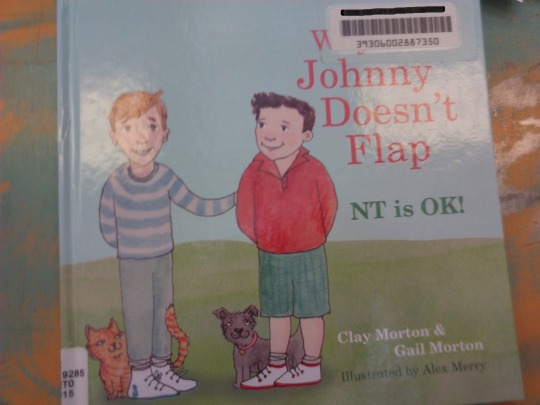
Last week I came across this lovely children’s picture book called Why Johnny Doesn’t Flap: NT is OK! by Clay Morton, Gail Morton, and illustrated by Alex Merry. (Pardon the library barcode covering part of the title here.)
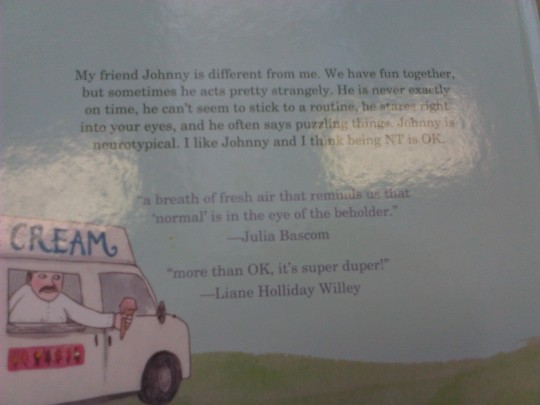
[Pictures of the front and back covers of the picture book. The back cover summary says: “My friend Johnny is different from me. We have fun together, but sometimes he acts pretty strangely. He is never exactly on time, he can;t seem to strict to a routine, he stares right into your eyes, and he often says puzzling things. Johnny is neurotypical. I like Johnny and I think being NT is OK.”]
The fact that I was seeing the term “NT” on the cover of a children’s book was enough to pique my interest. Upon further inspection, I discovered that the book is really quite lovely!
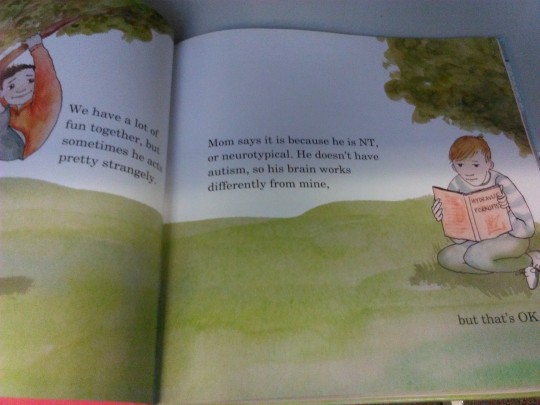
[Two page spread reads: “We have a lot of fun together, but sometimes he acts pretty strangely. Mom says it is because he is NT, or neurotypical. He doesn’t have autism, so his brain works differently from mine, but that’s OK.”]
It flips the typical “little Timmy has a special friend” narrative on its head. Instead, the narrator is an autistic boy who has an NT friend who he sometimes struggles to understand.
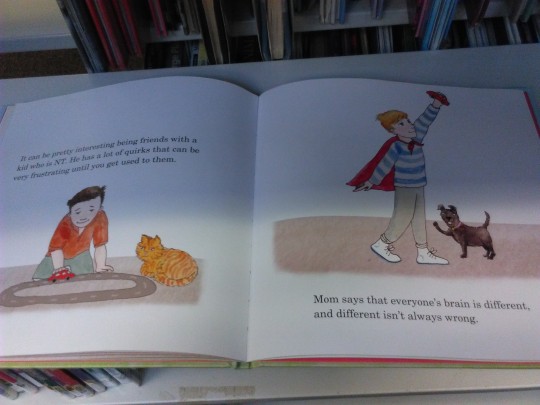
[Two page spread reads: It can be pretty interesting being friends with a kid who is NT. He has a lot of quirks that can be very frustrating until you get used to them. Mom says that everyone’s brain is different and different isn’t always wrong.”]
The book uses simple terms to describe a perspective not usually seen in any literature, let alone lit intended for children.
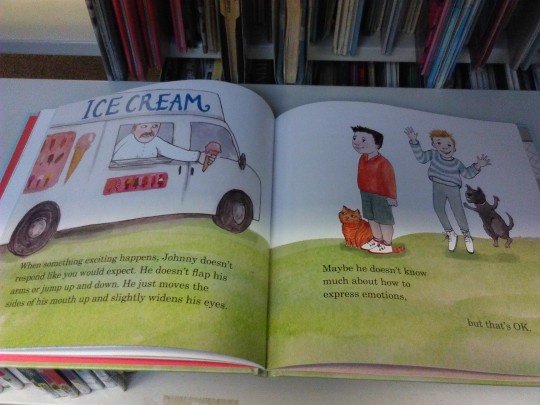
[Two page spread reads: “When something exciting happens, Johnny doesn’t respond like you would expect. He doesn’t flap his arms or jump up and down. He just moves the sides of his mouth up and slightly widens his eyes. Maybe he doesn’t know much about how to express emotions.”]
I think ultimately this flipping of the narrative is more effective in getting the message across that kids with autism are just like everyone else but with unique needs.
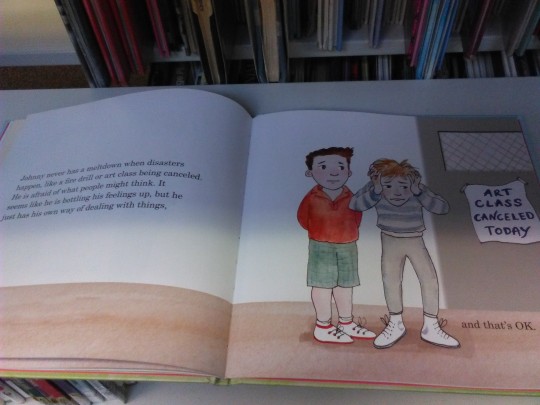
[Two page spread reads: “Johnny never has a meltdown when disasters happen, like a fire drill or art class being canceled. He is afraid of what people might think. It seems like he is bottling his feelings up, but he just has his own way of dealing with things, and that’s OK.”]
And this book is something autistic kids don’t usually have– it’s a book from their perspective! And it’s a non-offensive, matter-of-fact perspective, which is all the rarer.
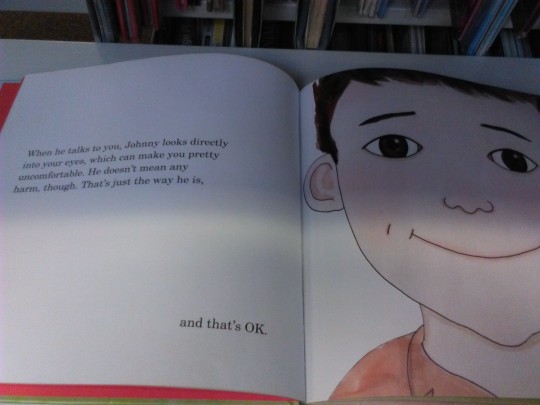
[Two pages spread reads: “When he talks to you, Johnny looks directly into your eyes, which can make you pretty uncomfortable. He doesn’t mean any harm, though. That’s just the way he is, and that’s OK.”]
It talks about things that autistic people experience and can relate to.
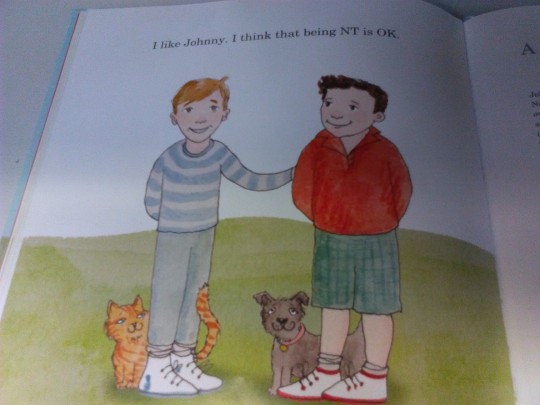
[Page reads: “I like Johnny. I think that being NT is OK.”]
How awesome is that?
A book like this would have been so beneficial to me as a kid to help me not feel alien. If you want autistic people to relate to others in fiction, we need stories from our point of view too.
I NEED THIS BOOK
I love that it flips the narrative, that’s so clever.
I’ve started the cats on a diet (gotta get rid of those small saggy bellies), & this has resulted in Pangur shadowing me for the last 2 hours, screaming & biting whatever body part I leave accessible
no more ankle-biting!
Pangur, why
y’all losing your minds in the comments/reblogs over Pangur’s diet are gonna have to find someone else following the medical advice of a professional to threaten via anon, because, like a butterfly emerging from the chrysalis that was her over-plump cat bod, she has transformed!
sorry folks, PETA didn’t come in time! my cat’s now a healthy weight for her breed! choke!
“Putting an animal on a diet is animal cruelty” I wonder if these people ever hear themselves sometimes
—mod Nick
She looks so pretty now! Skinny-bones kitties in particular don’t need extra weight on them, can’t be good for their joints.
One of our cats was given a particularly tasty wet food for a week or so because it was the only thing we could mix with a medication that she needed. She now Screams Demandingly if we look like we might have some some of that food. Doesn’t mean she’s starving, just means she wants More Food. Animals will happily eat themselves into obesity, they don’t know how much food is good for them.
Oh god is it my turn to be the killjoy? I don’t want to. But also I’ve seen this video get increasingly popular so I’m going to break it down and also send it to @why-animals-do-the-thing to spread the word:
Octopodes (or octopuses, or octopi, all good) aren’t social/physically cuddly animals. While they are very curious and very intelligent, this octopus isn’t showing signs of willingly engaging with this diver.
To start with, it’s probably not trying to swim towards the diver to begin with: octopodes (like all cephalopods) swim backwards, and its initial jet towards the diver is likely unintentional. After this, the octopus repeatedly tries to adjust course to get around this unexpected impediment, and the diver repeatedly puts their hand in its way and prevents its escape. When the octopus successfully manages to turn towards the camera to escape, the diver catches it by the arm to stop it, then grabs its entire body and pulls it back towards them. This is the point when the octopus settles on the diver’s other arm and wraps its arms around the diver’s hand, an action we have no reason to believe it would have done without the diver’s interference.
Then, the diver begins to… I’m assuming try to pet the octupus? But in practice what they’re doing is kind of squinching its mantle. I suspect it’s not hurting the octopus, both because the hand motions look reasonably gentle and the octupus doesn’t do anything drastic like ink. However, when the diver’s hand first moves towards the octopus to do this, the octopus tries to crawl away along the diver’s arm and then eventually just… flattens out, at which point the video ends.
Good points: the diver isn’t being overly rough with the octopus, so I doubt it was hurt by this interaction. Also, this octopus is small enough that the diver wouldn’t be hurt by the octopus (it’s not going to be pulling out air hoses or biting through the wetsuit).
Bad points: literally everything else. This diver is forcing this octopus into an interaction that isn’t natural for the octopus and which is likely causing some stress to the octopus by the end of the video. The octopus repeatedly tries to avoid or escape the diver, including trying to avoid being petted. If you ever go diving, please don’t do this.
@alternatez is totally right – I’m glad they tagged me in this. This is one of those pieces of internet media that we so desperately want to be an example of connection between totally different species (who doesn’t dream of an octopus taking interest in them?) that we end up projecting terrestrial behavior and mannerisms onto a cephalopod. As the last comment pointed out, the octopus is not “headbonking” the diver; it is trying to swim away. The octopus is not “relaxing” when being petted; it is hunkering down away from unwanted tactile stimuli.
The part of this video that really bothers me is the diver just reaching out and grabbing an animal that is trying to escape and physically restraining it. That octopus has no concept that the human is expressing affiliative behavior. When things in the wild grab an octopus, it is to eat them (or, if another octopus, get it on). That is incredibly stressful for the animal and a totally inappropriate way to interact with wildlife.
It’s likely that the reason the octopus settled on the diver’s arm is due to one or both of two things: escape wasn’t working, and 2/3 of an octopus’ neurons are actually in the tentacles. What the latter means is that it’s theorized that while an octopus’ brain gives high-level commands, much of processing / action / reaction sequences occurs independently in their arms. Octopus also have a reflex to suction onto things they come into contact with (they’ve literally got specialized chemical signalling in their skin so they don’t stick to themselves). What this likely means is that when the octopus stopped trying to escape – because if you can’t get away from a predator, staying still and hoping it forgets about you is a pretty decent next choice – it’s legs automatically gripped onto the diver’s arm. That doesn’t mean it wants to be there, or that it wants to hang out with the diver; it’s probably a combination of reflex and survival instincts, nothing more.
Here’s an example of how an octopus that is actually curious / looking to engage with a diver will approach: tentacles first, and with measured, almost languorous motions. Even though the two octopi in the videos are different species, you can see how the one that is trying to escape from the diver is moving in a much sharper, jerkier manner.
Here’s another example of an octopus choosing to interact with a diver. In this case, it approaches carefully but intentionally and then contact’s the diver’s hand in a much sharper motion. While I am not enough of an expert on octopus behavior to be sure of what is occurring in this second video, this looks less like curiosity and more potentially some type of antagonistic behavior, given how intense the octopus’ movements regarding the diver’s hand is and how it tries to leave with the hand rather than stay and investigate it.
As always with topics like this on the blog, I have to remind you of our old mantra: don’t fuck with wildlife. You don’t know if you’ll end up contributing to something that will hurt it in the long run, and it can also probably hurt you more than you think. But especially, if you’re going to interact with a wild animal at all, make sure it approaches you voluntarily and do not attempt to grab or restrain it in any way. Don’t be like the diver in the top video.




 BettSplendens Tumblr Evac