in high school I did summer programs at the art school near me: California College of the Arts, formerly California College of Arts and Crafts. A lot of students really opposed the name change, feeling that it marginalized crafts, and they were still pretty mad about it although it had happened several years before. A popular method of protest was to print “and Crafts” stickers and slap them onto the end of signs that had been redone with the new name.
BUT THEN someone had the incredible idea of just putting the stickers… on any signs with text… leading to such memorable mashups as “EXIT and Crafts” “MEN and Crafts” and probably like, “Please bus your own dishes and Crafts.”
I’m… really torn between buying a betta that looks healthy and beautiful (my favorites are halfmoon plakats) from a store I like, or trying to acquire an unloved, possibly ugly one for free and attempting to nurse it to health with medicine and good care, partly so I feel like I’m doing something objectively kind and partly so I can get some basic experience dealing with sick fish.
Why not both
Setting up one tank is expensive enough. I definitely don’t have the money for two.
Bettas really don’t need complicated setups. You can have a very happy betta with just
Tank (5gal or more)
Lid
The cheapest light you can find (for moss)
Heater
Any substrate
Java moss and/or Java fern
Depending on quantity of above, driftwood, rocks, and/or other suitable structures to add hiding places
Maybe some catappa or live oak leaves for tannins
and that’s it. The above plants are extremely easy to grow, especially Java moss. Just put it in a tank with the fish and keep the light on for a few hours a day. I know you’re going for an all-out fancy planted tank, but bettas don’t need all-out fancy to be happy, they just need clean, warm water and a few places to hide.
They especially like having something that’s just below the surface of the water that they can flop on. Take a plastic leaf from a fake plant, stick the base into a suction cup, and suction it half an inch below the surface of the water or less. Your betta will happily flump on it.
I love this video because it’s one of the few ones I’ve seen where an animal is being messed with using a holiday prop and is totally okay with it. This is a super happy, relaxed cat who really does enjoy the skriches and does not appear to be bothered at all by the fact they’re coming from spoopy decorations and not living human hands.
Bonus points because the person doing it is being really gentle and calm.
This month I’m in North Dakota banding Northern Saw-whet Owls.
1.
The owls make this face the entire time you’re handling them. Plus a bit of bill-snapping.
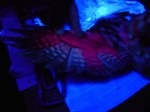
2. That pink pigment, porphyrin, fluoresces under a blacklight. We use it to determine the age of the bird. A bird born in 2018 (a hatch-year, or HY) will have uniformly colored feathers. A bird born in 2017 (a second-year, or SY) molts the inner primaries and secondaries (the large flight feathers in the middle) in one solid block. This bird has an interesting pattern. We aged her as an After Second-year (ASY) because she has a mix of feather age classes.
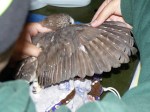
3. Here’s her wing viewed from above in normal light. I’m looking through the flight feathers to see the molt limit. If you look closely, you can see some feathers are light brown and others are darker.
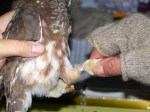
4. Here’s her band. Saw-whets have a lot of fluff all the way to the foot, so the band reveals the true size of her leg. Check out those talons!
We turn out the lights and let them readjust to darkness before release. Then it’s back to check the nets again.
Owl banding stations like this one, arranged in a network across the US and Canada, give us a sense of how the population is doing. NSWOs go through a boom-and-bust population cycle. So in some years, hundreds of birds are banded and most are HY, meaning the population structure is skewed towards juveniles. This year my station has only caught 10 birds, and only one of them has been a HY. Most are SY. What does that suggest about this population?