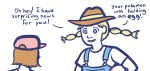
Pokemon nursery lady to trainer: Oh hey! I have surprising news for you! Your pokemon was holding an egg!
Nursery lady to self: WAIT. How old is this kid??? When do they teach sex-ed in school?? Have the parents explained the trumbeaks and the ribombees yet ??? Nursery lady to trainer: It’s a TOTAL MYSTERY where it came from. no idea. none. haha ha
—-
Maybe it’s not that the people at pokemon nurseries are oblivious, it’s that you’re like, ten.
@nerdpokemonheadcanons the adventure games are meant for kids, after all. Makes it seem much better than an oversight.
So I just read up more on what the actual fuck is going on and what this means for NSFW content creators and this twitter thread really explains everything and why no amount of petition signing is going to change the direction tumblr, and inevitably twitter, is going
While a lot of artists went the ways of newgrounds and HF and mastodon and whatever else, a lot artists (myself included) just moved to Twitter because we were all mostly there already. But I’m not just bringing this up because I care about twitter, twitter definitely sucks, but because NSFW creators are very quickly running out of options.
A vet is a high performance animal bred and trained to perform in a high stress environment. For peak performance a careful regime of training, rest and optimal nutrition is essential. Unfortunately, most veterinarians are equipped with all the innate survival instincts of a newborn merino lamb.
Acquiring nutrition is a basic component of survival, yet many domesticated veterinarians will fail abysmally at this task without strict supervision. We are looking at a species capable of simply forgetting to eat. Despite their training and reasonable experience, it is common for veterinarians to subsist the entire day on caffeine only, and then wonder with puzzlement why they’re so damn hungry after 7pm. This habit, coupled with mental exhaustion at the end of the day, will lead many veterinarians to consume a poor quality, impulse driven diet.
Even in those veterinarians with marginally more survival instincts, if presented with food in the middle of the day, it is common to see them eat rapidly, not stopping to savor the food or even rest. This may leave them prone to indigestion, and especially cranky after an 8, 10 or 12 hours day.
So ensure you provide good nutrition for your veterinarian which can be consumed in multiple small snack-sized portions between tasks, or in one go without reheating in the rare event of a true lunch break. (ha!)
As many veterinarians have been inherently selected to be in ‘work mode’ all the time, it is imperative that you teach them to calm down and unwind. Teaching calm exercises is extremely useful for their longevity but requires diligent adherence to the ‘no talking about work’ rule. Ensure guests and visitors are also aware of this rule for consistent enforcement. Your veterinarian may resist, as some are driven to work 24/7, but it’s in their best interest.
Many vets will have done a stint of ‘on call’ work after hours, through which they have been trained to rapidly answer the phone and leap into work mode at any time of the day or night. This conditioning will persist for many years after the event with the vet startling into work mode instantly upon hearing the dreaded after hours ring. To prevent this, ensure all ringtones for phones in the house are switched to something other than the default to ensure they are a distinctly different sound to the dreaded after hours phone.
A highly trained performance animal needs rest spells and opportunities to engage in natural behavior. Unfortunately these natural, human behaviors (socializing, going out, engaging in media) may atrophy without care as the vet spends a higher and higher percentage of their time engaged in vet activities.
A particularly fatigued vet may need significant hand-holding as you attempt to re-integrate them into normal social behavior. Short, controlled gatherings with small numbers of people are an ideal starting point, gradually scaling up to more normal behavior after more positive interactions.
Vets rarely show symptoms of something being wrong at work until it’s already catastrophic. Watching their behaviour outside of work is a more sensitive indicator for how they’re really going because like many performance animals, vets will frequently ‘buck up’ when there’s work to do and sacrifice their own well being to do so. They will spend so much time and energy advocating for their patients that they neglect to advocate for themselves, which is where you can most help your vets.
Remind them that 60 hour weeks is both madness and unacceptable. That they shouldn’t be risking their health. That they need to eat properly, rest well, and be a complete being not just a vet 24/7 and enforce those rules for their mental health on those that interact with them too.
Because such a caring profession really does have trouble when it comes to caring for itself.
don’t just pay it. do not automatically pay the hospital bill when you receive it. call your health insurance provider and POLITELY say, “excuse me, i just received a bill for $1200 for my hospital visit/ER visit/etc., is that the correct amount i’m supposed to pay?” because hospitals bill you before your health insurance and they will take your money no matter how the amount due may change based on your health insurance looking at it. 90% of the time, if your health insurance is in any way involved in the payment of that bill, you do not have to pay as much as the hospital is billing you for. call your health insurance provider first, and POLITELY request clarification, always remember that the person you are talking to is human and this is just their job, and then you will very likely find out you actually only owe $500.
don’t shout at anyone about it, don’t get mad, just understand that this is The Way Things Are right now and call your health insurance provider before paying the bill your hospital just sent you. there’s a chance the hospital bill might be correct, true, but call your health insurance provider.
THIS IS SUPER IMPORTANT. after my car accident last year the hospital billed me ~$8000. They sent me letters asking me to pay, and I called them back saying my insurance was processing the claim. This is also what I told the collection agency when they kept calling me about the $1000 emergency room fee (billed separately from the hospital fee, mind you). Once everything got straightened out, all I was actually liable for was my $200 emergency copay.
!!!!!!! things my ass didn’t know !!!!!!!!
Yes this is a life lesson my adulting ass didn’t know I needed and I’m out 80 bucks for an anti-nausea pill. 😒😒😒😒😒
Reblogging for American friends.
Also, it is important [for people receiving medical care in the USA] to carefully read all of the items on the medical bill and look for errors and overcharges. I know that the normal feelings of avoidance and dread can make it hard to look at scary hospital bills, and that’s okay! But as the OP mentions, private orgs like hospitals don’t monitor overpayment of bills – they are motivated to charge you extra – and it is basically impossible to get your money back. Read the bill carefully and make sure that the charges are correct, using the links below for help if you need. If they haven’t sent you an itemized list, you can ask for one. Sometimes you will be charged extra for items or treatment you didn’t receive. Most people don’t know that you can dispute medical bills! But in 2009, Consumer Reports stated that 8 out of 10 medical bills scrutinized by a watchdog had errors, and generally you are not obligated to pay for someone else’s error.
You may be charged for using medication that you actually brought into the hospital with you – that’s easy to dispute! You may be charged for the consumables used during your stay such as sheets, gloves, gowns, etc – the hospital should actually cover that under its running budget. You may be charged for a brand name drug if the generic was available for cheaper – the links below explain how and when you can dispute this. You may be charged a surprisingly expensive “oral administration fee” (where a nurse puts pills for you to take in a little clean paper cup and then hands it to you) but that’s worth disputing if you were actually able to take the pill out of a bottle and put it in your own mouth. And so on.
Ugh one thing I loved about Thailand was I had a hospital visit, filled out a (half) sheet of paper, saw the doctor, had tests run and got 5 medications under 45 minutes all for $60 flat no insurance needed.
Get it together America.
Another one for people in the US: I got an ER bill reduced from 1300.00 to 125.00 by writing a letter of hardship explaining I am unemployed, uninsured, and unwed, and also pointing out they’d billed me for one test twice by writing it in differently each time.
Not all autistics get meltdowns (or get them often), but many of us know the harsh reality of how bad they can be.
You scream; you cry; you get angry; you snap at every little thing. You feel like your skin is on fire; every sound is thunder in your ears; your head hurts; you’re going to explode. You rock, you pace, you bang your head, you throw things, you scratch at your body, you kick, you hit. Some or all of these things can happen during an autistic meltdown. When everything just becomes way too much for you to handle, when every emotion, sense, and thought is screaming “STOP! NO MORE!”, it literally becomes the definition of “sensory hell”.
It doesn’t get much better after the meltdown passes. You end up exhausted, sensitive, weepy, unable to talk. You need quiet and darkness and you feel disoriented and dizzy, even physically sick. The meltdown aftermath can last for hours or even days while you recharge.
We can’t stop our meltdowns from happening any more than we can stop physical pain when we get hurt. It is completely involuntary and none of us want to have them. So what can we do? Survive them.
Meltdown Survival Tips:
Before
If you know you are prone to frequent meltdowns, keep your nails short so there’s less chance of damaging your skin.
Always keep sound-cancelling products near you (ear defenders, ear plugs, headphones). If you are in a work environment and can’t get accommodations, ear plugs might be your best bet.
Keep stim tools nearby. Tangles, fidget cubes, fidget spinners, and chewelry are great for when you’re at home or in a casual environment. When you are at work, spinnable pendants, bead jewelry, spinner rings, diffuser necklaces, or something small and soft to touch can be helpful. If you have pockets, you can also quietly fidget with something inside them (For example: one time I was in meltdown mode all day at work and the only way I could cope was by smoothing my thumbs across these two slick tags I found on the ground).
If you can tell you’re approaching meltdown mode, try explaining to others that you need to go somewhere quiet and dark. If you can’t explain, make some logical excuse to take a short break and go somewhere else.
Have a comfort object or plushie available. Even bringing a small one like a Disney Tsum Tsum in your bag can be comforting.
Explain to people you trust what meltdowns can be like for you before you have one around them so they can try to help and keep you safe. Make sure you tell them what they should and shouldn’t do in the event of a meltdown so they don’t accidentally make it worse while trying to be helpful (i.e. touching you, asking too many questions, etc.).
If you bang your head during meltdowns, don’t put anything hard and pointy in your hair. There might not be time to take it out while in meltdown mode and it could cause serious damage to your head.
Have alternate communications available! Texting, a notepad app on your phone, pen and paper, or even basic sign language can all be good options.
During
Even if you don’t have stim tools, try to body stim (it really does help!).
Do your best to keep breathing. Resist the urge to hyperventilate.
Use grounding techniques, counting, or singing and humming little nonsense songs during the meltdown to help you focus on something to stay calm.
Sometimes weight and pressure can help you better ride out a meltdown.
Don’t be afraid to sit or lie on the ground. It would be a lot worse to fall down and hurt yourself during a meltdown than it would be to avoid the stares of people around you.
If a police officer tries to confront you, keep your body language as open as possible. Don’t act aggressive, call for help if you need to, and don’t try to run away. Don’t reach for anything in your pockets or bag and don’t try to protect your possessions from being taken. They most likely won’t understand your behavior even if you explain you’re autistic, so do your best to follow what they say, even if it’s hard while in meltdown mode. Your physical safety is of utmost important in that moment.
If a stranger confronts you to ask if you need help or accuse you of causing a disturbance, just say as simply and calmly as possible that you need to be left alone and that you’ll be okay soon.
If you can, try and remember that the meltdown will pass, no matter how awful it feels. It’s going to be okay.
After
If you accidentally do something harmful to someone during a meltdown, please be responsible for your actions. You can’t help that it happened, but it still happened. Apologize for what you did to those people and explain what was going on without using it as an excuse. If possible, ask if there’s anything you can do to make up for the “damage”.
Meltdowns take a lot of energy and might make you hot. Make sure to find ways to cool down if you need to (Sometimes you can feel very cold after too, like a fever, so change your needs accordingly).
Please be understanding of yourself once your meltdown is over. Try not to hate and blame yourself; it’s not your fault.
Reach out to one of your comfort people and tell them you don’t feel well (or if they know you’re autistic say you had a meltdown) if it will make you feel better to talk to them. Just don’t overwhelm yourself with conversation.
If you did end up harming yourself somehow, please try to take care of it as soon as possible after the meltdown. Clean any wounds, get ice packs, and take medicine.
Drink plenty of water and eat something if you need to.
After the meltdown, practice self-care. Watch a comfort movie, wrap up in a blanket, take a bath or shower, eat some sweets, pet your animals; do something that makes you feel a bit better and happier.
If you have a meltdown while you’re out, go home as soon as possible.
If you can, take time to rest and sleep.
It may take a couple of hours to days to fully recover so go easy on yourself during those times.
A meltdown can be one of the major symptoms we hate having as autistics, but there are ways to make it easier and help them to not interfere with our ability to enjoy loud, fun things we want to do, to work, interact with our friends, or anything else.
If you have any other suggestions for how to manage and survive meltdowns, please reblog and add them!
If you don’t think you’re around people who will understand that you need to go somewhere to avoid a meltdown, say it’s because you have a migraine coming on. People understand migraines, usually, and will be sympathetic.
Eggnog: milk and eggs heated until the eggs aren’t quite raw, then mixed with spices, more milk, and heavy cream. That… really doesn’t sound tasty.








 BettSplendens Tumblr Evac