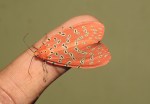
Mangina argus is a moth of the family Erebidae. It is found in south-east Asia, including Zhejiang, Fujian, Jiangxi, Guangxi, Guangdong, Yunnan, Taiwan, Hunan, from southern India to Kashmir, the Himalayas, Nepal, Bhutan and Sri Lanka.
concept: a death god that is actually surprisingly supportive and on the side of the good guys, supporting actions and promoting policies that will lead to the kingdom growing and thriving instead of being destroyed, because the more the kingdom grows, the more people there are, and the more people there are the more people will eventually die, and when you’re an immortal god of death, you know there’s no need to rush. you’ll get them all in the end
said Nice Guy Death God has a particular dislike of children being killed, because if they’re killed that early then they can’t grow up and have children of their own who will someday also die, so it’s a net minus for their kingdom
I love this and wish I had this to fall back on with my Necromancer Halfling, Grace.. the most Cheerful of Necromancers…=D
She even quoted Robin Williams “Death is just lifes little way of saying Slow down.”
Two federal immigration agencies worked together in a coordinated effort to set deportation traps for unsuspecting immigrants seeking legal status, the American Civil Liberties Union (ACLU) alleged in a lawsuit against the Department of Homeland Security (DHS) Secretary Kirstjen Nielsen this week.
According to the Boston Globe, the two agencies arranged meetings for the undocumented immigrants at government offices, where they were subsequently arrested, and in some cases deported.
Recommended article, because they don’t want the public to “catch on” to what they are doing.
“According to e-mails obtained by the Globe between Immigration and Customs Enforcement (ICE) agents and employees of U.S. Citizenship and Immigration Services (USCIS), ICE asked government officials to space out the meetings so that the public wouldn’t catch on and draw ‘negative media interests.‘”
So many people are suffering under this Republicon-controlled government, while so few–specifically, only the 1%–are doing well.
As some people may know I’m a huge advocate of the use of IAL in the aquarium when appropriate. It has so many benefits that easily outweigh the cons in my eyes.
Pros:
Poor Man’s conditioner: The leaves naturally change the water chemistry and can be of great benefit to those who have severely alkaline water. It lowers the ph (how much depends on your city water), it acts as a natural stress coat (more on that later), creates a black-water environment for your fish, medicinal effects, removal of some heavy metals, adds mircro nutrition to the water …
Security for the fish and the feeling of a natural environment: A lot of fish hail from waters that contain tannins and natural leaf litter. The addition of the leaves can help make those fish feel more protected and secure. This could be a con though as many hobbyists dislike the look of black water or leaves on the ground. Needless to say if you’re going for your neon plastic or super pristine look this may not work for you.
Benefits to fry: They feed off the micro organisms that are on the leaves, it also provides them cover. These leaves are wonderful at increasing the survival rate of fry tanks. Their medicinal properties also will help make said fry stronger and more resilient.
Medicinal properties: Like how a cup of tea relaxes us it does the same for your fish, It lowers stress and raises the immune system. It tightens the scales or in scaleless fish the skin and helps prevent injury, infection, bacteria and fungus. It has its own anti fungal properties as well and is a good first treatment for finrot or fungus. You may not be able to use salt with the treatment on some fish though so wean them off before you attempt salt baths. It also acts as an anti inflammatory and contains antioxidants.
Cons:
Can be expensive $1-$3 per leaf
Hard to find the actual leaves in stores. Only a few LFS I’ve found carry them let alone have heard of them.
They can be unsightly to some people
Having to remove them when they become too decayed. (Every 2 months)
Alternatives to the leaves:
Though use of the leaves is the most natural for those that cannot get leaves or just don’t want to see them in the water there are a few alternatives to get some of the properties still.
Extracts:
These can be purchased more easily and are tannins filled. They do not offer the cover or natural food source but contain most other properties. It must be added with water changes.
Tea:
Harder to find. The shift in ph is slower though and doesn’t need to be replenished as often. Straight black tea is an alternative as well.
Dosage:
This depends on the size of the leaf, water prior and a few other factors. 1 leaf per 10 gallons is a common rule of thumb though. 1 per 5 is also common but will create a darker water. You cannot overdose with them. You will need to wean your fish off them when you run out if you do not plan to continue using them. This also applies if you plan on selling the fish.
When to use:
When setting up a new aquarium
When a new fish is introduced to an aquarium
To induce breeding, especially in Bettas
When setting up and maintaining a fry aquarium
When a fish is sick, especially if the sickness affects the skin
In the plastic transport bag when a fish is moved to a new home
When keeping delicate fish species that are considered difficult to keep and breed in captivity
Notes:
Not to be used with high PH fish such as Cichlids, mollies, guppies, platties or others of the such. Look up which fish you plan on using it with first.
Do not use if you have acidic water already and aren’t using it in conjunction with crushed coral and mineril stones/powder.
Do not use If you are using them with a chemical treatment such as ph up or down, any medications.
If your filter contains carbon remove it before use.
It does not harm you plants unless they like hard water.
They may float for the first 3 days, this is okay, you may want to wedge them below something.
Fish/inverts/amphibians that benefit most:
Fish:
Neon and Cardinal Tetras; Chili, Phoenix, Dwarf and Galaxy Rasboras, Licorice and Chocolate Gouramies, Bettas, angelfish, dwarf cichlids, discus,
Hatchetfish, Corydoras, Farlowella, Loricarids…
Inverts: Almost any shrimp (Unless your ph is super low already, don’t let it go below 6.5), Crabs (Vampire), Snails so long as your ph doesn’t drop too much (you may have to provide them with a calcium supplement),Crayfish…
Amphibians: Pretty much any aquatic amphibian will benefit from the use of almond leaves in the water. Is the safest thing for any skin problems.
Additional substitute: Oak leaves! They release a lot of tannins. Just leave the decomposing leaves in, they don’t hurt anything.