
This month I’m in North Dakota banding Northern Saw-whet Owls.
1.
The owls make this face the entire time you’re handling them. Plus a bit of bill-snapping.
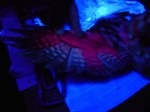
2. That pink pigment, porphyrin, fluoresces under a blacklight. We use it to determine the age of the bird. A bird born in 2018 (a hatch-year, or HY) will have uniformly colored feathers. A bird born in 2017 (a second-year, or SY) molts the inner primaries and secondaries (the large flight feathers in the middle) in one solid block. This bird has an interesting pattern. We aged her as an After Second-year (ASY) because she has a mix of feather age classes.
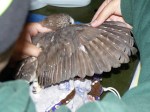
3. Here’s her wing viewed from above in normal light. I’m looking through the flight feathers to see the molt limit. If you look closely, you can see some feathers are light brown and others are darker.
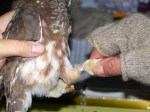
4. Here’s her band. Saw-whets have a lot of fluff all the way to the foot, so the band reveals the true size of her leg. Check out those talons!
We turn out the lights and let them readjust to darkness before release. Then it’s back to check the nets again.
Owl banding stations like this one, arranged in a network across the US and Canada, give us a sense of how the population is doing. NSWOs go through a boom-and-bust population cycle. So in some years, hundreds of birds are banded and most are HY, meaning the population structure is skewed towards juveniles. This year my station has only caught 10 birds, and only one of them has been a HY. Most are SY. What does that suggest about this population?
(OvO)

 BettSplendens Tumblr Evac