So when I was five, my Aunt Helen called me to inform me that since I was the next-oldest of the cousins, I got to name her new puppy. Unfortunately, she called me at like 9 in the morning and my ADHD ass was really focused on the concept of breakfast so I said “Pancake”. And Helen, bless her, named her little German Shepherd Puppy “Pancake”.
For the first few weeks, Pancake was a regular dumb, clumsy and awkward puppy. Then he… kept doing that. And getting weirder. Pancake could run up the stairs just fine, but refused to go down them. He’d trot right up to people… diagonally. he’d travel most smoothly at a 45-degree angle, feet crossing like a fancy line-dance.
He was also… not bright. If his dishes were moved, he wouldn’t be able to find them until walked to the new location several times. He also had a long-standing feud with the stop sign at the end of the drive, lunging and snapping at it every time they passed.
He did mange to enjoy life. Helen’s husband, my Uncle Nicolas likes to play the accordion after his third glass of wine at family functions. Every previous dog has either hid under the couch, or in Mazel’s case, growl menacingly until he stopped. Pancake LOVED the accordion, and would howl along with it, tail wagging happily. Helen breeds Morgan horses, and while they mostly hated the dogs and tried to murder any of the other dogs that came near, Pancake could walk right up to them, licking noses, and even allowed to approach foals.
“I swear, that dog only has half a brain.” Nicolas joked.
Eventually, Helen noticed that Pancake was walking into corners and furniture, mostly on his right side. She took him into the vet, and they realized he was blind in his right eye, despite there being no apparent damage. They took a scan of his brain, wondering if he’d been hurt at some point.
Turns out Uncle Nick was right.
Pancake’s right hemisphere was perfectly normally developed, but his left was literally about the size of a walnut. The vet said it was an absolute miracle that he was alive at all, but he didn’t seem to be in any pain. Helen commissioned my Mom, and she made him a padded right-side face mask becuase if he couldn’t see out of that side anyway, they ought to protect his eye.
Pancake lived to be an astonishing 12 and a half, half blind and friend of the horses.
My face is having uncontrollable spasms. Great. It hurts really, really, really bad.
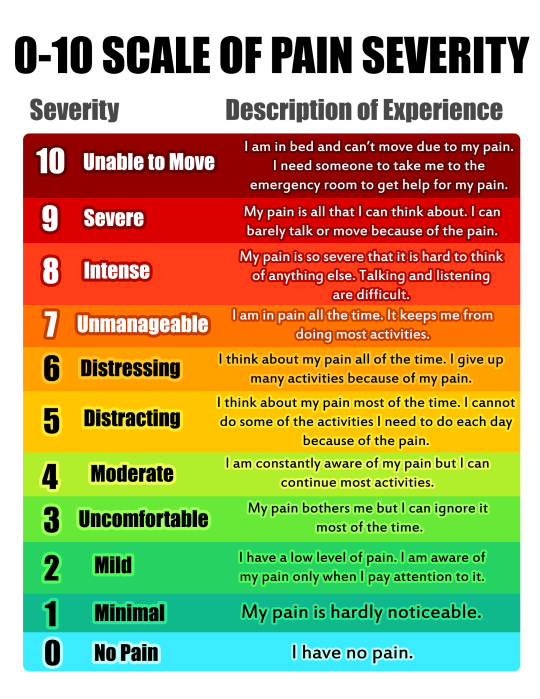
I think part of why I have trouble explaining pain to the doctor is when they ask about the pain scale I always think “Well, if someone threw me down a flight of stairs right now or punched me a few times, it would definitely hurt a lot more” so I end up saying a low number. I was reading an article that said that “10” is the most commonly reported number and that is baffling to me. When I woke up from surgery with an 8" incision in my body and I could hardly even speak, I was in the most horrific pain of my life but I said “6” because I thought “Well, if you hit me in the stomach, it would be worse.”
I searched and searched for the post this graphic was from, and the OP deactivated, but I kept the graphic, because my BFF does the same thing, uses her imagination to come up with the worst pain she can imagine and pegs her “10″ there, and so is like, well, I’m conscious, so this must be a 5, and then the doctors don’t take her seriously. (And she then does things like driving herself to the hospital while in the process of giving birth. Probably should have called an ambulance for that one!)
So I found this and sent it to her. Because this is what they want to know: how badly is this pain affecting you? Not on a scale of “nothing” to “how I’d imagine it’d feel if bears were eating my still-living guts while I was on fire”.
I hate reposting stuff, but I’ll never find that post again and OP is deactivated, so, here’s a repost. I can delete this later, i just wanted to get it to you and I can’t embed images in a chat or an ask.
This is possibly why it took several weeks to diagnose my fractured spine.
Pain Scale transcription:
10 – I am in bed and I can’t move due to my pain. I need someone to take me to the emergency room because of my pain.
9 – My pain is all that I can think about. I can barely move or talk because of my pain.
8 – My pain is so severe that it is difficult to think of anything else. Talking and listening are difficult.
7 – I am in pain all the time. It keeps me from doing most activities.
6 – I think about my pain all of the time. I give up many activities because of my pain.
5 – I think about my pain most of the time. I cannot do some of the activities I need to do each day because of the pain.
4 – I am constantly aware of my pain but can continue most activities.
3 – My pain bothers me but I can ignore it most of the time.
2 – I have a low level of pain. I am aware of my pain only when I pay attention to it.
1 – My pain is hardly noticeable.
0 – I have no pain.
This scale was SUPER helpful in getting my diagnosis/proper attention from the ER doctors this week. Even if you can’t remember the numbers, it’s helpful for doctors if you tell them “My pain is/isn’t impairing my ability to move or think”
I have alluded to sheep being a rather unfortunate species in terms of survival, and many of you have been patiently waiting for me to elaborate. I intend to start now. So let me try to explain just a fragment of why we veterinarians say “the goal in life of a merino ewe is to die, and take 50 of her closest friends with her).
Sheep (specifically in Australia where we probably have more than 70 million of them) can and do die in any of these ways:
If it rains too much while a sheep has a full fleece. They get soaked, weighed down, can’t move and die.
If it rains too much when a sheep has too little fleece, they get hypothermia and die
If it rains too little, there’s no water to drink and they die.
If there’s not enough grass or food available, they die.
If they eat too much perennial ryegrass, the most common pasture species in Australia, they can develop tremors from the neurogenic toxins it contains, and die.
Annual rye grass, which is the second most common pasture species, also causes staggers if the grass carries a particular bacteria, and if sheep eat too much or it then they die.
Merino sheep in particular are often bad mothers. They commonly (20-30%) will give birth and just wander away without a second thought, leaving the lamb to die.
We also have foxes that like to eat lambs (or at least their tongues), sometimes while they are being born, and they die.
Eagles will also take lambs or young sheep, and then they obviously die.
Sheep pregnant with twins are susceptible to Twin Lamb Disease where the mother physically cannot consume enough energy for herself and the growing fetuses. Without great care they will all die.
Sheep producing milk commonly develop hypocalcaemia and can die
Sheep given intravenous calcium to treat the hypocalcaemia, if it is given too fast, will die.
Sheep producing milk on lush pasture are at risk of hypomagnesaemia (grass staggers) and can, you guessed it, die.
Grazing pasture that is too lush or too high in protein can cause bloat, which can take out an entire flock of sheep and cause them to die.
Grazing too much red clover, a very popular pasture species in Australia, can cause both infertility and bloat. Then they die.
Sheep in Australia are very prone to flystrike, where blowflies lay eggs i the wool or flesh of the sheep so maggots can eat them. This starts while they’re alive, but it will cause them to die.
They also carry huge numbers of worms which compete for nutrients from their food, cause diarrhea and can cause sheep to die.
That diarrhea in their wool makes them extra attractive to files and, again, death.
Johne’s Disease is a chronic wasting disease similar to Crohn’s, which will result in a slow wasting away as individuals are often infected for most of their life, and then they die.
And this list is by no means complete.
Reblogging because it’s relevant to the post earlier today, and to clarify for those people wondering how sheep still exist: Because there’s so very many of them and we spend a lot of energy maintaining their existence.
They are also prone to predation by feral dogs, all sorts of nutrient deficiencies and walking away from shelter in a storm because the wind was blowing in the wrong direction
Those guides to cat tail behavior are really more of guidelines than rules. My mother has a cat for whom ‘happy’ tail is thrashing all over the place, constantly (until I learned to read her specific body language I thought the cat was always half a minute away from mauling me). Does your cat display normal behaviors of a happy cat when his tail is in that weird position? If, it’s probably just a quirk unique to him.
Is there any way his tail was broken in the past? It may be that the tail just doesn’t go straight. We had a cat like that, who we adopted off the street, and the last few inches of his tail couldn’t straighten up. It didn’t seem to hurt him, and the vet said it had healed years ago.

 BettSplendens Tumblr Evac